Copy
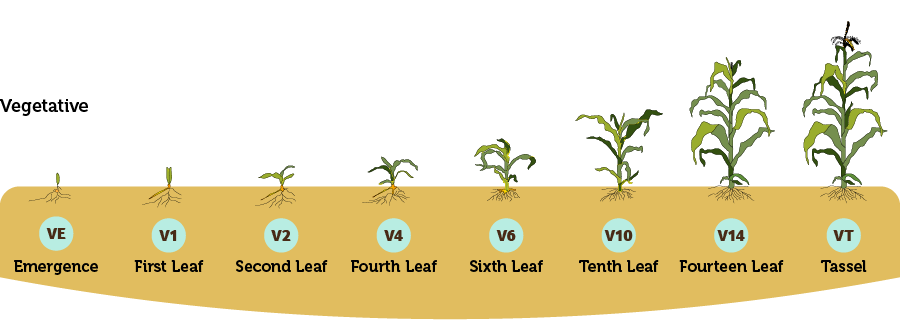
Emergence happens when the first leaf or the spike leaf appears above the ground. The seed absorbs water and oxygen for fermentation. The radicle root emerges from the tip of the kernel. Soil temperature should be 50-55 degrees Fahrenheit with moisture present for optimal emergence. Planting depth is critical for this stage—too deep can delay emergence and too shallow can create a weak plant.
During the first leaf stage there is one lead collar visible. The leaf collar is found at the base of the leaf. The stages are defined by the uppermost leaf with visible collars. Scouting is suggested at this stage for early weeds and pests.
Nodal roots are emerging farther into the ground at this stage and seminal roots begin to grow.
Nodal roots are farther in the ground and taking up more volume. Leaves are developing off the stem of the plant. At this point of growth, the leaves are primarily growing more than the root system.
Six leaves with collars have formed. The growing point emerges above the soil surface, the plant continues to grow, height increases, and nodal roots are established in the lowest, below-ground nodes of the plant. Scouting is suggested again at this stage for weeds and pests. Nutrient uptake begins to increase rapidly at this stage, and nutrient application should be timed properly. Ear and tassel shoots begin forming, so nutrient deficiencies at this stage can impact later yields.
During this stage, brace roots have developed in the lower-above ground nodes. Nitrogen and water demands are at their highest, and plants are easily susceptible to drought, heat, and nutrient deficiencies. Weed control is critical during this stage of growth because of early competition. Maximum number of rows per ear is being determined at this time. The number of potential maximum kernels per row is determined from about this stage to tasseling (VT).
Rapid growth happens during this stage. Flowering will begin in approximately two weeks. Plants are sensitive to heat and drought stress. Growers should scout during this stage for root lodging issues and diseases.
During tasseling, kernels start developing in rows and the final potential ear size is determined. The last branch of the tassel is visible. Silks may or may not have emerged. Nitrogen and water demands are high for the crops. Heat and drought will affect the number of kernels. During this stage, growers should scout for insects and diseases.
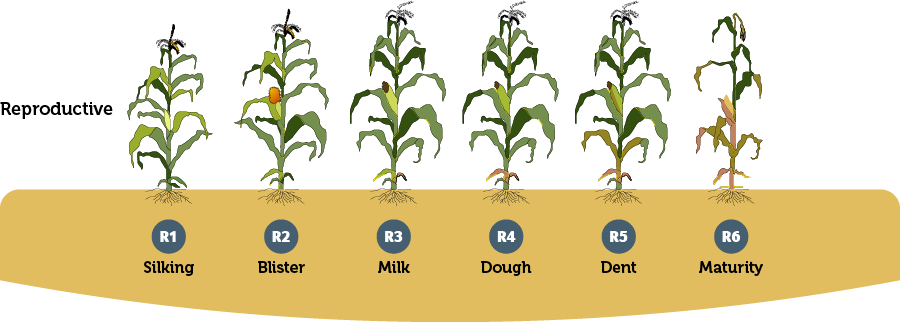
During this stage, flowering begins and silk is visible on the outside of the husks. The first silks are attached to potential kernels near the base of the ear. Maximum plant height is achieved, pollination is occurring and the potential number of kernels is being determined. Nutrient needs are high for fertilization.
At this stage, silks darken and are drying out. Kernels are about 85% moisture and will soon fill with starch. Environmental stress can reduce yield potential and final grain count.
Silks are dried out. The kernels are turning yellow and a milk-like fluid can be squeezed out of the kernels. Any stress at this point will cause kernel abortion at the tip of the ear.
Starch materials inside the kernels have a dough-like consistency. Nutrients and starch are accumulating with kernels being at 70% moisture. Environmental stress at this point can cause reduced yield by reducing kernel size and cause kernels to be shallow or chaffy. Impact of frost on grain quality can be severe with 25-40% yield.
At this stage, most of the kernels are dented. Moisture is declining to about 55%. Stress will reduce kernel weight. Many growers will harvest for silage soon.
At maturity, a black layer forms at the bottom of the kernel, blocking any movement of dry matter and nutrients from the plant to the kernel. Kernels will be around 30-35% moisture and are physiologically mature. At this stage, grain is not ready for storage, but maximum dry weight bas been attained. Disease and pests can result in physical damage and grain loss. Scouting is suggested for ear drop from pest damage.