
Copy
The seeds will begin to absorb water about 24-48 hours after planting if enough moisture is available. As water uptake begins, a radical root emerges forming a taproot, anchoring the seed to the ground. The hypocotyl (the initial seedling stem) forms and straightens, pulling the seed coat up through the soil. During this stage, the cotyledonary node is visible.
Cotyledons are the first visible structures above the ground. A unifoliate is the first true leaf produced. During this stage, the cotyledon and unifoliate are visible above the soil.
During this stage, the first trifoliate is formed. This is the second true leaf and has three leaflets. As the plant is grows it produces alternately arranged trifoliate leaves from the main stem and branches. Within this stage, photosynthesis is enough to meet all energy requirements by the seedling.
At this stage, the third true leaf is unfolded at the third node and the tendril is present. Root nodulation by nitrogen-fixing bacteria should be initiated by this stage and will begin supplying nitrogen to the plant. Rapid development of initial leaves can provide greater energy to developing nodules and improve nitrogen fixation.
During this stage, the pulses have more leaves developing and unfolding from the stem. Cells that will become flowers and eventually seeds are being initiated at V3 and beyond, and yield potential is being determined. Stress at this stage can reduce the total yield potential.
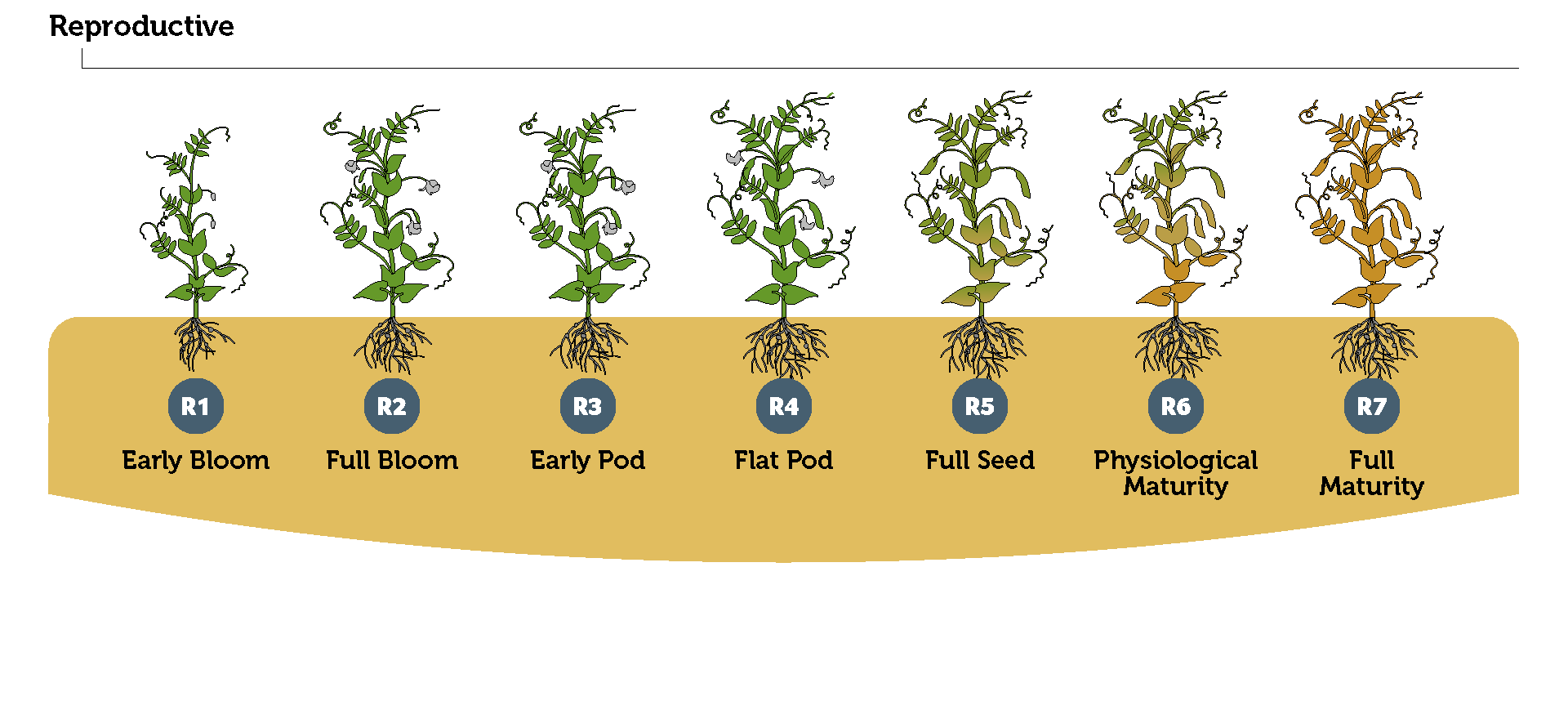
Flowering occurs from axillary buds on the main stem and branches. It proceeds acropetally from lower to higher nodes. At this stage, flowers begin to open at one or more nodes. Stress at this stage and beyond can cause flowers to abort and reduce yields.
Most of the flowers are open on nodes 10-13 of the basal primary branch. Approximately 50 percent of the plants in the field will be in bloom.
The developing pods are visible on the plants during the early pods stage. The pods are at nodes 10-13 of the main branch on about 50 percent of the plants in the fields.
The pods during this stage are on nodes 10-13. They have reached their full length but are mainly flat. The seeds inside these pods are less than half of the pod area but can be felt as a bump between the fingers. Stress during seed fill will reduce seed size and final yield.
During this stage, seeds inside the pods begin to swell and completely fill the pod cavity. The leaves will start yellowing and the lower pods have turned yellow to golden brown.
During this stage, the moisture content is 30 percent or below. Nearly 80 percent of the plant has changed from yellow to brown in color, but the top of the plant may still be green with seeds fully formed and not juicy. Seed pods on the bottom-third of the plant are tan to brown in color and are hard to the touch. Seeds in the middle third of the plant are full-sized, are light green to tan in color and are firm. The top third of the plant has only 50-57 percent color change with no immature seeds.
Nearly 90 percent of the pods on the plant have turned tan to brown in color. The seed moisture ranges from 20-30 percent. The crop is ready to harvest when seed moisture is below 20 percent and 90 percent of the pods on the plant are golden-brown in color.