





Read Full Transcript
Mike Howell (00:08):
The Dirt with me, Mike Howell, an eKonomics podcast where I present the down and dirty agronomic science to help grow crops and bottom lines. Inspired by eKonomics.com, farming’s go-to informational resource, I’m here to break down the latest crop nutrition research, news, and issues helping farmers make better business decisions through actionable insights. Let’s dig in.
(00:38):
Well, hello again everyone. Welcome back to the Dirt. I’m glad you joined us. Today we’re doing things a little different. We’re not going to be talking about soil fertility or agronomy. We’re going to focus on farm safety. We’ve got a lot of people that are just getting back in the field. We’ve got a lot of implements running around out there, a lot of dangerous things going on, and I thought it would be great if we just took a few minutes today to focus on farm safety and hope we can do something to prevent a few accidents this year. To help me do that, we’ve got Brian Kuhl with us today. Brian, thanks for joining us.
Brian Kuhl (01:08):
Yeah, thanks for the opportunity, Mike.
Mike Howell (01:09):
Brian, if you would start us off and tell us a little bit about who you are, where you work, and what you do.
Brian Kuhl (01:14):
Sure. So as you mentioned, I’m Brian Kuhl. I’m the President and Chief executive Officer with the Progressive Agriculture Foundation. We are an organisation that provides resources to communities to provide Progressive Agriculture Safety Days, which is recognised as North America’s largest farm safety education programme for children. It’s great to be on a programme like this because as you mentioned, a lot of folks are starting to get into the field. I actually am up in northwest Wisconsin where we still have a foot of snow on the ground, but I also farm, so I’m patiently waiting for that snow to melt so that we can also get in the field up here and get our corn and soybeans planted.
Mike Howell (01:51):
It’s amazing how the weather is so vastly different from where you are to where I am. Well, we’ve got corn in the ground. We’ve actually got some seedlings coming up. Got a couple of leaves on some corn. And had a frost this morning, hope it doesn’t deter it too bad, but Brian, why are we talking about farm safety? I grew up on a farm. I’ve seen all kind of safety videos and been to safety classes, but you work in farm safety every day, tell us why farm safety is so important.
Brian Kuhl (02:16):
All of us that are in agriculture and in farming know that farming as an industry is one of the most dangerous industries on the planet. We put ourselves in harm’s way almost every day. And there’s some of those risks we can control and some of those hazards and risks that just simply are a bit out of our control, we have to be aware of them, but we just need to be able to recognise that in some of those cases we just truly cannot control all the hazards that are involved in the industry. What makes agriculture and farming so unique is that it’s one of the few if only industries where we have children, in some cases very young children, engaged in the actual working operation of the farm. And that adds a whole new level of risk to the industry and to the work that we all do, and it just raises that need for us to be almost hyper aware of safety when we get back into the field while we’re planting throughout the summer months as then when we get to harvest towards the end of fall.
Mike Howell (03:12):
Brian, I grew up on a farm and one of my earliest memories is watching my dad plough the garden and get the garden ready to go every spring, and I always had to sit under the shade tree there and watch, but I was waiting on that last round because I knew every time he’d make that last round it was my turn to get to sit on the tractor and ride in his lap, making that last round. Looking back, that may not have been the best thing to do. Is it okay for kids to ride tractors with their parents?
Brian Kuhl (03:37):
Mike, it’s great that you asked that question because it’s a question that we get asked throughout the year as we’re out at both Progressive Agriculture Safety Days and visiting farm shows and exhibiting and trying to just raise the awareness of what some of those risks are and what are good behaviours, good role modelling behaviours that adults can have to keep their kids safe. When I was raised, I have some of those same memories too, and I think the first thing as adults is we have to identify that how we were raised and things that we did as children are not the same as kind of the environment that we’re raising our children in. I mean, farming has changed, the equipment has changed, it’s gotten bigger, it’s gotten more sophisticated, and in some cases it has gotten a little bit more dangerous. We have to just be aware of that.
(04:17):
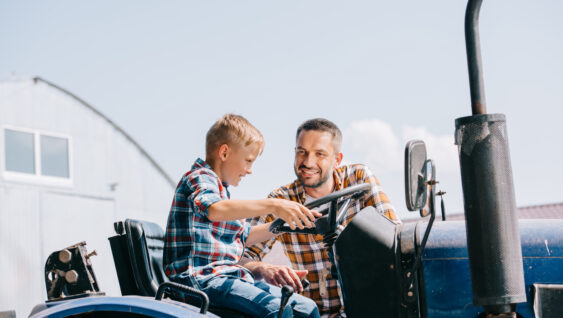
Should kids be riding in tractors? Now, when we think about the tractors of today’s age, everybody thinks they’re overly safe because we have cabs and we have extra seats in tractors. That’s the common question we hear is, “Well, I’ve got this extra seat in the cab of my tractor, in the cab of my combine, in my forage harvester. My child can ride there safely, right?” And the answer is, well, it depends. And the reason it depends is we need to start with what is the function of that seat in that cab? Some people may refer to it as a buddy seat, but when you truly look at your owner’s manual or instruction manual, when you talk to the manufacturers, that seat is actually for an instructor. It’s an instructor’s seat. It is meant for an adult to instruct another operator on how to safely and efficiently operate that machine. It’s not meant for kind of a permanent resident in that seat throughout the mode of operation.
(05:12):
Now, do adults put children in those seats? Yes, they do. And I could stand here and say you should never put your child in that seat, but that may just turn some of your listeners off to anything else I’ll say for the whole rest of this podcast. So let’s get a little bit to reality because I think the reality of it is parents and adults are going to put others in that seat other than an instructor. Are there risks involved? Absolutely there are and we hear the stories all the time of cases where in individuals in that instructor’s seat have been thrown from the vehicle in an incident, the door has come open and they have fallen out and been struck by the vehicle. We need to identify what are those risks we can control and what are the ones we cannot control?
(05:58):
Some of them that we can control. The first one is those seats should have a seatbelt. Anyone in the operator’s seat or in that instructor’s seat should be seat belted in. Now, go back to our childhood, Mike, that probably wasn’t a common practise of wearing a seatbelt when you were operating the tractor.
Mike Howell (06:15):
We didn’t have seat belts on most of those open cab tractors. Probably wouldn’t have wore if we did have it
Brian Kuhl (06:21):
Right. Now thinking to what are some of those safety components that have been put in place for us to keep us safe in those cabs? Seat belts is one of those key ones. The safest place for an operator in the tractor to be is in the seat of that cab. Instructor, keeping them in the seat is going to be a first line of safety, but knowing that at the end of the day the manufacturers built safety around the operator, not the additional riders in that cab. We need to be just aware as parents and as adults, when we open up the opportunity for another person to be in that cab with us, there is a risk involved and we need to be willing to accept that risk that they are not going to be put in as a safe position as the operator would be in that cab.
(07:08):
Like I said, it depends. I think we need to know what are the risks, how can we keep them safe, but at the end of the day, we also need to be truthful to ourselves that that seat was not meant for children, it was meant for an operator. But knowing if children will be put in that seat, what are the risks involved and how can I keep them safe, as safe as I can?
Mike Howell (07:26):
Thanks, Brian. That kind of leads me to our next question. How old should a child be before they’re allowed to start helping out on the farm? When I was coming up, it was kind of expected it was time to get up and go to work. When my dad got up and got started, I was usually right out the door with him. And I’ve got a cousin that was actually planting my uncle’s cotton crop when he was eight years old. My uncle kind of got in some bad health and couldn’t do it and from the time he was eight years old all the way through, he was in charge of planting and harvesting the cotton. That’s kind of young for some kids to be on this big of equipment these days. How old should we start a child working on the farm?
Brian Kuhl (08:03):
Some of that does come back to it depends. And we could try to draw a line in the sand and say, at this age a child can do this. There have been studies that have been done by the National Children’s Centre for Agriculture Safety and Health. They put together some great guidelines, have continued to update them over the years called the Agriculture Youth Work Guidelines and really dropped down to the task level of things we’re doing on the farm and at what age, what capability should a child be at to be able to safely conduct that task as well as what level of instruction, supervision, personal protective equipment needs to be provided to a child to be able to do that task safely.
(08:42):
Now, the easiest way to step back as a parent and say, should my child participate in this task or that task, is to think about it. You know your child the best, right? You need to think about what is my child capable of, both physically as well as cognitively? So again, physically, what’s the size of the child? Can they safely do this from a physical aspect. I take operating a tractor, for example, we can put any child in that tractor, they can turn the key, put it in gear and go. But can they safely operate that tractor? Again, when I say safely operate it, can they sit clear to the back of the seat, seatbelt fastened, be able to easily and comfortably reach all the controls as well as be able to see what they need to see to be able to operate that tractor.
(09:30):
When we talk about a 16-year-old, they may be driving a car, but for them to get into some of this larger equipment, if they’re of shorter stature, they may not be able to comfortably and safely be able to operate all of the controls of that equipment. We need to be able to look at the physical nature of our children to see can they safely physically operate the machinery?
(09:53):
And then the other one is cognitively, do they have the decision making process? Do they understand the risk? Can they comprehend the instructions that have been given to them to clearly be able to do the task? And so those have to be woven together to hopefully make sure that number one, they identify the risks, but they know how to actually safely do the task.
(10:17):
Agriculture’s a wonderful place to raise kids. I was raised on a farm, my kids are being raised on a farm, but again, as I mentioned before, it has changed since we were children and so we have to take it from a mindset of it is different and the role modelling of safety behaviour has to start with us as parents and adults if we expect that our kids are also going to conduct themselves in a safe manner on the farm.
Mike Howell (10:40):
Brian, you started that answer with it depends and I really appreciate that answer. That’s the number one answer an agronomist is going to give you, it depends. And I really understand what you mean when you say it depends. I’ve got seven kids and the one I can put out there doing anything I want to do here on the farm, he started driving a tractor when he was about 10 years old and I would trust him to do anything. His younger brother that’s a year younger, maybe not so much. He’s still learning and he’s getting better, but several years ago he wanted to drive the tractor and I had some discing to do and I was right there with him. I showed him exactly what needed to be done and he did great. I watched him, he was doing really good, and I said, “I need to run back to the house for a minute.”
(11:19):
I wasn’t 200 yards away and I ran to the house and I looked out and here he comes driving back to the barn. He thought he was finished and he was going to park the tractor in the barn. It ended up, the barn ended up on top of the tractor before it was all said and done. He ran over the post holding the barn up and we kind of had a little mess to clean up there after that. But every child is a little different and it doesn’t matter how much training they’ve got, if they’re not ready to take on that task, they’re not going to be successful at it.
Brian Kuhl (11:45):
That’s exactly right, and it has to start with being an understanding parent too. In so many cases, and I’ve seen it on our own farm, where we have gone through these tasks, we have done these things year after year, day after day, we get ingrained in it to the point where we don’t see the risks in some cases anymore and we just assume that everybody else knows how to do some of this. I mean it’s like this is just general farming. You know how to do this, just go and do it. With kids, I think we need to take a little bit more of that approach of how do we help them to understand both what is expected in the task, how to do it, what are the expectations of how to do this safely, how to do it completely as well as what are the things that they’re going to need to go out and do this?
(12:30):
I can remember doing so many things as a kid without gloves or hearing protection or eye protection. And now with my own kids, I focus more almost on some of those things and try to not only wear that personal protective equipment myself when I’m doing those tasks, but also expect that they will do the same when they do some of these tasks too. Because we all know folks who have been in incidents, have lost their vision, have lost their hearing, and some of that many times could have been preventable. The last thing I would want is for me asking my child to do something that is going to result in some type of an injury or permanent damage or even possibly death. I know it’s a dangerous industry, it’s dangerous activity. Again, I’m back to I need to understand how to identify the risks, those I can control and those that I can’t, and how do I not put my child in harm’s way if I don’t have to?
Mike Howell (13:23):
And that’s exactly right. We don’t want to do anything that’s going to cause an injury. We need to do everything we can to try to prevent these injuries. And Brian, there’s some things on the farm that children just shouldn’t be around altogether. And I understand that the kids are going to be out there with their parents, but is there any way that a parent could set up something like a safe zone for the children if they have to be around and keep them far enough away that something’s not going to happen to them?
Brian Kuhl (13:47):
Yeah. Many times the operations where we are actively farming is also where we raise our children, right? It’s where our home is, it’s where the play set is. It’s where these kids are growing, but until they’re ready and able to start working on the farm and having that safe play area is important, not only to have kind of that area designated as, hey, that’s a safe place for you to play. This is a work area. First and foremost, identifying that the farm is a work area, this is a working space. If everyone can identify that this is a working space, both children and adults, and speak to it that way, that helps just create some of that awareness for kids. Again, role modelling that behaviour that this is not where I should be, that this is an unsafe place.
(14:31):
But secondarily, having a true safe play area designated on your farmstead and not just, hey, that’s the safe play area over there, but truly fence it off, delineate it from the work area. Because that is going to provide a clearer sense of what is safe and where is it dangerous. And for kids, we don’t want to mix that together.
(14:55):
There’s also opportunities for parents when they’re around their farmstead to take an afternoon, take your farmer hat off and put your parent hat on and walk around and just try to see things through the eyes of your child and through the eyes of a protective parent. And where are some of those places that you just truly see and you’re like, wow, I was letting my kid spend time in this area. It really is not safe. Being able to identify some of those risks, some of those you can correct. I got to make sure I keep my kids away from this area because there’s just some risks here that I cannot control. And I think taking time to cognitively walk through that space and think about that is important. Many times we don’t see hazards on our farm because it just becomes another piece of the landscape. We need to take the time to identify those hazards.
(15:43):
One other thing I think is important that parents can do, I led by sharing that I’m part of the Progressive Agriculture Safety Day programme, but identify where there could be safety education programmes for their kids to learn about the hazards on the farm. As a parent, I can tell my kids about hazards all the time. If they hear it from another adult, they hear it from an authority figure or they hear it from one of their peers, they’re going to consume that information much more clearly and potentially better able to change their behaviour. Whether it’s a progressive agriculture safety day, which again, we have progressive agriculture safety days happening in over 400 communities in North America every year. An event like that, it could be something through 4-H or FFA, or they may have an opportunity once they get to a certain age, around that 13 year old range, where they can actually participate in the tractor driver certification programme, which is offered a lot of times by 4- H and FFA instructors to learn about how to be safe on their farms.
(16:41):
So again, as parents, there’s a lot we can do, but I think there’s other opportunities for kids to do some of that exploration and learning on their own to identify what some of those risks are and how to be safer on their farms and in their rural communities.
Mike Howell (16:54):
Brian, I appreciate the way you said that we need to put our parent hat on and walk around and do the spot checks and make sure. A lot of times we get tunnel vision and don’t really focus in on the hazards. One thing that I would like to encourage our listeners to do is there’s organisations out there that’ll come out to your farm and help you free a charge. I know here in Mississippi, Farm Bureau does that, they will come out and walk through and do an inspection with you, help you identify some of those hazards, and I’m sure they do that in many states, not just Mississippi. But even if that’s not an option, maybe even getting a neighbour to come by and walk around the farm with you, somebody else’s eyes may be better than yours and help you identify those problem areas and things that you may need to work on.
Brian Kuhl (17:34):
Yeah, there’s great resources available out there, Mike. Locally, like you said, Farm Bureau’s are great one. Neighbours are good. Fire department, first responders, they will be more than open. And I’ll just share some of my personal experience. I spent several years as a volunteer firefighter and being able to step foot on some of these farms and just walk around with the farmer, the owner of that property and that operation, number one, as a first responder, it was good to get a feel and get a kind of a view of if we were to respond to an incident here, what does that landscape look like? What does that environment look like? I get a preview of that by walking around with the farmer. I can ask questions. I can see different things. I can find where some of the hazards are before I actually have to respond to an incident. If there were one on that farm. It’s a great opportunity to have discussion before we’re there for an incident if that was to occur. They are a great resource for that.
(18:25):
Another one is that there are agriculture safety centres spread throughout the United States that are funded by NIOSH and the CDC, and they are there not only to do research, but also to help make operations safer. They’ve got many, many resources available, and it’s just a matter of looking to some of those universities that are close to you to see what resources and experts that they can provide if you’re looking for someone to help identify risk, but at the end of the day, make your farm safer for both you as operators as well as for your family.
Mike Howell (18:58):
Brian, one thing that I see riding around the countryside and visiting different farms, and we did this when I was growing up, we had ATVs, three wheelers, four wheelers, and now it’s moved up to the side by sides. They have a place on the farm. They’re there to do a job and I understand that, but kids don’t necessarily see them as something to work with, they see them as a play toy. And most of these, they have an age limit before you can safely operate them, and I know a lot of times kids operate those before that age limit. Talk a little bit about ATVs and what we need to be concerned about as far as kids and ATVs?
Brian Kuhl (19:31):
Definitely a big use of ATVs and UTVs in rural communities both on and off the farm. It’s probably one of the most taught topics at a Progressive Agriculture Safety Day because of the broad usage of them throughout our rural communities. As well, we’re starting to see more and more counties open up public roadways for operation of ATVs and UTVs in different states. They’re definitely becoming much more widespread usage of them both on-farm and off-farm, as I mentioned before.
(20:03):
The guidelines that are posted, whether it’s in the operator’s manual or on a safety sticker on the machine, are just that. I mean, it’s a guideline. As I said before, we need to look at first and foremost, what is the size of the child who is going to be operating that machine? And it could be a child or it could be an adult. Smaller statured adults may not be able to safely operate some of the larger machines as well. The one thing that we will do often, whether it’s at a Progressive Agriculture Safety Day or when we’re exhibiting at some of the different farm shows across the nation is we’ll have a number of different size ATVs and UTVs side by side for parents and children to look at. And we’ll put different size kids on different size machines.
(20:42):
Let’s start with ATVs because I think there’s still a lot of ATVs out there that are being operated both by adults and children. We’re talking about four-wheelers and ATVs. If we want to look at safety of measuring the size of the operator to the size of the equipment, we want that operator to be an active rider. What’s it mean to be an active rider? We always ask kids, when you look at a four-wheeler an ATV, why does it have that long seat? Well, that long seat is not so you can put three of your friends on there. That long seat is so that the operator of that ATV can slide forward and backward on that seat or side to side to keep that machine in balance, keep the centre of gravity centred on the machine. If we’re going uphill, we’re going to be sliding forward on the seat downhill, sliding back on the seat. We need to have that full length of that seat available to us so that we can distribute our weight to keep that vehicle in as close of balance as we can.
(21:36):
When you have a smaller person on that machine, they cannot safely sit on the seat with their feet flat on the foot pads and comfortably holding the controls and still be able to slide on that seat as they need to. The easiest way to try to pair size of machine to size of operator is to have the operators sit on a machine, be able to show that they can sit on the seat feet flat on the foot pads and hands comfortably on the controls and be able to make those different sliding positions to keep that machine in balance.
(22:09):
The same with the side-by-side and UTV, just like I mentioned, tractor safety, if you’re operating a UTV, we want you in the seat all the way to the back of the seat with your seat belt fastened. Those seat belts are there for a purpose. We need to make sure that we’re wearing that seatbelt because that’s going to keep us in the caged in area, that safety zone in the seat, that’s what that seatbelt is going to do in the case we have an incident. But you should be able to sit in that seat, seatbelt fastened and be able to comfortably reach the accelerator, the brake, as well as the steering wheel to operate that machine. If you can’t do that with the seatbelt fastened, the machine is probably too big for that operator, and we need to go a size down. We want to talk first and foremost about size of the machine and matching that with the size of the operator.
(22:55):
The second one is helmets, helmets, helmets, and I have to say that I believe that the industry, rural America, I think we all as parents even have done a much better job probably than our parents did, and that’s not a hit on our parents, but we didn’t wear helmets when we were growing up. Now we’re starting to see kids, it’s becoming ingrained. They’re wearing helmets when they ride their bikes, when they ride their horses, when they go skiing, and also when they’re riding their ATVs. And the more we can do to help our children identify the importance of wearing helmets. Our medical professionals can only go so far in repairing our bodies. They can do a lot for mending bones and bumps and bruises, but helping us in mending brain injuries and spinal cord injuries, we’re not quite there as medical professionals to be able to repair those to the point where we’re to where we were before the incident. We need to protect those areas the best we can and helmets are good first step in preventing those types of long-lasting injuries.
Mike Howell (23:56):
Great advice, Brian. When we were growing up, we didn’t know what a safety helmet was, much less put one on. I’m glad to see kids are wearing those these days and hope it’s preventing a lot of these injuries.
(24:08):
Brian, the next topic I wanted to talk about is here in rural Mississippi, it’s not uncommon to see a 12 or 13 year old kid and sometimes even younger on a tractor or a combine, a large machinery driving down the road. What is the laws about that? Can they do this legally? I know the safety issue is one thing, but is this legal for them to be doing?
Brian Kuhl (24:27):
Mike, I think that’s going to vary by state and by county even in some cases. We could spend a whole hour probably talking about the different laws across North America, but where I would come back to, talking about risk. Whenever anybody is operating a machine on a public roadway, we increase the risk immensely. We’re operating equipment that’s not made for a roadway. When we’re in a field, we’re in a sense by ourselves, we’re ploughing, we’re planting, we’re harvesting, we’re kind of by ourselves. We get on the roadway, now we’re introducing a lot of other individuals, and again, those risks we cannot control. We cannot necessarily control what other drivers are going to do when they encounter us on a public roadway with a machine not made for a hard surface roadway in many cases. And also machines that may take up more than a basic lane of traffic, we increase the risk immensely.
(25:17):
Back to being a parent. What can I do to reduce the risk in those hazardous environments I’m putting my child in? If I’m asking my child to operate a tractor on a roadway, I need to, number one, identify that I’m putting them in a very, very hazardous environment, so that’s first and foremost. Number two, it could be illegal for a certain aged child to operate as well. But then the third piece, when I talked about both the physical capabilities and the mental capabilities, there’s a reason why in some cases we have these age limits on when children can operate cars, and it’s not necessarily about the size of that individual, but it’s can they make decisions? Can they make those quick decisions that in some senses could save their life, but also could save somebody else’s? You think about not only putting yourself as an operator or your child as an operator operating on a public roadway in a risky, hazardous position, but you’re also creating that hazard and that risk for other operators on that roadway as well.
(26:19):
As a parent, it took me until my child was 16 before I let them start operating on a roadway with one of our tractors. I would drive it to the field and let them operate it in the field before I would let them take it by themselves on the roadway. That was more because, number one, I love my child, I don’t want to see my child become injured. But I also don’t want to put my child in a position where they could potentially injure someone else and have that lasting effect as well.
Mike Howell (26:43):
That’s exactly right, Brian. I’ve got several children that are old enough to drive now and they, “Well, dad, why can’t I go here? Why can’t I do that?” I said, I’m not so much worried about you and your ability to drive, it’s the other guy that we can’t control that I’m worried about. Some great advice there.
(26:59):
Brian, we’ve talked about a lot of topics today and I think our listeners are definitely going to benefit from what you’ve told us today. If you would take just a minute and sum up what you’ve said, what’s your take home message for our listeners today?
Brian Kuhl (27:10):
Yeah, sure. As I mentioned before, agriculture and farming is a great industry. It’s a great place to raise a family. It’s a great way to get kids involved in work and build work ethic and great behaviours. But we also know that it is risky. There are hazards involved. It’s one of the most dangerous occupations in the world. We need to identify what those risks are. We need to identify not only the risk to ourselves, but others involved in the operation, both working in the operation, but then also those that are just present around the operation. Many of those being our kids.
(27:43):
Kids are getting killed and injured on farms all the time. Many of them are not working when they’re injured or killed on that farm. We need to recognise what are those risks? How can we control the risks that we can control? And how can we at least identify and communicate, educate others about the risk that we cannot control. Knowing that this is a great place to have children, to have families to grow up. Rural America is amazing, but there are hazards involved. We want to keep those kids safe. We want to keep those families safe. And some cases, it all starts with a parent, it all starts with an adult being safety minded role modelling that behaviour for their kids.
(28:24):
I would encourage your listeners, if they have an opportunity, to go out to our website ProgressiveAg.org, see where there may be a Progressive Agriculture Safety Day in their area, see how your kids can attend that. Children will have fun. We have many, many hands-on activities. Our focus is if we can engage kids in active learning, they’re going to, number one, consume that information much more efficiently. But number two, they’re going to be more excited to come home and tell you, as the parent, mom, dad, grandma and grandpa, here’s what I learned. Here’s what we should and shouldn’t do to be safe on the farm. They’re going to be excited about safety. Not necessarily something that people often talk about being excited about, but when you think about the positive outcome of being excited about safety, it’s that at the end of the day, everybody comes home with a smile on their face. Everybody’s happy because no one got hurt, no one got injured, and we had another great day on the farm.
(29:16):
I definitely appreciate the opportunity to share safety messages. I know that you said this was a bit of a stray away from your normal topics with The Dirt, but it is so important that we’re thinking about safety on top of all the other great work that we’re doing to grow food and fibre on our farms. And thank you for the opportunity and thank Nutrien as being one of our big sponsors, our big partners in really helping make farming and farm life safer throughout all of North America.
Mike Howell (29:43):
Brian, we sure appreciate you taking the time out to be on the show with us today. I think we’ve got a lot of useful information. And listeners, I hope that we’ve touched a hot button topic here and encourage you to go out and inspect your farm, walk around and make sure that everything is safe, not only for you, but for those youngsters that may be out there with you every day.
(30:02):
Ow, at this time is when we switch gears a little bit and we go to our second segment of the day and talk about our famous person in agriculture. I try to pick these people with something along the topic of the day, and I really ran out of time today and didn’t get to look up somebody that had played an important role in farm safety, but one person that I had done some research on and wanted to talk about was William Bullock. He probably doesn’t ring a bell for most of us, but he was an American inventor and in 1863, he made improvements to Richard Poe’s rotary printing press. And that helped revolutionise the printing industry into what it is today. It was able to speed up and make more efficient the printing press so that modern newspapers were able to print things a lot faster.
(30:46):
In his youth. He worked with his brother as a machinist and he designed several machines that are used in farming. Today he was able to invent a shingle cutting machine. He invented a cotton press and a hay press, a seed planter and a lathe that are still used today. One of his most famous inventions was a grain drill that won him a prize from the Franklin Institute in 1849. Bullock had two wives and 13 children, but it kind of ties back into today’s topic, bullock was actually killed in a bizarre accident working on one of his inventions. In 1867, he was making an adjustment to one of the new processes that was being installed in the new newspaper room. He tried to kick the belt onto a pulley and we can all imagine what happened. His leg got caught up in that pulley and several days later, gangrene had set up in that leg and had to have an operation, and he actually died during that operation to amputate his leg. That kind of stuff can happen to anybody on the farm. Just look at all the moving parts, the PTO shafts, the grain augers, that type stuff. Anything like that could happen. Another example of some things that we need to take a look-out for around the farm.
(31:59):
Listeners, once again, thanks for joining in today. Until next time, this has been Mike Howell with The Dirt.