






Read Full Transcript
[00:00:00] Mike Howell: The Dirt with me, Mike Howell, an economics podcast where I present the down and dirty agronomic science to help grow crops and bottom lines. Inspired by ekonomics.com farming’s go-to informational resource. I’m here to break down the latest crop nutrition research use, and issues helping farmers make better business decisions through actionable insights. Let’s dig in.
Well, good morning everybody. We’re glad you’re tuning back in this week. This week we are on location again. We are here in Calgary at the Calgary Stampede. We’re doing some events around the rodeo and doing a focus on Canadian agriculture to help us do that today, we’ve got a familiar face in the studio with us.
We’ve got Lyle Cowell. Lyle, welcome back to the Dirt.
[00:00:57] Lyle Cowell: Always good to be here, Mike, and welcome to Canada.
[00:01:00] Mike Howell: It is good to be here. A little smoke outside this morning, but other than that, everything seems to be quite nice. I’m really enjoying this cooler weather. It’s quite different than it is at home.
[00:01:08] Lyle Cowell: I bet it is.
[00:01:09] Mike Howell: Lyle, if you will remind our listeners who you are and what you do before we get into it.
[00:01:13] Lyle Cowell: You bet. Lyle Cowell. I work as an agronomist in Canada covering the agronomy of the. Nitrogen, phosphorus, potassium, sulfur products that nutrient manufactures in terms of agronomy, in terms of sustainability of those nutrients.
Just tried to do our best to make sure that our farm customers and the public understand soil fertility.
[00:01:34] Mike Howell: Wow. Let’s go ahead and jump right into it. Flying in yesterday, I was routed from Winnipeg over to Calgary and got to see a lot of stuff. From the air. It looks like the canola was in full bloom and maybe some that wasn’t blooming.
Tell us a little bit about how the crop’s progressing this year and if there’s any issues going on right now.
[00:01:50] Lyle Cowell: Well, crops are early this year, so you got to see canola in full bloom sometimes it’s not quite yet, and it’s always very nice to see from the air. Lots of yellow. Generally, probably the route that you took in your flight was over some pretty green fields as well through that region of Western Canada.
Uh, and that flight path, rainfall’s been pretty good. Generally, crops are quite good this year in Western Canada. There’s always going to be a dry corner in Western Canada. It’s just the way it is where dry land farmers mostly, but in the end, were in generally pretty good condition for a number of reasons and early crops, so pretty good crops, quite early crops.
We’re sitting pretty good right now.
[00:02:30] Mike Howell: Okay. Well that’s what we’d like to hear. Everybody’s anxious to get this crop finished up and get it out of the field and start planting for next year.
[00:02:36] Lyle Cowell: Yeah. That time of year we’re already have to start thinking about the 2026 crop. You bet.
[00:02:41] Mike Howell: Well, it seems like every time we talk, we kind of compare differences between Canadian agriculture and the southeast part of the US where I’m located and there’s an issue that we haven’t really talked about, and that’s.
The fertilizer storage issue. Now in my part of the world, we basically stored no granular fertilizer on farm, and most of the retail locations wanna have it down to bare bones. By the time we get the current crop fertilized, they don’t wanna carry anything over and get it there just in time. I understand that’s a little different in Canada.
[00:03:09] Lyle Cowell: It is. Well, we would like to be that way. We would like to not store fertilizer on farm or at retails for long periods of time. But we do, and there’s a number of reasons both that we have to, and that we can, so we have to, because some of our fertilizer has to come from long ways away, and that’s in particular phosphorous fertilizer.
We don’t have a phosphorous reserves that are being mined in Canada, so we have to bring phosphorous from somewhere else. So that’s key to the dry blends that we use and means that we have to start putting those products into storage. Another part of the. Have to part is that in Western Canada in particular, we have a very, very short seating season.
Uh, we will probably start seating late April, early May and be done within three weeks. Very, very short seating season. So there’s just not enough time and logistics to have everything in place if we wait. So that’s primarily the reasons that we have to store some, we can do it because. Unlike you, we have a pretty miserably long cold winter, and so we can put fertilizer into storage and it stays usually in pretty good condition over those cold months in winter time.
So some fertilizer for 2026 is already going into store now, and that will continue right through the summer, fall, and wintertime as we prepare for the next crop.
[00:04:36] Mike Howell: Lyle, I just can’t get over that. If we tried to store fertilizer at home like that with our humidity, we would end up with about half of the fertilizer we put in the bin when we went to get it out the next spring.
I understand y’all don’t have the humidity issue here, but there is a little bit of humidity from time to time and I see a clumping issue. Talk a little bit about the issue with the clumping of the fertilizer.
[00:04:56] Lyle Cowell: Yeah. We like to say, well, it’s cold here in winter, but it’s a dry cold. So when we fill in winter time when it’s very cold, we usually have no problem at all.
But we also start fills in summer and fall sometimes. The fertilizer itself is quite warm no matter when you put into into storage and. Because of that, we still have some risk to water absorption from the air. You can get over the course of time, very slow absorption of water from the air. In the end, fertilizers are salts or behave as salts and salts absorb moisture from the atmosphere.
That’s just the way it is. So we have that problem, this very slow absorption of water from the atmosphere. And then we also run into problems with condensation. We can have very wide fluctuations in temperature, in particular in spring. It might be minus 15 degrees Celsius at night and plus 15 degrees Celsius during the day.
And those fluctuations at temperature can cause direct condensation of water that can drip onto fertilizer. It can happen in storage, it can happen in application equipment. So those are the two primary ways that water gets introduced into the fertilizer, and it can certainly be a problem. The type of equipment that we seed and apply fertilizer with really has very little tolerance of clumping, of fertilizer, forming lumps and fertilizer.
So we really have. Be aware of the problem and manage it as best as we can
[00:06:24] Mike Howell: Lyle, you talked about the application equipment, and I’ve seen the pictures of the big air seaters. I kind of know what you’re talking about. I’ve never seen those actually run, and hopefully next spring I can get up here and we can get a little hands-on demonstration with some of that.
But in my part of the world, most of the granular fertilizer goes out with a spreader buggy or a. Spreader truck, and if it is some small clumps, we can just blow that right on through the back. We are getting some of those machines in and putting it out with the seed now a little bit, but talk a little bit about the machinery and how it works.
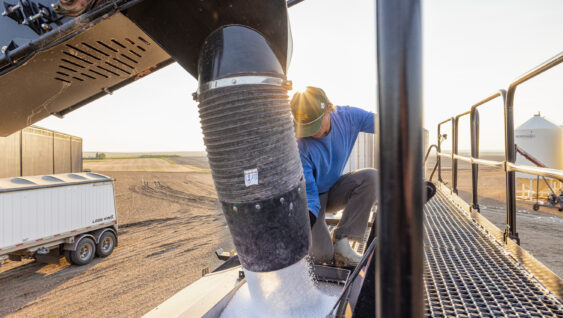
[00:06:53] Lyle Cowell: Right, so most crops in Western Canada are seeded with air drills, so a pressurized tank where the seed and fertilizer is stored while seeding, then the fertilizer and seed then goes through. Pipes to enter into an airstream through a number of hoses enters into a manifold that distributed to each opener.
So it goes through a lot of steps within that Airstream to finally get to the seed. Most Western Canada is direct seeded without any tillage whatsoever. We are using relatively low rates of fertilizer that have to be very precisely placed because we’re using really low rates of fertilizer, trying to do it without it disturbing the soil at all.
And so we end up with a machine that has pretty narrow turns and twists as the fertilizing seed goes through to the soil. So for that reason, clumping and moisture within the system can be a problem. And on top of that, there’s rollers and other things within the delivery of the fertilizer that again, we just can’t tolerate having moisture within that system.
[00:07:54] Mike Howell: So while at home, I know we’ve had some issues from time to time comes a shower or rain and the, the guys get knocked out of the field for a day or two and come back and it’s a big, giant ball of fertilizer in that spreader truck and it takes shovels and pick axes and sledgehammers and everything else to break it up just to get it out of the truck.
Obviously you can’t do that in these air seaters. What can we do to address this problem?
[00:08:16] Lyle Cowell: Well, it’s not easy to deal with, but there’s steps that we can take. So for one, we have to be careful with multi nutrient blends. So an individual fertilizer product will absorb moisture at a given rate, but when you blend fertilizers together, those fertilizers will absorb.
Moisture even faster. So for example, if you combine urea and ammonium sulfate, that blend will absorb moisture to a greater extent and faster than if urea or ammonium sulfate is by itself. So we have to be really aware of those specific blends in which ones are highest risk. The storage that we use tends to be quite good.
We have to maintain the quality of the storage. A lot of it’s in bins, especially on farm. It’s in bins at retails, it’s at bins or sheds, and just have to control the moisture conditions within those facilities as well. Then just to be aware of how fertilizers absorb moisture, so. This long term absorption of water.
We just have to keep an eye on the storage over the course of time. Sometimes we need to do that a lot better. You know, if it’s grain in storage, we check it every week, we should be checking fertilizer every week as well when it’s in storage. And then the problem with condensation, that’s hard to manage.
For example, even when you’re seating. An air drill is pressurized with a fan, and often we do have quite high humidity in the spring, so it’s pulling that warm, moist air right into the tank that has the fertilizer in it, and we have to then, again, comes back to checking things, checking your lines, checking your rollers, checking your manifolds, just to make sure that there’s no buildup of fertilizer starting to occur.
Don’t wait till there’s a problem. Be aware of what can cause a problem, and be ahead of the game. Don’t wait for a problem. Those are the main things. There’s not a lot of other things you can do. There are products that you can add the fertilizer that can help. Reduce the contact between fertilizer pearls, so there’s those products in the marketplace.
The product ESN is actually one of the primary reasons that farmers in Western Canada use a lot of ESN, is that it resists absorption of water from the atmosphere. And so that is a big deal. One of the reasons that farmers use ESN actually isn’t about agronomy. It’s about storability and flowability of the fertilizer with a blend.
So farmers will often use a urea blend. With say, 20 to 30% of ESN, and that really improves the storability and flowability of the entire blend. Those little things you can do every step helps that little bit more.
[00:10:47] Mike Howell: While you mentioned the ESN, I know you’ve done a lot of work around that in the last few years.
I’ve seen some excellent pictures. You’ve got actually got some publications out about that. I think those are published on our website. If anybody’s interested in that, you can go take a look at that. One other thing. Back home, there’s a few, not very many storage shed, but some of them have heated floors and kind of climate controlled environments.
Some variation going through there to help keep the humidity out. Are any of the on farm storage systems like that here in Canada?
[00:11:15] Lyle Cowell: You know, we’re not there yet, and probably it’s a direction that we need to consider to look outside of our region. When you start talking, Mike, that it’s always interesting that we often have this opportunity to.
Contrast and compare how things are done in your region to mine, and we could learn a lot from what you do in your area and apply that to Western Canada. I think to improve our storage and management, we should be learning from regions that have a lot of problems in storage and we don’t. We’re not using those methods of improving storage, but I really do think that we should be looking at those and just continue to work with it.
I, I should give a bit of a shout out to, in Saskatoon, Nutrien has what’s called the nutrient pilot plant, and Courtney Roach at the pilot plant and her team have done some excellent work for, to a better understanding fertilizer blend quality. Measuring the compact ability, this whole problem of forming clumps within storage.
I think it’s important to realize too, for our customers, that we are trying to improve knowledge and feature handling of fertilizer. We have a problem. The best way to deal with it is to try and understand it a little bit better.
[00:12:25] Mike Howell: Well, I, we’ve spent a good bit of time this morning talking about the issue and talking about some things that we can do to address it.
I think it’s important that we make people aware of this issue to better understand it and understand how they can help prevent that problem. Do you have any closing comments or take home message you wanna leave our listeners with before we sign off for today?
[00:12:43] Lyle Cowell: Yeah, I think the one thing that we should consider on farm and at retails is that sure, preventing clumping, preventing water absorption is a problem within equipment.
It’s a problem agronomically if we can’t properly apply fertilizer, but there’s an aspect to it that I worry about a lot, and that’s a safety aspect. If you have absorption of moisture in sheds, it can cause cliffs of fertilizer in sheds. It can suddenly release and cause risk. To people and in bins. I’ve seen farmers put themselves in the way of trouble.
Frankly, when they have fertilizer that is not coming out of a bin, we have to stop and slow down and think about how we’re storing this fertilizer. Monitor it constantly, not wait till it’s a problem because it’s about more than just the fertilizer. It’s about farm safety and employee safety and retails to make sure nobody gets hurt in all of this.
That’s an important part of this question that we sometimes forget.
[00:13:39] Mike Howell: Yep. Great message, Lyle. We definitely want everybody to get home safe every day. We have way too many accidents in the the industry as it is, so anything we can do to help prevent that is gonna be one step ahead. Lyle, we really appreciate you taking time to come in and visit with us today.
I think we got a lot out of this episode. Listeners, thank you for tuning in this week, and if you will hang around for just a couple of moments, we’ll be right back. Let’s segment two. Farming isn’t farming without questions, and now there’s a place to go for answers. At economics, an entire team of agronomists is waiting and ready to help for free.
No question is too big or too small. Visit Nutrien-ekonomics.com at submit your question with the ask an agronomist feature. Welcome back for segment two. If you’ve been listening for very long this season, this is a part of the show where we asked one of our agronomists a question about agronomy.
Today, we gave Dr. Karl Wyant back in the studio with us. Karl, welcome back to the Dirt.
[00:14:37] Karl Wyant: Hi. Thank you for having me,
[00:14:39] Mike Howell: Karl. Today our question is on pH. Our question is, what is soil pH and why is it so important in crop production? And then we wanna follow that up with the what is the
[00:14:48] Karl Wyant: ideal soil pH, so that soil pH, that’s something you can find on your soil test report.
Usually. So if you’ve got one of those nearby, maybe on the dash of your truck, pull it off and pull over first, and then take a look at the soil test, you’ll see a pH number, and that’s telling you how acidic, neutral, or alkaline your field is. So how many hydrogen atoms are in the soil? So if it’s got a lot of hydrogen atoms, it’s going to be acidic.
If it’s got that perfect amount of hydrogen, that soil peach is gonna be seven. If it has a lot. Fewer of hydrogen atoms. It’ll have a alkaline or basic reading, so above seven on the pH scale. So that’s how to interpret that scale. What is the pH of my soil? And this is important because pH is one of your big controlling factors for directing the nutrient availability conditions of a soil.
We’ll pick on phosphorus, for example. Under acidic conditions, phosphorus can. Set up that chemistry where it ties up with aluminum iron or manganese, and therefore you’ve got a fertilizer program that won’t work as well, that aluminum and phosphate, when it comes together, not super available under more alkaline conditions.
So pH of above seven, calcium and phosphate can come together and form a mineral. Same thing that your teeth remain out of. A mineral that renders that phosphorus unavailable to your crop. So that’s why we manage it so carefully because if we can manage those pH conditions towards seven, for most crops towards seven, we tend to have fewer of those nutrient sort of chemistry reactions that we don’t want, and we tend to have more nutrients applied, nutrients available to the crop.
I said there were some exceptions because we have crops like blueberries and cranberries. They love acidic soils, so you need to actually purposely drop the pH to grow really good blueberries and cranberries. On the alkaline side, we have crops that are more tolerant of a higher pH, and we just sort of manage around the pH because it’s gonna cost too much money to drop it.
So we just figure out how to supply more nutrients because we know that calcium phosphate reaction’s going to happen.
[00:16:46] Mike Howell: Karl, that’s why we grow so many blueberries here in the Poplarville Mississippi area. Our pH is naturally pretty low. We’d like to think we’ve got the best blueberries in the world, and if you don’t believe that, come out the second weekend in June to the Blueberry Jubilee here in Poplarville.
Thank you for joining us. We really enjoy these Ask the agronomy sessions. Listeners, thank you for tuning in this week. And as always, if you need more information on anything we’ve talked about today. You can visit our website, Nutrien-ekonomics.com. That’s Nutrien-ekonomics.com. Until next time, this has been Mike Howell with the Dirt.
Hey, guys, if you like what you heard today, do us a favor and share this podcast with someone else. It could be your neighbor, your friend, your crop advisor, or whoever you think would enjoy it. Your support helps ensure future episodes, so please like, subscribe, share, and rate the show wherever you’re listening from.