



Growing Degree Day Calculator: Track Crop Development And Predict Growth Stages
Summary of what you'll find
Growing degree days (GDD) help you understand where plants and pests are in their development cycle so you can make more timely decisions in the field.
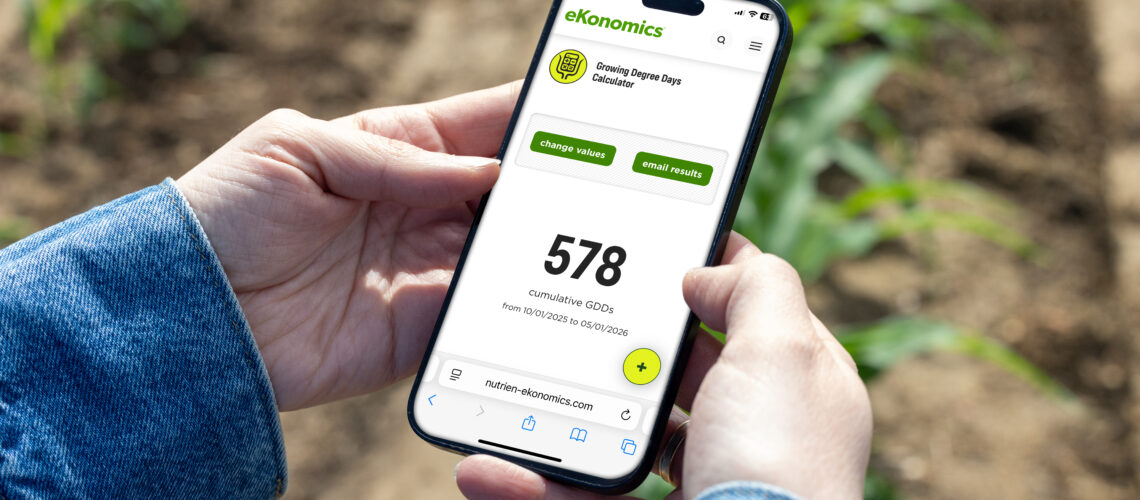
The eKonomics Growing Degree Days Calculator measures heat accumulation over time, giving you a reliable indicator of how crops, weeds, and insects are developing throughout the season. Using regional weather data, it calculates heat units above a minimum temperature threshold to help you track crop development and estimate when key growth stages are likely to occur based on accumulated heat units from past conditions.
Understanding how the calculator works is the first step to putting it to work across your fields.
How the growing degree day calculator works
Different crops require exposure to different amounts of growing degree days (GDDs) or heat units to complete their life cycle. The GDD Calculator measures this heat accumulation over time to help track plant and pest development, including key crops like corn and soybeans, where GDDs can be used to help determine growth stages.
Growing degree days are calculated using average daily temperatures (adding maximum and minimum temperature together, divided by two, minus the base temperature).
When temperatures rise above the baseline, crop, pest, and insect development accelerates and GDDs begin to accumulate; when they fall below it, development slows or stops and little to no GDDs are added. That’s how the calculator measures accumulated GDD over time to help track crop progress and help you better predict key growth stages.
The GDD calculator uses temperature data from the Agronomy and Environmental Sciences (AES) team at Nutrien to provide GDD values for a variety of crops and pests.
Using GDD calculators to track development, growth, and more
Understanding how a degree day calculator works is just the starting point. The real value is in how farmers apply GDD values across the entire growing season. From regional planning to pest management, a GDD calculator is a tool growers, agronomists, and advisors can rely on to inform decisions at every stage in the growing season:
- Assess whether a region has enough heat units to support the successful production of a particular crop
- Estimate the growth stages and life cycles of crops as well as weeds and insects that compete with or feed on growing crops
- Estimate crop maturity and cutting dates for forage crops
- Better predict the best time for fertilizer and pesticide applications
- Estimate heat stress on crops during critical growth stages when high temperatures can impact yield potential
- Better plan for planting a variety of crops to ensure separate harvest dates
How to use the growing degree days calculator
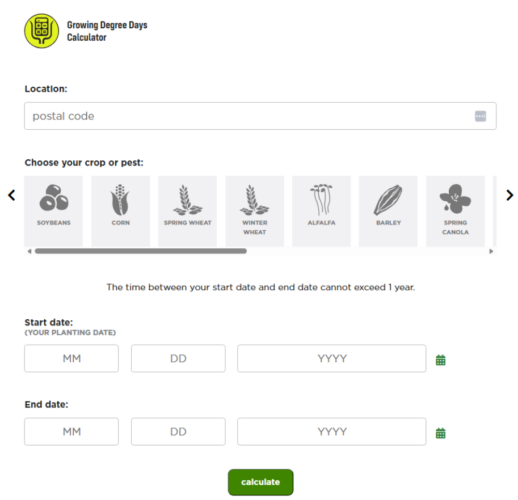
Getting started with the eKonomics GDD Calculator is easy:
- Location: Enter your postal/zip code. If your exact area isn’t available, select the geographical location nearest to you.
- Crop or pest: Choose the crop or pest you want to track.
- Start date: Enter your planting or tracking start date (ensure the time between your end and start date does not exceed one year).
- End date: Enter your end date (ensure the time between your end and start date does not exceed one year).
Calculating growing degree days for corn
Let’s walk through an example of how to use the calculator to track GDDs for corn.
The growing degree threshold for corn is 50°F (10°C).
- If the average air temperature is above the threshold for one day at 51°F (10.5°C), you accumulate one GDD for that day.
- At 80°F (26.5°C), temperatures contribute 30 GDDs.
Over time, these daily values add up giving you a running total that helps predict where a crop, pest, or insect is in its life cycle and when you need to be in the field scouting for potential problems.
Start tracking growing degree days on your farm
For most crops, development toward maturity depends largely on daily air temperature when other factors like moisture aren’t limited. Many key developmental events in both plants and insects are tied to heat accumulation, making GDDs a reliable way to predict when those events should occur regardless of year-to-year temperature variation.
Pest management is another practical application of GDD tracking. Knowing where a pest is in its life cycle helps you to better time control methods for when pests are most susceptible, improving effectiveness and reducing wasted inputs.
Use the Growing Degree Days Calculator to start tracking development and make more informed in-season decisions.
Explore a suite of ROI tools on the eKonomics app
The GDD calculator is just one of many tools available in the eKonomics app. Explore a full suite of ROI calculators and agronomic resources designed to help you make smarter, more profitable decisions every season when you download the app: