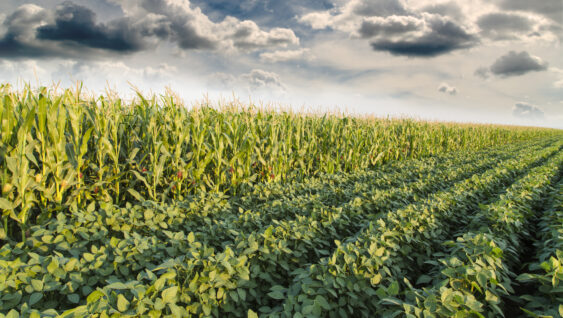
Sorghum (Sorghum bicolor) is an ancient grain and non-GMO protein source that’s rich in nutrients and can be grown as a grain, forage, or sweet crop.¹ Known for its versatility, sorghum is a high-energy, drought-tolerant, and environmentally friendly crop.
It’s become the fifth most important cereal crop around the world after maize, rice, wheat and barley.² In the United States, sorghum is planted on dry acres throughout the ‘Sorghum Belt,’ running from South Dakota to the South of Texas.¹ Sorghum grain is most commonly used for livestock feed (including poultry, beef, dairy, and swine) and ethanol production. It’s also grown for human consumption and has become a popular addition to a variety of recipes around the world. It is gluten free and rich in fiber, antioxidants, protein, iron, phosphorus, magnesium, vitamin B6, and niacin.¹
Producing high-yielding, quality sorghum requires a strong understanding of its growth throughout production. A deep understanding of each stage of development will help you better manage the crop from planting to harvest. Certain fertility decisions are only effective at specific stages of development, and factors like the climate and soil conditions can impact the evolution of growth. Thus, it is important to better understand sorghum’s growth stages and development cycle to make more informed management decisions while meeting your productivity and profitability goals. Knowing what stage of growth your sorghum crops are in will also allow you to better manage their health, assess crop quality, and determine the best time to harvest.
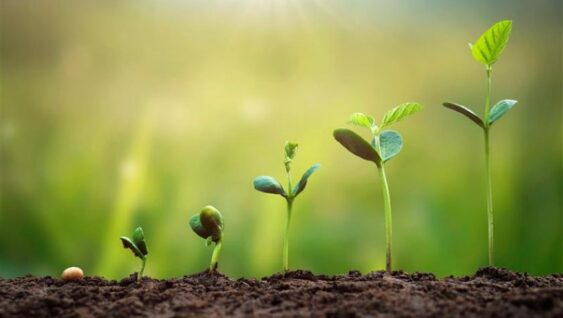
Sorghum goes through nine stages of growth, beginning at emergence and ending at maturity. The growth stages can be broken into two main parts: the vegetative stages and the grain-filling stages. In the vegetative stages, the number of fully expanded leaves on the plant is used to establish which stage of growth the plant has achieved. The grain-filling stages begin once growth has reached 50 per cent. Click through each of the MORE buttons below to learn more about each stage of growth.
CLOSE X
Heading
Copy
Stage 0: Emergence
This is when the plant first breaks through the soil surface – generally occurs three to 10 days after planting. The time required depends on soil temperature, moisture conditions, depth of planting, and vigor of the seed. During this period growth depends on the seed for nutrients and food reserves. Cool, wet conditions during this time may favor disease organisms that seriously damage stands.
Stage 1: Three-Leaf Stage
Leaves are counted when the collar (the place where the leaf blade and leaf sheath attach) of the leaf can be seen without tearing the plant apart. The growing point is still below the soil surface. While the plant’s growth rate depends largely on temperature, this stage will usually occur about 10 days after emergence.
Stage 2: Five-Leaf Stage
Approximately three weeks after it emerges a sorghum plant has five leaves fully expanded; its root system is developing rapidly and roots produced at the lower nodes may push the lower leaf off the plant. This usually does not cause difficulty in identifying the five-leaf stage because the lower leaf has a rounded tip and the second leaf is pointed. The plant enters its “grand period of growth” in Stage 2. Dry matter accumulates at nearly a constant rate until maturity, if growing conditions are satisfactory. This is a good time to side-dress, if additional nutrients are needed, to prevent deficiencies during the next stage of growing point differentiation.
Stage 3: Growing Point Differentiation
About 30 days after sorghum emerges, its growing point changes from vegetative (leaf producing) to reproductive (head producing). The total number of leaves has been determined and potential head size will soon be determined. About one-third of the total leaf area has fully developed – seven to 10 leaves depending on maturity class – and the lower one to three leaves may have been lost. Culm or stalk growth increases rapidly following growing point differentiation. Nutrient uptake is rapid. Time from planting to growing point differentiation generally is about one-third of the time from planting to physiological maturity (maximum dry weight). Maximum potential head size is set during the growing point differentiation. Nutrient deficiencies and other stresses during this time can affect final yield.
Stage 4: Flag Leaf Visible
Following growing point differentiation, rapid culm elongation and rapid leaf development occur simultaneously until, at Stage 4, the flag leaf (final leaf) is visible in the whorl. By then all except the final three to four leaves are fully expanded and about 80 percent of the total leaf area is present. Light interception is approaching maximum, and growth and nutrient uptake continue at a rapid rate. This is the period of maximum nutrient uptake. Nutrients should be readily available during this rapid growth phase. The head is developing. The lower two to five leaves have been lost. Any reference to leaf number from now on should be from the top, counting the flag leaf as leaf number one. While only about one-fifth of the total growth has occurred, nutrient uptake is far greater with more than 40 percent of the potassium already taken up.
Stage 5: Boot Stage
All leaves are now fully expanded, providing maximum leaf area and light interception. The head has now developed to nearly full size and is enclosed in the flag-leaf sheath. Except for the peduncle, culm elongation is essentially complete. Peduncle elongation is beginning and will result in exertion of the head from the flag-leaf sheath. Potential head size has been determined.
Stage 6: Half-Bloom
Following the boot stage, the peduncle grows rapidly extending the head through the flag-leaf sheath. Half-bloom is usually defined as when one-half of the plants in a field or area are some stage of bloom. However, because an individual sorghum head flowers from the tip downward over four to nine days, half-bloom on an individual plant is when the flowering has progressed half-way down the head. At half-bloom approximately one-half of the total dry weight of the plant has been produced. However, nutrient uptake has reached nearly 70, 60, and 80 percent of total for nitrogen, phosphorus, and potassium, respectively. Stresses during bloom, or pollination, can reduce the number of kernels produced and have dramatic effects on final yield.
Stage 7: Soft-Dough
Between half-bloom and soft-dough the grain fills rapidly; approximately half if its dry weight is accumulated in this period. The culm weight increases slightly following half-bloom; then, because grain is forming rapidly, the culm loses weight. The loss in culm weight may account for as much as 10 percent of the grain weight. Lower leaves are still being lost with eight to 12 functional leaves remaining during Stage 7. Nutrient and environmental stresses during grain fill can reduce grain size, one of the components of yield, and reduce yield and test weight.
Stage 8: Hard-Dough
By hard-dough stage, about three-fourths of the grain dry weight has accumulated. The culm has declined to its lowest weight. Nutrient uptake is essentially complete. Additional leaves may have been lost.
Stage 9: Physiological Maturity
Maximum total dry weight of the plant has occurred. Physiological maturity can be determined by the dark spot on the opposite side of the kernel from the embryo. The kernel on the left is physiologically mature; the one on the right is not. After physiological maturity, the remaining functional leaves may stay green or die and brown rapidly. If temperature and moisture conditions are favorable, branches may start to grow from several of the upper nodes. The culm or stalk weight may increase slightly near physiological maturity.