Blake grew up on a mixed grain and livestock farm near Shaunavon, SK. He holds a joint role of Applied Research lead at Glacier FarmMedia Discovery Farm and Research Chair at Saskatchewan Polytechnic. Blake obtained a PhD in Soil Science from the University of Saskatchewan working under the supervision of Drs. Jeff Schoenau and Jane Elliott. He is a Professional Agrologist (PAg) with the Saskatchewan Institute of Agrologists and was recognized by the institution as the 2024 Outstanding Young Agrologist. His research focuses on evaluating agricultural management practices and emerging technologies for their ability to optimize water and nutrient use efficiency while limiting nutrient losses in runoff water.
Sustainable phosphorus management in agriculture seeks to strike a balance between achieving beneficial agronomic goals (i.e., economically optimum crop grain yield, preservation of residual soil phosphorus in a plant-available form) while limiting off-site losses in runoff water. Therefore, the agronomic and environmental performance of a phosphorus fertilizer source should be a key consideration in phosphorus fertility planning. As the plant-availability and mobility of a phosphorus fertilizer source is influenced by its solubility, consideration of the differences in solubility among phosphorus fertilizer sources is also warranted. The relative solubility of a phosphorus fertilizer source also interacts with localized soil conditions, as soil-available water and other soil properties that influence phosphorus solubility tend to vary across the landscape. Therefore, sustainable phosphorus management may benefit from the prescription of site-specific agronomic management practices.
Assessing Phosphorus Fertilizer Sources
A recent study was conducted in the Prairie Pothole Region of the Northern Great Plains to assess the agronomic and environmental performance of eight phosphorus fertilizer sources, which vary in their relative solubility (see Table 1). Agronomic performance was assessed through the measurement of crop phosphorus uptake and grain yield, and environmental performance was assessed through measuring soluble phosphorus losses in runoff water from a snowmelt simulation experiment.
The study was conducted at three sites representing unique landscape positions that reflect the characteristic topography of the Prairie Pothole Region, including shoulder, level, and footslope positions. To assess performance across a range of soil conditions, two sites (shoulder and footslope) were situated in a single field in the brown soil zone of Saskatchewan, Canada and the third site (level) was situated in a field in the dark brown soil zone of Saskatchewan. The variation in topography at these landscape positions reflects differences in soil-available water due to the movement of surface runoff water across the landscape and variation in water retention capacity due to differences in soil organic matter. Digital elevation models are provided in Figure 1, showing the variation in topography at each site.
Table 1: List of phosphorus fertilizer sources by name, chemical analysis, and relative solubility. Figure 1: Digital elevation models showing the landscape position of each of the three field sites included in the study.
Agronomic Performance
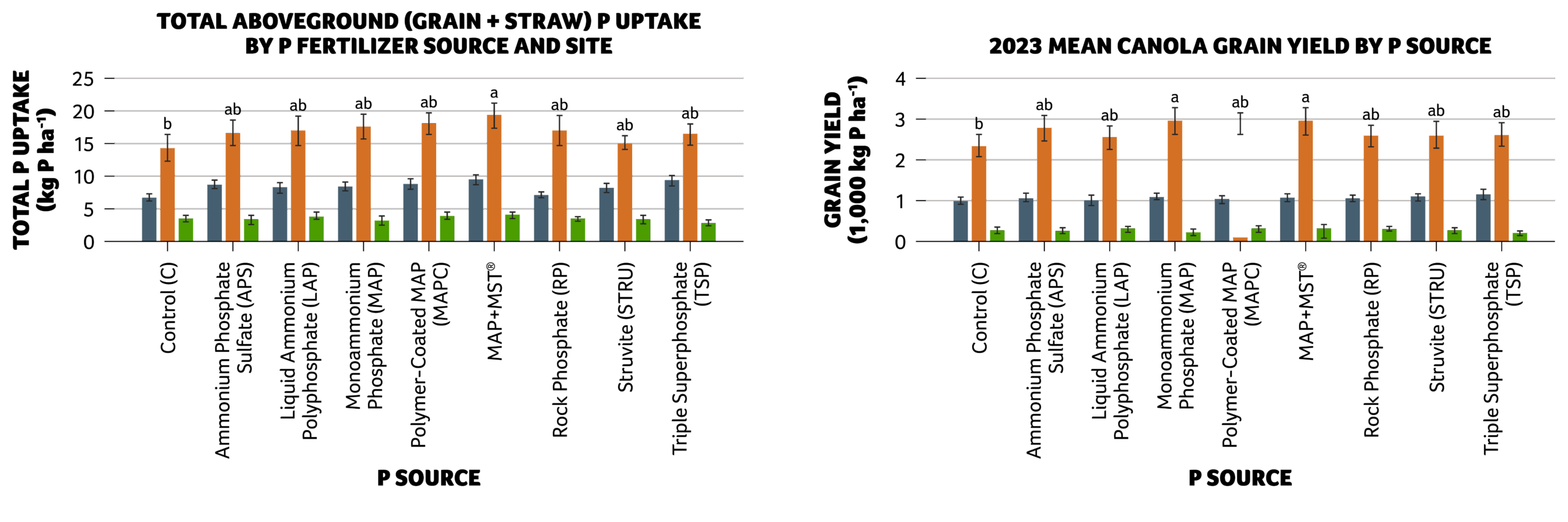
The impact of phosphorus fertilizer source on total phosphorus uptake in the harvested grain and straw and canola grain yield during the 2023 growing season is shown in Figure 2. Drought conditions during the 2023 growing season likely muted the agronomic performance of all phosphorus fertilizer sources. However, at the footslope site (see the orange bars in Figure 2), the application of MAP+MST® resulted in significantly greater total phosphorus uptake and canola grain yield compared to the control treatment, where no phosphorus fertilizer was applied. At the other two sites, a tendency was also shown for MAP+MST® applications to perform best agronomically.
With the site’s prevailing drought conditions, the high relative solubility of MAP+MST® likely improved the canola crop’s ability to access phosphorus from the soil. Across all phosphorus sources, total phosphorus uptake and grain yield increased in the pattern of level<shoulder<footslope, reflecting the landscape position’s soil-available water during drought conditions. The footslope site had greater soil-available water than the shoulder site due to a greater soil organic carbon content. Soil-available water was particularly limited at the level site due to the presence of excessive soluble salts in the surface soil profile.
Figure 2: Agronomic performance of various phosphorus fertilizer sources on total phosphorus uptake (the top graph) and canola grain yield (the bottom graph) for each field site. The blue, orange, and green bars represent the shoulder, footslope, and level sites, respectively. Error bars (shown in grey with the letter a, b, and ab) represent the standard error of the means of each treatment. Sites with common letters are not significantly different at the five percent level according to Tukey’s Honestly Significant Difference (HSD) test. Differences can be seen at each site. If two treatments at one site both show ‘a,’ they are not significantly different. If one treatment shows ‘a’ and the other shows ‘b,’ they are significantly different. Treatments labelled ‘ab’ are not significantly different from treatments labelled ‘a’ or ‘b.’
Environmental Performance
The results of the simulated snowmelt runoff experiment were based on soil samples collected from plots where each of the phosphorus fertilizer sources had been applied (Figure 3). At the shoulder and level sites, phosphorus fertilizer source significantly influenced soluble inorganic phosphorus concentration in snowmelt runoff water. For example, while application of the highly soluble ammonium phosphate sulfate fertilizer resulted in significantly greater soluble inorganic phosphorus concentration compared to the control treatment, application of the poorly soluble rock phosphate resulted in statistically comparable losses compared to the control.
Results
At all three sites, phosphorus losses from the application of MAP+MST® were not significantly different from the control treatment, where no phosphorus fertilizer was applied. Despite its high relative solubility and potential mobility in runoff water, the strong agronomic performance of MAP+MST® favored phosphorus uptake by the crop. With a greater amount of phosphorus being removed from the site in the harvested grain, less phosphorus was left in the soil to be lost in the runoff water. Considering all phosphorus sources, losses differed among the sites, with losses increasing from the footslope<shoulder<level. Low soil-available water, due to excessive soluble salts, and basic pH at the level site negatively impacted the crop’s ability to take up soil phosphorus. This caused the surface soil to become enriched in soil phosphorus, promoting greater losses in snowmelt runoff.
Figure 3. Impact of phosphorus fertilizer source on soluble inorganic phosphorus concentration in snowmelt runoff by field site. The blue, orange, and green bars represent the shoulder, footslope, and level sites, respectively, and represent the amount of phosphorus runoff at each site. Error bars (shown in grey with the letters a, b, and ab) represent the standard error of the means of each treatment. Sites with common letters are not significantly different at the five percent level according to Tukey’s HSD test. Differences can be shown at each site. If two treatments at one site both show ‘a’, they are not significantly different. If one treatment is ‘a’ and the other is ‘b, they are significantly different. Treatments labelled ‘ab’ are not significantly different from treatments labelled ‘a’ or ‘b.’
Agronomic Management For Win-Win Solutions
Meeting the dual goal of beneficial agronomic and environmental performance of phosphorus fertilizer application is best achieved through prescribing win-win solutions. This study showed that practices that promote phosphorus uptake by the crop simultaneously resulted in lower losses in runoff water and therefore represents a general win-win strategy for sustainable phosphorus management. For example, across all sources evaluated in this study, phosphorus losses generally increased in the pattern footslope<shoulder<level, and phosphorus losses in snowmelt runoff were inversely related to the pattern of crop phosphorus uptake, where phosphorus uptake increased from level<shoulder<footslope. While the performance of phosphorus fertilizer sources varied across the sites, MAP+MST® application simultaneously achieved beneficial agronomic and environmental outcomes at all three sites, representing a range of soil conditions. The high relative solubility of MAP + MST® promoted phosphorus uptake by the canola crop, and consequently reduced phosphorus losses in runoff water.
Want to dig deeper? Explore the following resource to learn more about phosphorus management and fertilizer sources: