





Read Full Transcript
Mike Howell (00:08):
The Dirt with me, Mike Howell, an eKonomics podcast where I present the down and dirty agronomic science to help grow crops and bottom lines. Inspired by ekonomics.com, farming’s go-to informational resource, I’m here to break down the latest crop nutrition research use and issues, helping farmers make better business decisions through actionable insights. Let’s dig in. Well, hello again everyone. Welcome back to The Dirt. I was sitting here in sunny south Mississippi today. The temperatures are in the mid eighties. And we’ve got corn planting going on wide open. Everybody’s in the field and enjoying this warm weather Lyle, I’m venturing to guess that it’s not quite 84 degrees in your neck of the woods.
Lyle Cowell (00:55):
It is not, but it’s not too bad for Western Canada. Well, celsius, about minus 10, somewhere around 20 fahrenheit, I suppose. It’s not so bad for our corner of the world right now.
Mike Howell (01:04):
Wow, that’s pretty cold for us. We don’t like to see temperatures get in those negative numbers like that. Lyle, I know you’re with Nutrien Ag Solutions. I have never had the opportunity to meet you personally, but you came highly recommended to help us go through a discussion about canola and canola fertility today. If you would introduce yourself to our listeners, tell them where you’re from and what you do.
Lyle Cowell (01:24):
Yeah, you bet. My name is Lyle Cowell. I’ve worked with Nutrien Ag Solutions now for I believe 27 years now. I work as a regional agronomist in northeast Saskatchewan in really the heart of canola country of Western Canada. And my job, well, it’s to be in my mind, just a well-rounded agronomist that helps service the agronomy of our retail staff and our customers with Nutrien to try to answer all questions in agronomy. I guess my first love though does remain soil fertility.
Mike Howell (01:54):
Well, you mentioned that you’re in the heart of canola country. What other crops are y’all growing in that part of the world?
Lyle Cowell (01:59):
Well, canola is our number one. It’s number one in terms of acres and in terms of income potential for our farmers. Canola, probably in our area of Western Canada, and across the Northern Grain Belt, would account for 45 to 50% of our acres. And then that’s balanced off for a huge portion of the crop on annual grains, wheat, barley, and oats. In my corner of the world, it’s probably about 30% wheat, and 10% each of barley, and 10% of oats, and then a smattering of pulse crops, be they peas or fab beans or other crops. But that’s pretty much the annual crop mix on our arable end.
Mike Howell (02:39):
Okay. Now, I don’t know a whole lot about the area where you are. We have a good bit of irrigation in certain parts of the United States. Is that area irrigated, or is it rain fed? How’s that work?
Lyle Cowell (02:49):
This corner of the world, as is the case with most of the Northern Grain Belt of Western Canada is not irrigated. We don’t have a lot of irrigation in Western Canada, and it’s primarily in the south, in the drier region of Western Canada, so entirely rain fed agriculture up along here, as is the case, again, as most of the area that canola has produced. It’s a cool damp climate. Our snow will start the melt in a few weeks and spring will be upon us hopefully by May 1st, and the crop ends hopefully by September 1st is where we’re hoping to be harvesting. So it’s a pretty short season. It’s cool throughout the season, even on our warmest months. And that’s what canola likes. It really likes a cool damp climate.
Mike Howell (03:33):
Let’s dive in and talk a little bit more about canola. If you asked me anything at all about cotton, I’ve got a pretty good idea how to answer that question. I do pretty good with corn and soybeans, a lot of the southern crops. But you throw a question in there about canola and I’m going to have to find somebody else real quick to help answer those questions. Tell us a little bit about when canola’s planted, what kind of soil conditions we need, land prep and that kind of stuff.
Lyle Cowell (03:56):
You bet. So it is an interesting crop. It’s actually not so much a species as a description of the oil quality. It’s canned oil, Canadian oil quality, and that means that it has low erucic acid and just higher quality oil than conventional rape seed that has been grown across the world. So essentially the breeding invention of canola from a couple of breeders in Western Canada about in the mid 1970s brought about a new crop for an old species. And it’s an annual crop. There are winter canola varieties, but they don’t survive in Western Canada. So in some places in the world, they’ll grow it as a winter crop. But we’re growing spring canola. And we tend to seed it towards the end of May because it’s very sensitive to spring frost, so it tends to be seeded in the last, somewhere between May 10th, and well hopefully by the end of May, grows very rapidly in our growing season, we have long day lengths, and so it tends to reach maturity by the end of August, and harvest comes then late August, and hopefully into September before the snow comes again.
(05:03):
So we kind of have a fast and furious growing season in western Canada. We don’t have a lot of time to get things done, and we have to do it quickly. And that includes the crop. The crops have to get things done quickly.
Mike Howell (05:13):
So what about land prep? Is canola grown in rows, or is it sown like wheat? How do we grow canola?
Lyle Cowell (05:18):
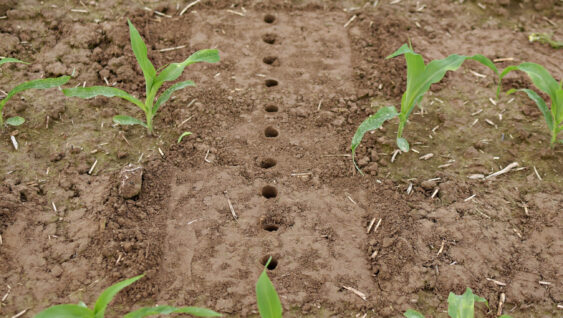
Yeah, so we seed canola with the same implements as we do with wheat. Almost all of our land in Western Canada is seeded with air drills, so with an air tank, and then through narrow openers to drop the seed in through an air system. Most of our land, probably 80 to 90% is essentially zero tiled, and a lot of the fertilizer is applied at the same time as seeding. Seeding becomes a somewhat complicated operation because we’re applying seed, we’re applying fertilizer in the seed row, and we’re also applying often nitrogen fertilizer at the same time between the rows or to the side of the rows. The seed row spacing varies generally between eight inches and 12 inches. Most of the seed row spacing is at about 10 inches. And again, really a focus on, because there’s no irrigation, preserving that seed moisture that we have. That was kind of a gift of the snowfall that we’ve got on the ground right now. That’s our seed bed moisture, and then we just hope for some good rainfall through the season to keep things going.
Mike Howell (06:22):
When you get into the season, what about pests? Do you have any pests you have to worry about, insects or diseases that come into this crop?
Lyle Cowell (06:29):
Everything likes to eat canola. Flea beetles are our primary pest in the spring, and they’re the most predictable pest. We always have flea beetles. There’s a couple of different species, black cruciferous flea beetles and then two striped flea beetles. In the end, they emerge as adults in the spring, at about the same time as our canola is emerging from the ground. And they’re pretty hungry insects that feed on the canola as it’s emerging, feeding on the cotyledon and are a huge problem to us. We try to deal with flea beetles primarily through insecticides applied to the seed. Sometimes we still have to use foliar applications of insecticide to keep control, but in the end, that’s our main pest. There’s other pests, diamondback, moth larva, Bertha armyworm larva, number of other insects that do feed on canola. Like I say, everything wants to eat canola.
(07:19):
In terms of diseases, there’s three primary diseases that we deal with. Two of them, we deal with through genetic resistance, and that’s blackleg, which the infection occurs just as the crop is establishing in spring at the cotyledon, their first leaf stage. And we’re fortunate that our breeders have been able to keep ahead of blackleg with genetic resistance. It’s very key that we do that. A more recent disease that we are having to deal with through genetic resistance is club root. And club root forms, large gulls in the roots, and then the crop essentially suffers from an inability to take up water and nutrients from the soil. Again, that’s a disease that our breeders are keeping ahead of currently through good genetics.
(08:00):
And then the third primary disease that we deal with is sclerotinia, or white mold, depending which crop you’re looking at, and that’s one that genetics have. It’s not easily controlled, and that’s the primary disease that we would use fungicides to try to gain some control on. So that’s pretty much it. Like I said, it is the crop that is our most profitable. It’s our most popular crop, but it’s also the most fragile crop to get it through the season.
Mike Howell (08:23):
Once you do all of that and get it through the season, let’s talk a little bit about harvest. I’m assuming it’s a small grain and you’re going to combine that similar to how you would any other small grains. Am I right on that?
Lyle Cowell (08:36):
That’s right, and essentially with the same equipment that we would with any of our other small grains, harvest it with the same equipment as we do with we wheat or barley. Things that have changed in the recent years is we used to swath all of our canola. So lay it down in windrows with a swather, and then pick it up with a header of several weeks later. And the reason for swathing is twofold. One, we have a short season, so cutting it off just as it reaches physiological maturity allows us to gain some time in the fall. We’re trying to get this crop off before the snow flies. The other advantage, of course, is that we are starting to get better shatter resistance. So we’re trying to do it, we swath to make things go faster in terms of maturity, but we also do it to prevent seed shatter. So those little pods of canola, they traditionally have shattered quite easily, but our breeders in Western Canada have been able to find selections that have better pod strengths where more and more straight cutting, straight harvesting the canola just with the combine.
(09:34):
So we’ve seen that shift. I would probably over 50% of our canola is now simply straight cut. We do use some harvest aid sometimes, but it’s not the easiest crop to dry down in the fall with harvest herbicides. It’s often just naturally dried and matured.
Mike Howell (09:48):
And what typical yields are we seeing on canola?
Lyle Cowell (09:51):
Well, that’s a wide range because it’s non irrigated for most of the acres. Probably the Western Canadian average would probably be in the range of 45 bushels per acre in there someplace. We occasionally will see yields over 60 bushels per acre, but that’s also balanced off with dryer crops or crops that have had something happen to them, lots of… There’s an equal number, 20 bushel per acre crops. So in that, 40, 45 is probably the average yield that we’re at right now.
Mike Howell (10:20):
I’ve been hearing reports from some of my colleagues. Things have been pretty rough up there the last couple of years as far as rainfall, and y’all have been right in the middle of that drought and things haven’t worked out real good, but hope that’s going to change for this growing season.
Lyle Cowell (10:33):
Well, 2021 was rough for all Western Canada. Last year, where most of the canola was produced actually wasn’t bad. We had a drought in Western Canada, but it was more isolated to the southern prairies where there’s really not a lot of canola produced. Most of the canola is produced along the forest fringe in the northern green belt. And things were actually pretty good last year. We were pretty happy with our yields.
Mike Howell (10:55):
Okay, that sounds good.
Lyle Cowell (10:57):
Hopefully we can do it again.
Mike Howell (10:59):
Yeah, hope so. I can go to the grocery store and I see canola oil sitting on the shelf, but that’s about the only use I know about for canola. I’m sure there’s some other uses. If you would tell us a little bit about what the product’s used for.
Lyle Cowell (11:11):
Yeah, so it is crushed for oil. It’s over 40% oil, and that’s the primary goal, is to produce an oil oil seed crop. And the canola’s excellent quality. Again, that was really what the breeding efforts were to create canola, was to make a product that was more healthy and more palatable. But there is still the meal. Anytime you crush a crop for oil, there’s always the meal leftover, and that mostly moves into the animal feed market. So the efforts to create canola oil were twofold. One, to improve the oil quality and healthy aspects of the oil, getting the erucic acid levels down to an acceptable level, and then also reducing the glucosinolates in the meal. They’re off-putting to the taste of the canola meal with animals, and they were able to successfully reduce glucosinolate levels as well so that it’s also a valuable meal that is exported from Western Canada. So two primary products. There’s the other aspect now that we’re going to see in the next few years, is there’s crush plants being developed for canola that’s entirely focused on biodiesel.
(12:15):
So there’s going to be a biodiesel market for canola oil. There is already in some parts of the world, and there’ll be canola crushes specific to biodiesel in the near future in western Canada.
Mike Howell (12:26):
Well, Lyle, we sure appreciate you going through all of that. I know I’ve learned a lot about canola just in this short time. Let’s back up a little bit and talk more about the fertility aspects and fertility management. You mentioned a lot of the fertilizer goes out with the seed, and you’re putting that down in between the rows or with the rows. Talk a little bit more about what canola needs and how you’re applying these fertilizers.
Lyle Cowell (12:50):
It’s a fairly hungry crop in terms of nutrients. So nitrogen fertilizers, some of it is applied in the fall, in September or into October, banded into the soil, and then it remains relatively very low risk to loss over a course of our winter season. But in the end, most of it is, in Western Canada, is applied in spring. Some of the nitrogen is applied prior to seeding, but a big portion of it is actually applied at seeding, and it’s almost entirely banded in the soil. We’re banding urea or ammonia fertilizer usually about three to four inches deep. Almost all of… There’s very little surface application of nitrogen fertilizer in most of Western Canada, and in particular the canola growing region. It’s all banded, or almost all banded, and a big portion of it is actually banded actually at the same time as seeding, bands being placed between the rows.
(13:43):
Phosphorus and occasionally potassium, we try to apply that at relatively low rates. It has a fairly high demand for phosphorus, but the phosphorus, we try to apply at the time of seeding sometime directly with the seed in the seed row, and sometimes in a band just to the side. And that would be the same with potassium. Phosphorous, potassium, not terribly mobile. We need to have it near the seed, but it is almost entirely subsurface banded as well with the seed. And then when we think of canola, we often think of sulfur because it has a much higher sulfur demand than other crops. And sulfur’s pretty flexible. You get about the same efficiency whether you broadcast it or place it near the seed. The whole package has to be there, and sulfur is a big part of it. You have to keep an eye on your requirements. And we have a pretty good understanding of our requirements.
(14:35):
There’s actually, as an aside, a new project being led by the University of Saskatchewan to look at nutrient removal by crops in Western Canada. The data that we had been relying on was a little old, and there’s brand new data that will be published in this next six months. We have a much better understanding now of requirements. So as an example, removal rates for canola is in the range of about 1.8 to two pounds per bushel of canola. And that’s about what we assumed, so we are actually pretty accurate on that. But the new data suggests that we actually are removing not quite as much phosphorus or potassium or sulfur as we thought, which is good news. We can probably refine our fertilizer rates a little bit so that… Our removal rate for phosphorus is about 0.8, 0.9 pounds per bushel, potassium, about 0.4, and sulfur, about 0.25 pounds, about a quarter of a pound for a bushel, which is much lower than we thought it was with sulfur.
(15:34):
We used to think it was about a third of a pound. But at the same time, it’s double the rate of requirement of our other small grain type crops. The margins are slim in Western Canada for profitability, so farmers are pretty focused on getting the right rate on when it comes to fertilizer application.
Mike Howell (15:51):
Anything we can do to save a dollar definitely going to help. I’m glad to see them putting the forth the effort to get these rates exactly right. And we don’t want to be putting out anything we don’t have to in these soils. Look forward to seeing the results of all this research. Lyle, what about micronutrients? I know we have a lot of micronutrients, and we’ve been talking about those in some previous episodes. What are we looking at in canola?
Lyle Cowell (16:14):
Well, I guess take a step back. In western Canada, we’re fortunate to have very, very rich soils, and for two reasons. One, relatively recent glaciation, so we have quite young soils in terms of the age of average soils in the world, young soils that brought material from the north and deposited across western Canada. And so right off the top, we have original material that’s relatively high in micronutrients, and then we also have rich soils. Because of our miserably cold climate, we only have four months of summer where there might be some decay. We actually have soils that are quite higher in organic matter. Our low organic matter soils are in the range of 2% organic matter. Up in the area that I work, our soils tend to be somewhere between five and 10% organic matter. So between naturally rich mineral material and high organic matter content, we’re fortunate and we don’t face the micronutrient deficiencies that a lot of the world does.
(17:10):
The utilization of micronutrients on canola is actually very low. There’s occasional but rare boron deficiencies, occasional but rare responses to zinc and copper. In the end, really not the focus on requirement that we would see with other parts of the world in terms of micronutrients. Again, we’re fortunate for the soils that we have.
Mike Howell (17:32):
Yeah, that organic matter makes a big difference. In my part of the world, we’re lucky if we can ever get to 2% organic matter. We’ve got a lot of growers that are struggling to keep a half a percent organic matter, and that’s just a totally different animal when you start looking at that organic matter, and glad y’all are able to keep that organic matter and get the benefits from that.
Lyle Cowell (17:50):
We are fortunate. Yeah. Our focus primarily needs to be on the macronutrients and PK&S to be successful with canola.
Mike Howell (17:58):
Lyle, one thing we haven’t touched on is pH. What are your soil’s normal pH range? And is that acceptable for canola or do you have to make adjustments to that pH?
Lyle Cowell (18:07):
We very, very rarely need to adjust pH. Again, this is related to the origin of our soils. It tends to be fairly carbonated high pH soils that were deposited across Western Canada. pH ranges on a zero to six inch depth sample. We tend to see pH ranges between… At the low end for most of Western Canada, it would be six, and then upwards to close to eight, and it tends to be quite well buffered with natural carbonates where liming is almost unheard of. There are pockets that would probably benefit from liming in western Canada, but it’s not a very uncommon practice so far in Western Canada. And canola does well at that. It actually does its very best, fortunately, at about the soil pH range that we’re in here in Western Canada, kind of in that six and a half to seven range. So again, we’ve been really blessed to have the soils that we have.
Mike Howell (19:00):
Okay, Lyle. Well, we have sure covered a lot today. I really appreciate you being on and enlightening our listeners a little bit about canola production. What’s your take home message to everybody? What’s the one thing you want everybody to remember about canola production?
Lyle Cowell (19:13):
Boy, that’s a tough one. For those that are not familiar with canola production, I think the take home message is that we’re lucky to have a crop that’s well adapted to the northern prairies and for the cool regions of the world, really. Canola is not just a Canadian product anymore, but it’s really, it’s been a gift to the world as far as cool growing regions that have difficulty growing corn or beans or other warm season crops. We’re lucky to have a crop that’s produces a very healthy oil and a very healthy meal, and we’re also lucky to be able to produce in Western Canada in our short growing season on very rich soils. It’s been a nice coincidence of breeding and crop adaptation and acceptance into a marketplace for this crop.
Mike Howell (19:56):
Well, Lyle, we sure appreciate you taking the time to visit with us today. I’m sure our listeners have all learned something from this, and I know I have. Thank you for tuning in this week. And as we often do, we’re going to end this segment and move into our final segment of the day, our famous person in agriculture, or famous agronomist.
(20:16):
The man that we’re going to talk about today probably needs no introduction. I’m sure everybody has heard of Mr. John Deere. John was originally from Rutland, Vermont. He grew up as an American blacksmith and founded Deere and Company. Everybody knows that that is one of the leading agriculture and construction equipment manufacturers in the world. Now at a young age, Deere moved from Vermont to Illinois, and he found that the cast iron plows were not really working in those prairie soils. They weren’t able to withstand the heavy soils in that area. And he knew, from spending time in his father’s tailor shop, that he could take needles and polish those up with sand. In 1827, Deere developed and manufactured the first commercially successful plow, the wrought iron frame of the plow, and he polished that steel shank, and it made it ideal for the tough soils of the Midwest.
(21:05):
By early in 1838, he had sold the first plow to Lewis Crandall who quickly spread the word about this new plow and the success that it was having. By 1841, Deere was manufacturing 75 to 100 plows per year. And about 10 years after that, the production had increased over 10,000 plows per year. The plow became known as the plow that broke the planes, and there’s a monument to that effect in Vermont today. Now, from there, John Deere went on and made various other tillage implements. Everybody knows about the tractors and the combine sprayers. The sky was the limit for John Deere at that time. One of John Deere’s famous quotes, and I really like this quote, he said, “I will never put my name on a product that does not have in it the best that is in me.” I think that’s something that we can all take home with us and learn from that quote. Everybody has heard about John Deere, and we wanted to take just a minute to celebrate his contribution to agriculture.
(22:02):
Once again, thanks for tuning in this week. We want to invite you back again. Next week we’ll have more information coming to you about some various crops and the fertility requirements on those crops. Until next time, this has been Mike Howell with The Dirt.