Blake grew up on a mixed grain and livestock farm near Shaunavon, SK. He holds a joint role of Applied Research lead at Glacier FarmMedia Discovery Farm and Research Chair at Saskatchewan Polytechnic. Blake obtained a PhD in Soil Science from the University of Saskatchewan working under the supervision of Drs. Jeff Schoenau and Jane Elliott. He is a Professional Agrologist (PAg) with the Saskatchewan Institute of Agrologists and was recognized by the institution as the 2024 Outstanding Young Agrologist. His research focuses on evaluating agricultural management practices and emerging technologies for their ability to optimize water and nutrient use efficiency while limiting nutrient losses in runoff water.
Fertilizer and crop management practices are often implemented to optimize the agronomic use efficiency of applied phosphorus fertilizer. Many of these practices are centered around the 4Rs of Nutrient Stewardship, a decision support framework that asks growers making fertilizer application decisions to consider the Right Source, Right Rate, Right Time, and Right Place of applied fertilizer. Simply put, these practices seek to encourage the crop utilization of applied nutrients, leaving fewer residual nutrients in the soil where they are susceptible to environmental losses. Phosphorus Management in the Northern Great Plains can be enhanced by these strategies.
While much research has shown these practices to be effective in achieving positive agronomic outcomes, their influence on mitigating phosphorus losses in runoff water is less well known. Fortunately, recent research conducted in the Prairie Pothole Region of the Northern Great Plains has demonstrated that practices that match fertilizer application rates to a crop’s predicted nutrient demand are effective in promoting crop productivity while limiting phosphorus losses in snowmelt runoff water.
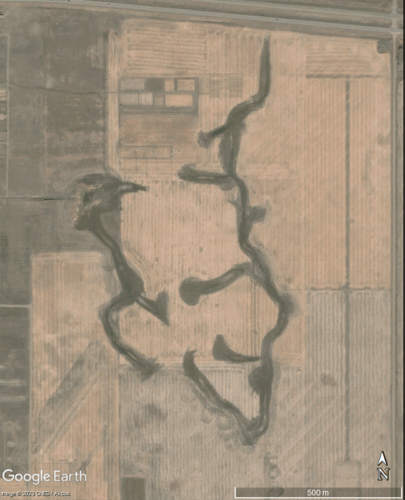
Figure 1: Digital surface model (left) and satellite image (right) of field site following construction of surface ditches conducted in September 2020. Each basin is labelled by number, and boundaries are outlined in black on the digital surface model.
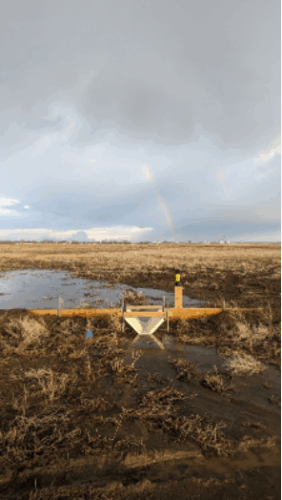
Figure 2: Image of flume installed at the exit location of the surface ditch from the drained depression taken in late spring of 2023.
Study Background
A recent three-year field study evaluated the effectiveness of fertilizer and crop management practices in mitigating phosphorus losses in snowmelt runoff water when implemented as a part of a comprehensive water management strategy within the context of Phosphorus Management in the Northern Great Plains. At a site near Langham, Saskatchewan, Canada, a network of surface ditches were constructed in the fall of 2020 to channel surface runoff from eight depressions in a single field as part of a wetland consolidation project. A satellite image and digital surface model of the site are shown in Figure 1.
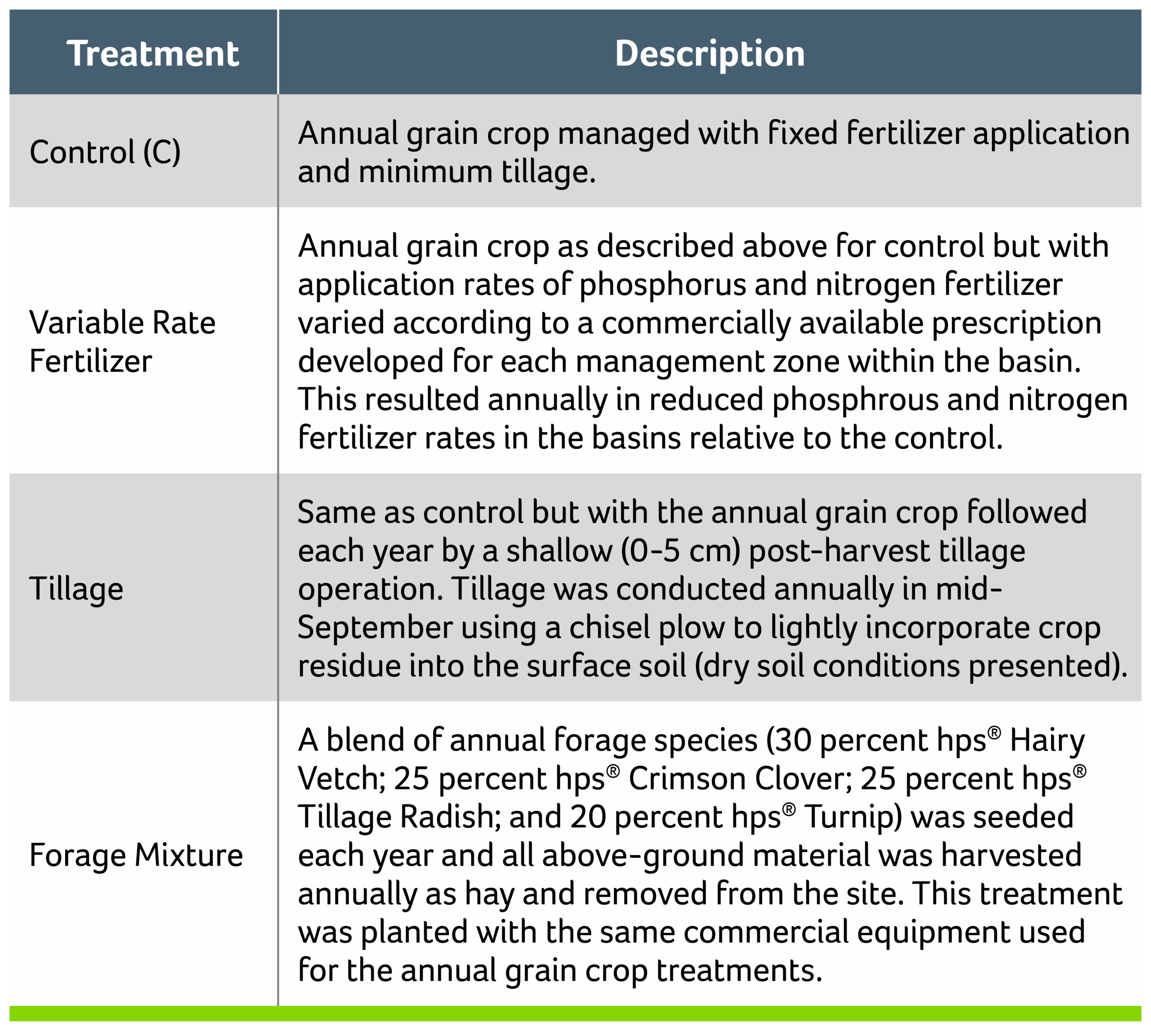
Following construction, four management practice treatments were implemented annually within two of the basins. The treatments included a control treatment of an annual grain crop grown with a fixed fertilizer application rate and minimum tillage, variable rate (VR) fertilizer application (nitrogen and phosphorus application rates reduced by 10-20 percent compared to the control), a light post-harvest tillage operation, and a forage mixture of annual species (see Table 1).
The VR fertilizer, tillage, and control treatments were seeded to an annual grain crop of flax, wheat, and canola in 2021, 2022, and 2023 respectively. The agronomic performance of each treatment was assessed by measuring crop yield, nutrient recovery, and influence on post-harvest residual soil test phosphorus. Environmental performance was evaluated through measuring soluble inorganic phosphorus concentration in snowmelt runoff water from each drained depression (Figure 2).
Table 1:List and description of fertilizer and crop management treatments.
The Results: Agronomic and Environmental Performance
Yield Outcomes by Treatment and Year
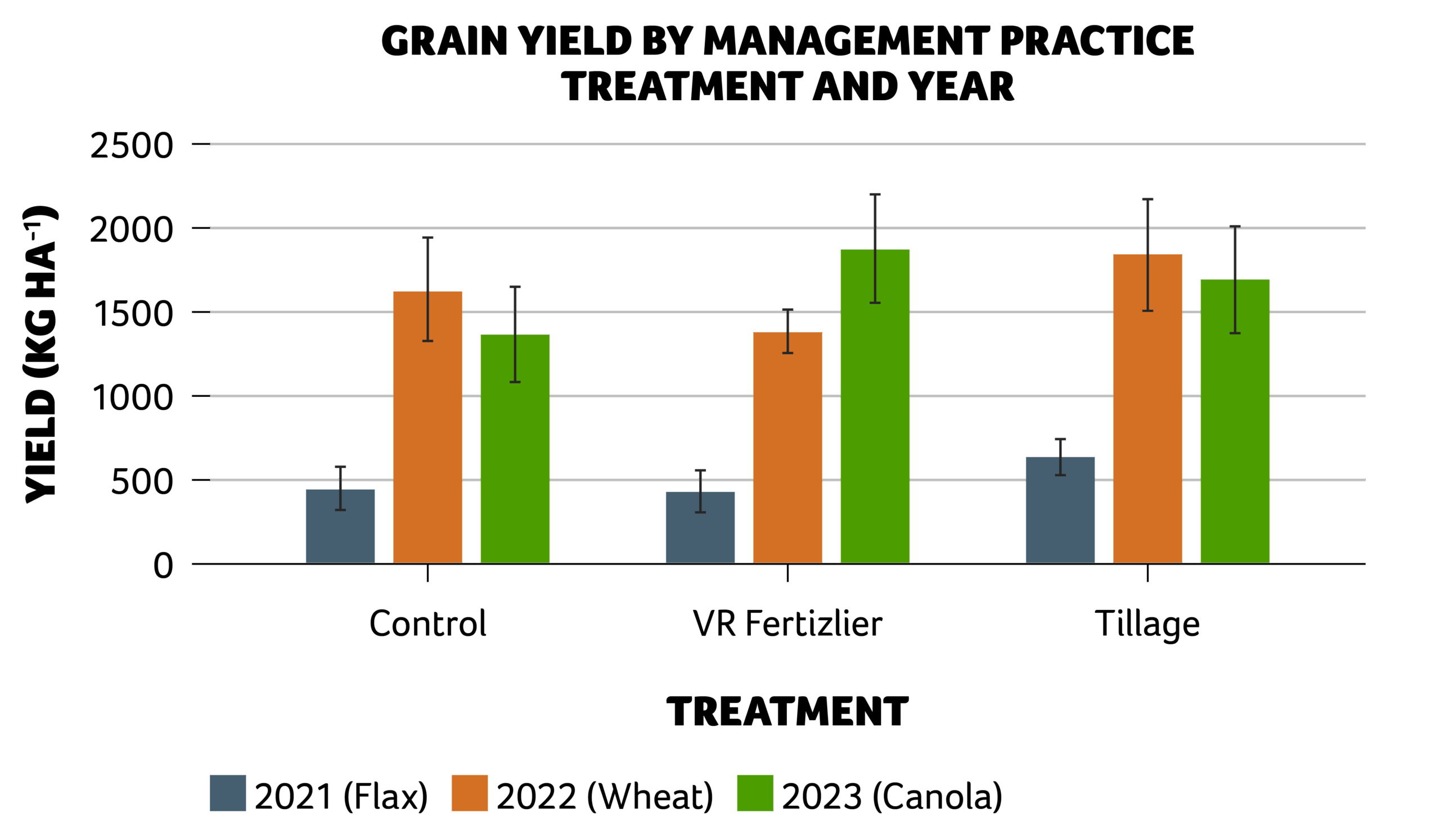
Yield results are presented (by year) for the VR fertilizer, tillage, and control treatments in Figure 3. In each year, grain yield was not significantly different among any of the annual grain crop treatments. Notably, grain yields from the VR fertilizer treatment were not significantly different from the control in any year, despite the reduced annual nitrogen and phosphorus fertilizer application rate of approximately 10-20 percent relative to the control. For Phosphorus Management in the Northern Great Plains, the similar yields of the tillage and control treatments are expected, as the same nutrient application rates were applied to both treatments, and the tillage operation was light and shallow in nature.
Figure 3: Mean grain yield by management practice treatment and year (excluding the forage mixture treatment as yield was not measured). Error bars (see grey lines above the colored bars) are the standard error of the mean of each treatment (n=12).
Phosphorus Losses in Snowmelt Runoff
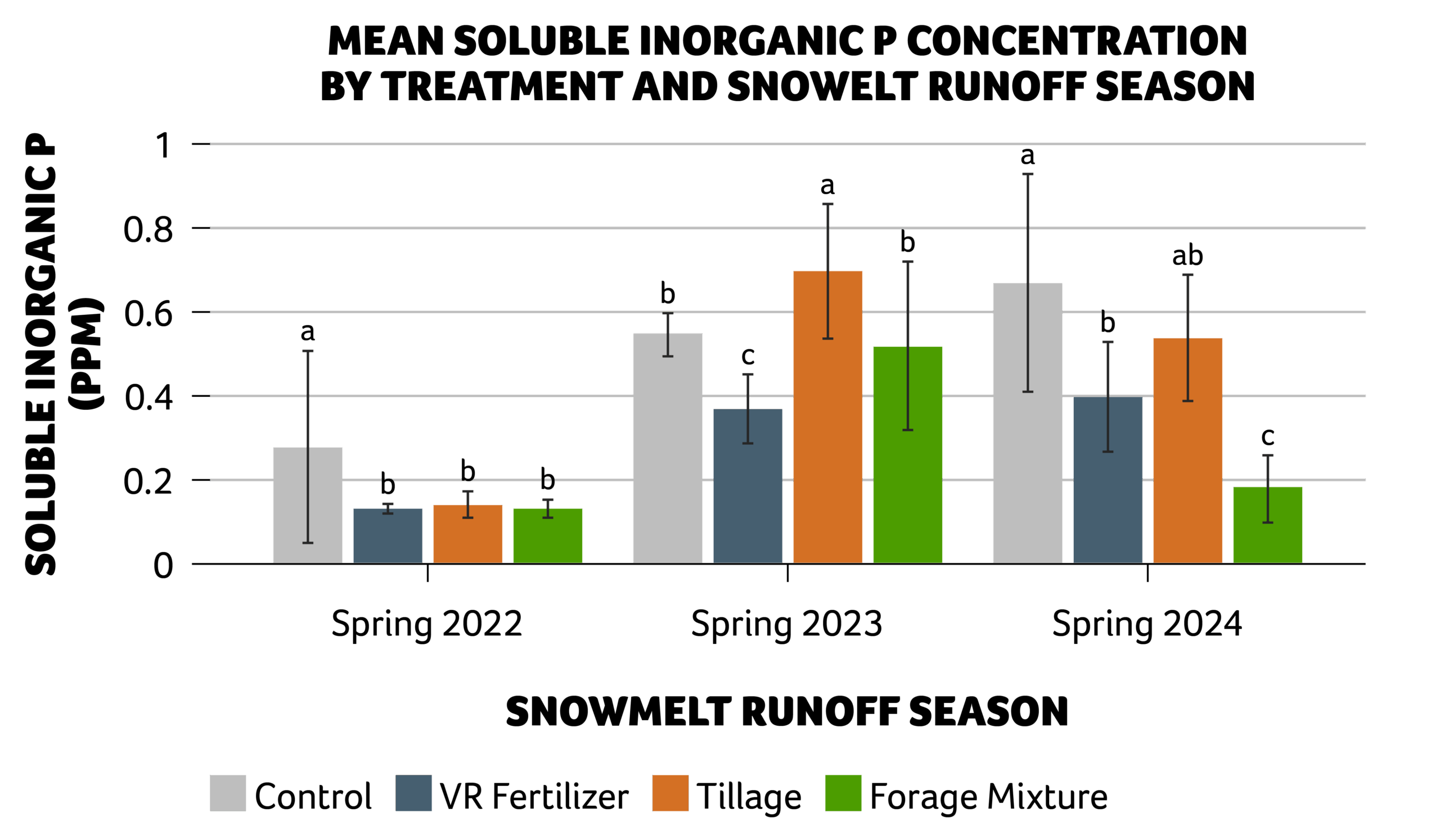
Soluble inorganic phosphorus losses in snowmelt runoff water as influenced by management practice treatment are shown in Figure 4. In each year, soluble inorganic phosphorus concentration in snowmelt runoff was influenced by the management practice treatment used. Notably, the VR fertilizer and forage mixture treatments caused significantly lower soluble inorganic phosphorus losses in snowmelt runoff compared to the control treatment in all three years.
The effect was tied to the reduced phosphorus fertilizer applied to these treatments relative to the control. The tillage treatment was inconsistent and generally ineffective in causing a significant reduction in soluble inorganic phosphorus concentration in snowmelt runoff water. While this treatment was intended to incorporate crop residue into the surface soil and consequently promote soil phosphorus fixation, a more aggressive form of tillage may have been required to consistently achieve this outcome and enhance Phosphorus Management in the Northern Great Plains.
Figure 4: Mean soluble inorganic phosphorus concentration by treatment and snowmelt runoff season. Error bars (see grey lines with the letters a, b, and c above the colored bars) represent the standard deviation of the mean of each treatment. Means within a snowmelt runoff season with a letter in common are not significantly different at the 5 percent level according to Tukey’s Honestly Significant Difference test.
Looking Ahead: Winning Management Practices
In this work, relatively minor (10-20 percent) reductions in phosphorus fertilizer application with VR fertilizer treatment consistently resulted in significantly lower soluble inorganic phosphorus concentration in snowmelt runoff water compared to the control. This environmentally beneficial outcome was achieved with no significant crop yield penalty in the VR fertilizer treatment compared to the control over a short three-year period. Therefore, this study highlights how the use of fertilizer and crop management practices that promote the crop recovery of applied and residual soil nutrients can simultaneously achieve agronomically and environmentally beneficial outcomes, representing a win-win solution for all stakeholders interested in sustainable phosphorus management.
Interested in learning more about phosphorus management? Visit the following resources: