Dr. Karl Wyant currently serves as the Director of Agronomy at Nutrien. In this position, Dr. Wyant contributes proven agronomic leadership in growing the Nutrien commodity and premium fertilizer product lines and promotes advanced sustainability initiatives. Before working at Nutrien, Dr. Wyant served as the Vice President of Ag Science for Heliae Agriculture (2019-2022) and as an agronomist for Helena Agri-Enterprises in California and Arizona (2014-2019). Dr. Wyant earned his advanced degrees at Arizona State University (PhD – 2014) and Colorado State University (MS – 2008). Dr. Wyant is a Certified Crop Advisor and Certified Professional Agronomist (CPAg) and has his CA and AZ Pest Control Advisor licenses. He is chair of the WRCCA Executive Committee for 2022 and 2023. He has received an industry mark of distinction as one of Fruit and Vegetable Growers’ Forty Under Forty.
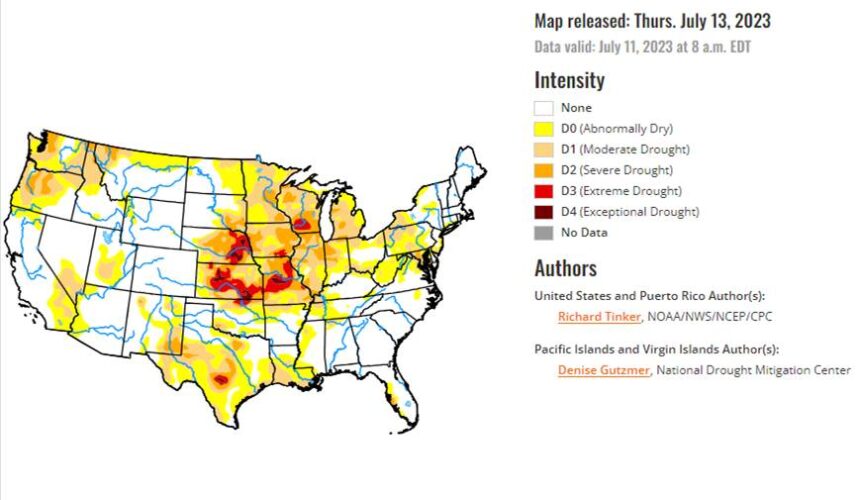
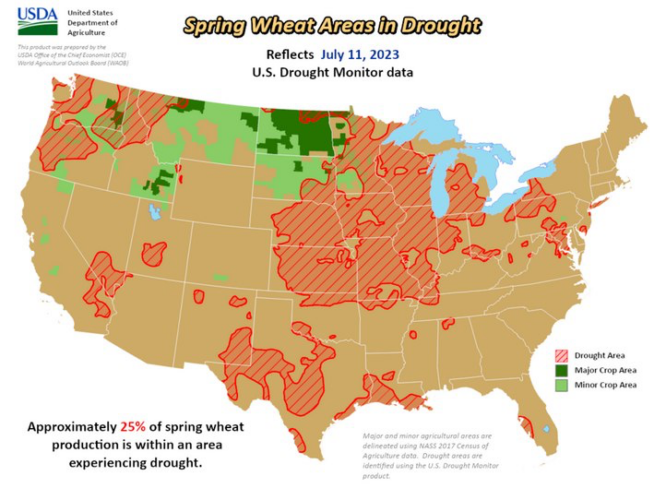
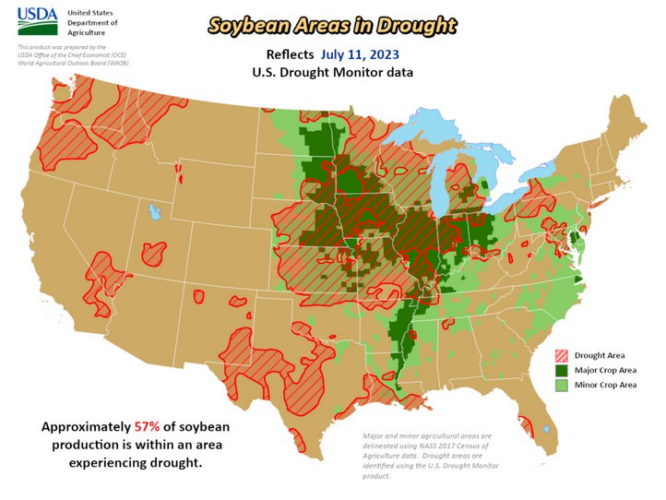
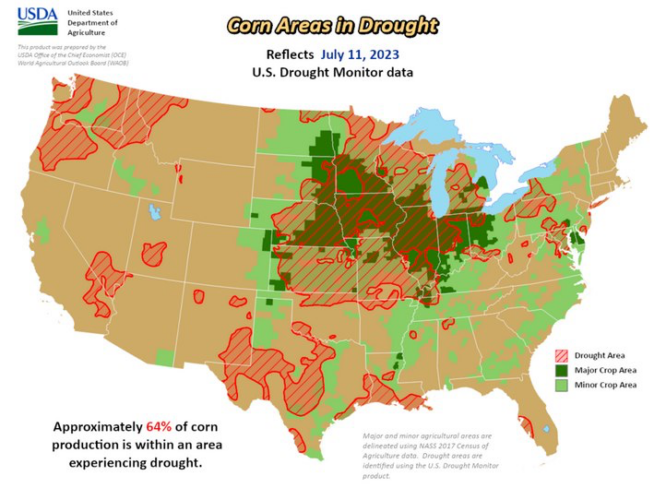
Drought conditions have impacted many growers across the North American crop growing regions (Figure 1). For example, the National Drought Mitigation Center shows drought now covers an estimated 64% of corn, 57% of soybeans, and 25% of spring wheat in the U.S. The impact of drought can be seen clearly in the Corn, Spring Wheat and Soybean Belts, according to recently released figure from the USDA (Figure 2).
Figure 1 – Drought has been a common threat across many crop growing areas in North America during the 2023 growing season. The map above shows drought conditions across Canada, the United States, and Mexico for July 13, 2023. The redder the shade, the worse the drought conditions for that area.
Figure 2 – USDA figures that overlay acres under drought and the major corn, soybean and spring wheat production areas of the United States for July 11, 2023 (Source: USDA).
What is mass flow?
There are three primary pathways that a crop can utilize to pull in necessary nutrients from the soil: mass flow, diffusion, and root interception (Barber 1984). Mass flow refers to the movement of nutrients with the flow of water from the bulk soil to the plant roots. As the crop actively pulls water from the soil to drive photosynthesis and other biological processes, this sets up a natural movement of water from the bulk soil to the root zone, carrying nutrients along with it.
With this much dependence on soil water and moisture conditions prior to acquiring the nutrient, it is easy to see how drought (e.g., dry, hot conditions) can have such a negative impact on nutrient uptake and subsequent yield. However, not all nutrients are impacted the same by drought. We can predict the impact of drought on nutrient uptake by ranking them by the proportion that is influenced by mass flow.
Which nutrients are most impacted?
Table 1 shows that many macro- and micronutrients can be impacted by drought due to the dominance of mass flow as the primary crop uptake mechanism. In the example below, nitrogen, sulfur, and magnesium are macronutrients that are susceptible to “drought induced deficiency” since most of the nutrient is brought into the root system via mass flow. On the micronutrient side, copper, boron, molybdenum, and manganese also have a crop uptake mechanism dominated by mass flow. As a contrast, phosphorus, iron, and zinc are nutrients that are not as dependent on the flow of water through the soil to drive crop uptake.
Table 1 – Macro- and micronutrients arranged by percent of plant uptake occurring by mass flow. The higher the percent uptake by the mass flow pathway, the higher the risk that drought will impact nutrient availability to the crop (Barber, 1984).
Nutrient
Percent Uptake Via Mass Flow
Nitrogen
99
Sulfur
95
Magnesium
87
Calcium
71
Potassium
20
Phosphorus
6
Copper
98
Boron
97
Molybdenum
95
Manganese
80
Iron
52
Zinc
33
*This nutrient is more susceptible to drought induced deficiency.
Conclusion
Drought can have a negative impact on your crop yield from several different mechanisms. Stress response to hot, dry conditions can reduce yield and this is a form of stress that we can personally sense and feel. However, below ground and sight unseen, drought can also cause induced nutrient deficiencies due the impact said conditions can have on the mass flow uptake pathway.
If drought is expected, growers can use tools to reduce evaporation from the soil including crop residues, minimizing runoff, deep watering if irrigating, and by managing the soil to have a good crumbly structure. Soils with good structure are great at capturing rainfall and snowmelt and storing the water for use later by the crop. In some situations, chemical management tools such as soil surfactants and wetting agents can be used to help get more moisture into the group and help promote the optimal mass flow of nutrients to the crop.