Blake grew up on a mixed grain and livestock farm near Shaunavon, SK. He holds a joint role of Applied Research lead at Glacier FarmMedia Discovery Farm and Research Chair at Saskatchewan Polytechnic. Blake obtained a PhD in Soil Science from the University of Saskatchewan working under the supervision of Drs. Jeff Schoenau and Jane Elliott. He is a Professional Agrologist (PAg) with the Saskatchewan Institute of Agrologists and was recognized by the institution as the 2024 Outstanding Young Agrologist. His research focuses on evaluating agricultural management practices and emerging technologies for their ability to optimize water and nutrient use efficiency while limiting nutrient losses in runoff water.
When thinking about sustainable phosphorus management in agriculture, we see an apparent dichotomy. On one hand, phosphorus is a nutrient that is required for all life, including the grain and forage crops we grow. As an important component of biomolecules such as DNA, phosphorus is said to be the energy currency of life and is critically important for early-season crop nutrition to promote robust root growth.
While phosphorus is naturally found in soils, the amount a plant can access is generally insufficient to meet its grain yield potential. This necessitates the application of phosphorus to the soil, largely in the form of inorganicfertilizer or manure, to prevent severe yield loss and support food security. On the other hand, phosphorus that is not used by the crop or does not remain in the soil can be lost from the field in runoff water, eventually entering surface water bodies. This enrichment of phosphorus may negatively impact water quality, leading to eutrophication.
Geographic Considerations
The grassland region of North America is often referred to as the Northern Great Plains. The eastern portion of this area, which generally receives greater annual precipitation than the western portion, is known as the Prairie Pothole Region (PPR) and extends over approximately 115 million acres from south-central Canada to the north-central United States. The region requires unique considerations for phosphorus management given its defining features.
For example, the PPR is characterized by its hummocky topography, where water-shedding knolls and water-accumulating depressions cycle throughout the landscape. The spring snowmelt typically represents the dominant annual runoff event in the region. While snow may represent only 30 percent of annual precipitation here, it may result in greater than 80 percent of annual runoff. Snow accumulates over several months during the winter, and the meltwater is often rapidly released as temperatures rise in spring. Water infiltration may be limited if runoff water flows across frozen soils during the spring snowmelt.
Phosphorus Transport Pathways
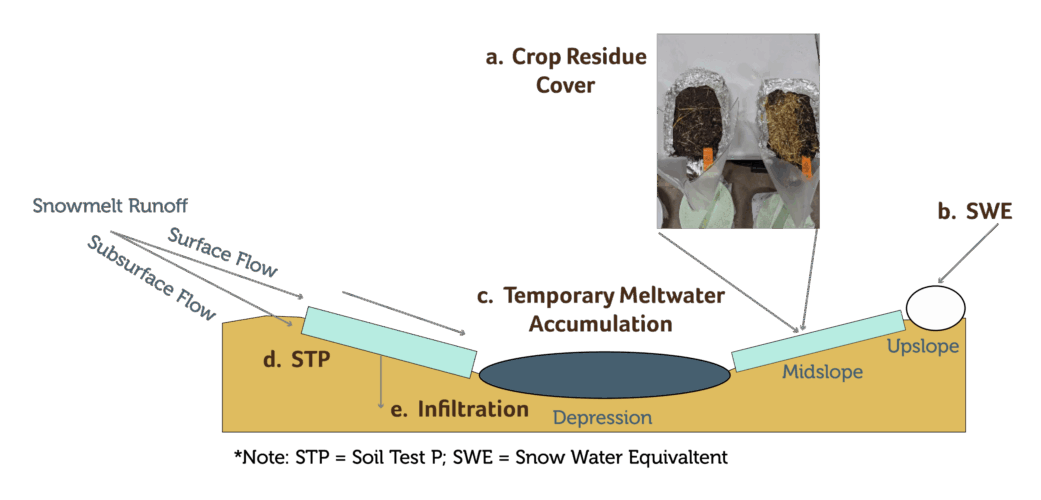
Phosphorus management in the PPR requires consideration of the major phosphorus transport pathways relevant to its characteristic hummocky landscapes, where snowmelt water from upslope portions of the landscape temporarily accumulates in depressions. These major phosphorus transport pathways are shown in Figure 1.
As snowmelt runoff flows across the landscape, the runoff water interacts with crop residue that is spread along the soil surface at harvest, which primarily remains on the surface at the onset of winter under a minimum tillage system. The crop residue contains appreciable quantities of nutrients including phosphorus, which may be released into runoff water as the residue undergoes several freezing and thawing cycles over the winter and spring period.
Similarly, the runoff water interacts with the shallow soil surface layer, where phosphorus may be released from the soil into the runoff water. Where minimum tillage is practiced in the region, phosphorus in runoff water largely exists in the dissolved form. In contrast, particulate-bound phosphorus is the dominant form in runoff water where conventional tillage is practiced. Given its relatively limited mobility in soil, soil phosphorus tends to accumulate in the upper soil surface layer when fertilizers are annually applied in bands and when minimal soil mixing occurs, favoring the potential transfer of phosphorus from soil to runoff water.
Key Factors in Snowmelt-Driven Nutrient Transport
Figure 1. Schematic showing characteristic hummocky landscape of the PPR, along with dominant processes affecting nutrient transport during snowmelt runoff, including a) the amount of crop residue cover, which can be influenced by tillage regime (inset image showing tilled versus minimum tilled land); b) snow water equivalent (SWE), which influences total runoff volume; c) temporary meltwater accumulation in landscape depressions, which may lead to a desire to drain depressions; d) soil test P (STP), which may increase in concentration near the soil surface in a minimum tillage management system; and e) infiltration, which may be restricted or limited when soils are frozen during the spring melt.
Applying 4R Nutrient Stewardship Practices
With these major phosphorus transport pathways in mind, application of 4R Nutrient Stewardship principles is an effective strategy to achieve both agronomically and environmentally beneficial phosphorus management outcomes. This widely recognized framework asks farmers and agronomists making fertilizer application decisions to consider the Right Source, the Right Rate, the Right Time, and the Right Place. While these factors are considered to inform decisions at an individual field or sub-field level, the practices must also align with logistical constraints evident at the entire farm level. For example, a farmer’s planting equipment and the fertilizer products they have access to from their local supplier influences the combination of phosphorus fertilizer source, application rate, placement method, and timing practices that can be practically implemented.
Timing and Rate: Meeting the Crop’s Demand
Simultaneous achievement of agronomically and environmentally beneficial outcomes is often guided by the overarching 4R Nutrient Stewardship goal of matching fertilizer application rate and timing to the crop’s predicted demand for those nutrients. While simple in theory, prediction of a crop’s nutrient demand may be challenging, as many factors other than soil fertility, such as growing season conditions, influence demand. However, the demand will also be related to the soil’s inherent productivity, driven primarily by a soil’s ability to supply nutrients and retain water, particularly under semi-arid conditions prevalent across the Northern Great Plains. Therefore, site-specific prescription of 4R Nutrient Stewardship practices for phosphorus management at the sub-field level may be warranted.
Regarding phosphorus supply, previous work has shown soil-test phosphorus to be highly correlated with topography. Therefore, delineation of soil management zones in the field with consideration of topography and related soil chemical properties may improve site-specific prescriptions of 4R Nutrient Stewardship practices. Regarding water retention, the plant-availability of a phosphorus fertilizer source is influenced by its solubility. Therefore, differences in soil-available water across the hummocky landscape of the PPR has been shown to influence the plant availability of applied and residual soil phosphorus. For these reasons, both phosphorus supply and crop demand for phosphorus will vary both across fields and within a given field on a farm.
Site-specific Adjustment
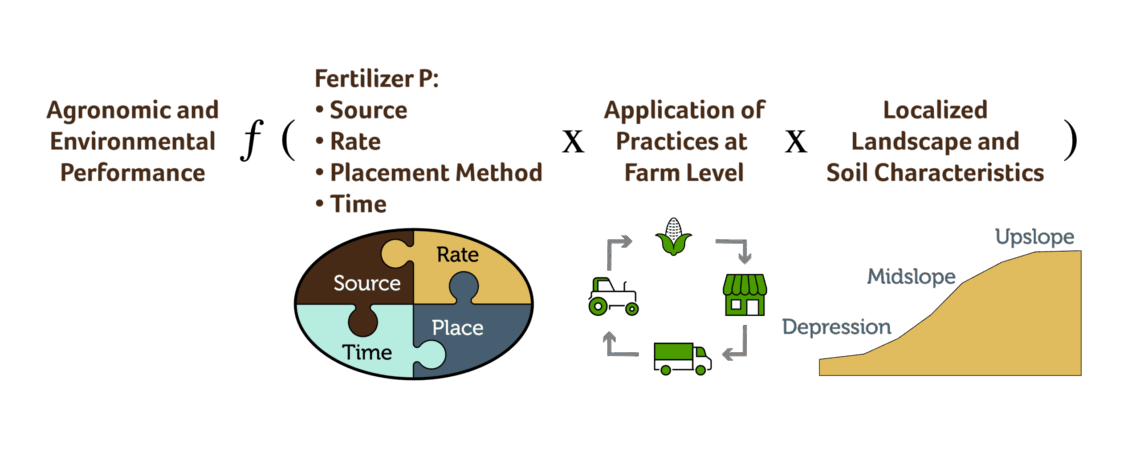
Therefore, the agronomic and environmental performance of a phosphorus fertilizer management practice is a function of interactions among several factors, including the following: 1) the 4Rs of Nutrient Stewardship; 2) farm-level management practices, including equipment configuration, crop rotation, and product availability from a supplier; and 3) localized soil and landscape characteristics, including differences in soil-available water and nutrient supply across the range of topographic positions relevant to the PPR including upslope, midslope, and depression positions. This conceptual model is shown in Figure 2.
Figure 2. Conceptual model to evaluate the agronomic and environmental performance of phosphorus fertilizer.
Conclusion
So, can the farmer and agronomist resolve the apparent phosphorus management dichotomy by simultaneously achieving agronomically and environmentally beneficial outcomes? Recent research has shown that appropriate application of 4R Nutrient Stewardship practices to promote healthy cropping systems can be effective in achieving these dual objectives. Healthy cropping systems are agronomically efficient and environmentally sustainable systems which promote crop recovery of applied and residual nutrients to produce food and other commodities of social and economic benefit and limit nutrient losses, thereby mitigating adverse environmental impact.
Related Resources
Want to dig deeper? Explore the following eKonomics articles to learn more about phosphorus management and best practices for managing this essential nutrient: