Lyle Cowell is based in northeast Saskatchewan, where he has spent his career in agronomy with a focus on better soil management. Lyle has always had the goal of connecting the three points of good research, agronomy extension and farm gate advice and application of soil fertility principles.
There are many reasons that soils have marginal potential for annual crop production, but in Western Canada the primary factor is soil salinity. It is estimated that salinity impacts 2.5 million acres with potential risk to 6 million acres (Wiebe et al, 2006). The area at risk declined substantially with the removal of summer fallow from most crop rotations but encroachment of annual cropping onto previous forage acres and removal of permanent cover of perennial species in low wetlands has triggered renewed salinity in recent years.
Source: Wiebe et al, 2006
Just too much of a good thing
Salinity is caused by excess levels of salts dissolved in soil water. In Western Canada the salts that cause salinity are mainly magnesium sulfate and sodium sulfate, salts that are both common in our soils and have a high solubility. There are often high levels of calcium sulfate (gypsum) and calcium carbonate (lime) in saline soils, but their low solubility prevents these salts from harming plant growth.
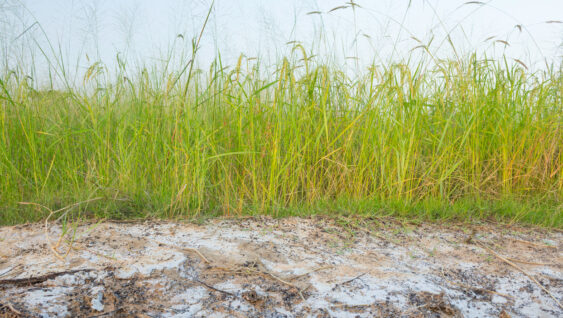
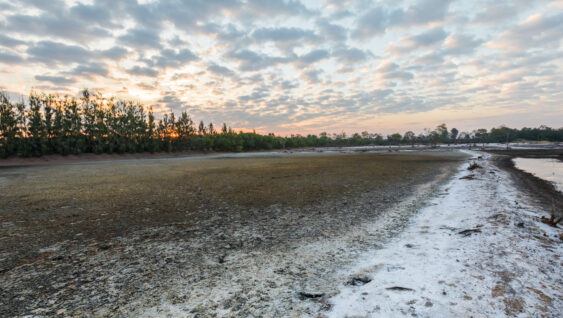
We know that salts can absorb water, and this leads to competition of soil water with plant roots. Even though the soil may be quite moist, the crop suffers from drought. Salts accumulate in areas of a field where water is moving upward in the soil profile. Dissolved salts from the subsoil accumulate on the soil surface and in the root zone of annual crops as water evaporates. Salinity is most often found in low-lying areas of a field but may appear in mid-slopes where soil water is seeping to the surface.
How does salinity affect soil fertility?
Soil salinity in Western Canada is caused by sulfate salts – thousands of pounds of sulfate salts per acre. A soil with only slight salinity that may not even reduce crop growth will even have hundreds of pounds of available sulfur per acre. Nitrogen and other fertilizer nutrients may also accumulate in saline areas if fertilizer has been repeatedly applied above crop potential. Saline soils often have reduced crop yield potential. The combination of high soil nutrient levels and lower yield means that saline soils will require less fertilizer.
Avoid saline areas when you soil sample
In many fields, soil salinity is extremely variable across the landscape, and this will then lead to a wide range of available sulfur to the crop. If you intend to sample a field with just one composite sample, avoid saline areas completely as they will skew your results. If you sample a single location that is saline, it may contain extremely high levels of nutrients, especially sulfur.
For example, if you sample 10 locations in a field, and only one is saline, the individual points may have sulfate sulfur levels of 15, 22, 32, 23, 40, 13, 50, 18, 36, and 2000 pounds of sulfur per acre. The average soil sample would have 225 pounds of sulfur per acre, even though 90 percent would likely require additional sulfur. This would create a high risk of recommending too little sulfur fertilizer on that field. It is very likely that the area with salinity would also have high levels of nitrogen and other nutrients too. One saline core of soil can contaminate an entire sample of a field and lead to lower recommendations and potential yield loss.
Every problem has an opportunity
Fields that do have saline areas offer an opportunity to use variable rate fertilizer application. It is simple to roughly map areas that are saline – if this is the main factor that limits yield in a field then satellite NDVI maps can be used to delineate the saline areas that will not need added sulfur – and of course the non-saline areas that do need sulfur. The first step is to confirm that portions of the field have some level of salinity by splitting the field into two or more zones. An example is below.
If only a random sample were used, the soil test level would be 840 pounds of sulfur per acre, and no sulfur fertilizer would be recommended. In contrast, the ‘green’ area has only 22 pounds of sulfur per acre and requires added sulfur – and this is also the area of the field with highest yield potential and profitability. Adjusting sulfur rates (and perhaps nitrogen rates) would maximize both crop yield and the efficiency of applied fertilizer. We should always manage fertilizer rates to maximize yield on the best soil, and not apply rates that are inadequate for the most productive land, yet excessive for marginal land.
Source: Echelon
Can I fix salinity?
Remember that saline soils have hundreds or thousands of pounds of salts per acre. Otherwise, they are often excellent soils with excellent fertility and structure. The only problem – the salts. There is no product that can be sold to precipitate or remove this much salt. The only solution is to understand the crop potential and manage accordingly. In some cases it is better to seed a perennial forage (or retain the native cover) that can both tolerate the salinity and use the groundwater to prevent the salts from spreading. In a few fields, subsurface drainage with tiles can be used to remove salts, but this requires substantial investment and excess rain or irrigation water to leach the salts away. Again, in most fields it is often better to focus crop and fertilizer management on the best land in a field and not the marginal soil.
Sources:
Wiebe, B. H., Eilers, R. G., Eilers, W. D. and Brierley, J. A. 2006. The presence and extent of moderate to severe soil salinity on the Canadian Prairies (digital map and database at 1:1 million scale). Proc. Manitoba Soil Science Society annual meetings, Winnipeg, MB