




Read Full Transcript
Mike Howell (00:08):
The Dirt with me, Mike Howell, an economics podcast where I present the down and dirty agronomic science to help grow crops and bottom lines. Inspired by economics.com, farming’s go-to informational resource, I’m here to break down the latest crop nutrition research, news and issues helping farmers make better business decisions through actionable insights. Let’s dig in.
(00:38):
Well, hello again, everyone. Glad you’re joining in with us today. Doing things a little bit different on this episode. We have got a potato farmer with us that’s going to talk to us about potato fertility and potato agronomics. But he is in the field already and starting his season. It’s a little late in the day to be recording these. We had to wait on him to get out of the field tonight, so it is a little after seven o’clock my time when we’re recording this. I’ve already had dinner and I just want to take a minute and share with everybody the wonderful dinner I had tonight.
(01:07):
My wife and I went to Perry’s Seafood here in Poplarville. And it is crawfish season here in the South. I don’t know if everybody’s familiar with eating crawfish, but we consider that a delicacy down here and they’re in season right now. We had some wonderful boiled crawfish and when you’re having boiled crawfish, you have to have the boiled corn to go along with that. We had some mushrooms in there, some sausage, and oddly enough, we had potatoes. That’s a staple with any kind of crawfish boiled. So Ryan, we did have the boiled potatoes tonight.
(01:35):
Now, I have had a couple of comments since we started back with season two. I’ve had a couple of people tell me things sound a little bit different. I’m going to tell you why that is. We have had to move the recording studio from my office to my living room. I had an accident a couple of weeks ago and broke my leg and I am not able to go up and down the stairs to my office right now. So we’re going to be recording from the living room for a little while and when I get this leg mended back up, we’ll be back in the studio and things will sound like they did last season. So you’ll just have to bear with us for a couple of more weeks until I can get back up there.
(02:07):
With that, we’ll go ahead and get started with tonight’s episode. Ryan, glad to have you with us. If you will, tell our listeners a little bit about yourself, where you’re from and what you do.
Ryan Christensen (02:15):
Yeah, thanks Mike. I’m Ryan Christensen from Grace, Idaho. We’re a small, little farming community in the southeast corner of the state. We grow potatoes, wheat, feed barley, a bunch of other different crops. I graduated from Brigham Young University with a bachelor’s degree in 2009. I came back to my family farm. My brother and I are fifth-generation farmers and I farm here with my brother and my dad who’s almost fully retired. And so we’ve been growing potatoes since the late ’70s, but since 2018, ’19 we’ve done some innovation where we’ve started to go no-till and reduce tillage in our potato operation. I’ve done a lot of research with nitrogen and water management. And I’m a researcher at heart, but still love to be in the soil and be in the fields growing crops.
Mike Howell (02:59):
One thing I picked up on there, you said you’re on your family farm and your dad is mostly retired now. In my world, when my dad is mostly retired, he can still sit back and tell us everything we did wrong. He doesn’t offer how to fix it or tell us before we mess up, but he’s always glad to tell us what we did wrong. Is that the same way it is in your family?
Ryan Christensen (03:16):
During the busy times of the year? Yes it is, but for the most part, my dad’s amazing, where he lets my brother and I innovate and sits back and just enjoys the show.
Mike Howell (03:26):
I know my dad will be listening and I’m just cracking a joke. He knows better than that. Ryan, if you will, tell us a little bit about your operation. You talked about some of the innovative things you’re doing. Tell our listeners a little bit more about some of those things.
Ryan Christensen (03:38):
Potatoes is a very high-tillage operation. It takes a lot of tillage passes to make the soil prepared to plant potatoes. And when you’re harvesting potatoes the only way to harvest them is to disturb the soil. And historically, we’ve been very high tillage. We’ve tried various different types, deep rippers, high-speed vertical tillage, and in 2018 we bought a no-till drill. We sold almost all of our tillage equipment and we’ve gone completely no-till except for the potato years. And that’s led to some challenges where we’ve had to learn how to deal with taller residue and getting that taller residue into the ground and not plugging up our potato equipment when we go in and remove the potatoes from the ground.
(04:22):
But we’ve been able to do that with crop rotations, adding different crops into our rotation, doing cover cropping to help break up the soil after it’s been no-tilled for two years. On our operation, we’re a split irrigation and dry land. We’re about 50-50 potatoes. In our country cannot be dry-land farmed. I know in places in North Dakota and Canada, potatoes are dry-land, but here with only 11 inches of annual rainfall, potatoes are very heavily irrigated and that’s the only way we can get a crop. As far as innovation goes, potatoes are very similar to corn, but they’re a high-input crop. They take a lot of nitrogen, especially a lot of nitrogen. They use a lot of phosphorus in the beginning of the year and they don’t do well at mining the soil. They just take the soil for everything it’s worth.
Mike Howell (05:13):
You mentioned some of these practises you’re doing and it sounds a lot like an episode we did last season. We had Dr. Carl Rosen from the University of Minnesota on and he was talking about some sustainability efforts and that sounds a lot like what you’re doing is trying to be more sustainable, and protecting the environment, and protecting your soil for generations to come.
Ryan Christensen (05:29):
Yeah, exactly, Mike, that’s what the whole goal is. I know sustainability is different to everybody. I remember, I listened to that Carl episode and a lot of the things that he said, I resonated with, that things that I’ve applied and tried to do on my farm. To me, sustainability is what you just said, trying to preserve the soil, trying to keep it from blowing away, keeping my good top soil there, reducing my inputs, managing my water.
(05:57):
Water’s a natural resource that we only have so much of. And if we can make it so that the ground retains the water and holds the water so I can apply less and still maintain the quality outputs that I get and I need to farm and be successful, then to me, that’s what sustainability farming is. And everything I do is based around that. Am I going to be able to reduce my inputs and still maintain or increase my outputs?
Mike Howell (06:24):
That sounds great, and that’s a lot of the things we tried to bring forth in our sustainability series last year. Glad to hear you say that from a different perspective. Ryan, I have very little experience with potatoes. In fact, it goes back to when I was a kid growing up and we grew potatoes in the family garden here in Mississippi. And my dad would get us out there. We would get the soil prepared and we’d start putting out those potato eyes. And he would always fuss at us, “You got to put that eye upright. And if you plant that eye down, the potato will grow down. It won’t come up.” Now, I’ve had enough education now that I understand that that’s not exactly right, but tell us a little bit about how you plant these potatoes.
Ryan Christensen (07:00):
Planting potatoes begins long before the potato planter hits the field. As soon as our fall crop is off in September, whether that’s barley, mustard, wheat, oats, flax, we’ve put potatoes behind almost everything. We have to till the ground to prepare the ground at least down six, seven inches. We don’t till as deeply and as fine as we used to. We have a lot of residue. We use a stripper header in all of our grains, so our stubble’s quite soft. And we try to chop that and work that into the top eight inches as best we can in the fall of the year. And then in the spring, once the grounds had a chance to absorb the winter moisture and to freeze and thaw and expand, kind of mellow that soil out, that soil profile, then we have very specialised equipment that go and put the potatoes in the ground.
(07:52):
And there’s two different ways the potatoes are planted in the potato industry. There’s whole-seed planting and cut-seed planting. That is just what it sounds like. Whole-seed is guys that just buy the whole potato and then the potato gets put into the ground and covered up. It has a seed, what we call the seed shoe, that opens the ground up, kind of like a digger point. And then various different methods of the potato getting dropped into the ground and then some hillers that throw four or five inches on top of the seed piece. And then where the tractor drives is then cultivated a little bit so that the wheel tracks and everything aren’t there so the water won’t run, so that the water can stay in between the hills and soak into the ground.
(08:37):
The other method is everything’s the same except the farmer will cut the seed. And that way you can cut the seed into multiple different pieces and just like you said, it definitely doesn’t matter if the eyes are up, or down, or sideways, or whatever. The stems are going to find the sun and the roots are going to find the soil no matter how it’s placed in there. We’ve been a cut-seed operation my entire life, but new for 2023 is we’re going to a whole-seed planter. We grow seed potatoes, so our potatoes are planted, raised, harvested, and then our potatoes are sold to other potato farmers who plant, raise, harvest. And then their potatoes are the ones that find it to your crawfish boil plates or your french fry box.
(09:23):
So because we’re seed potatoes, we have a lot of pressure to stay disease free. And that’s why we’re going to the whole-seed planter, ’cause just like your body, you just mentioned your broken leg, if we have a wound, that’s where disease is going to enter our body. We’re going to this whole-seed method where we’re not going to be cutting the seed. Yes, we’re going to have to buy more potato seed to make up for that difference, but we’re hoping that we can reduce our disease pressure, reduce the damaged spots where diseases can enter the seed pieces and eventually, grow a healthier, more productive crop by doing that.
Mike Howell (10:00):
Well, that’s pretty interesting. I did not realise that people would plant the whole potato like that, so that makes sense that you can do that. The next thing I remember about the garden and growing potatoes is when those potatoes started coming up, we always had to go in there and take a hoe and bring the dirt back to them. We had to make sure we kept the dirt pulled to them. Is that something that y’all still have to do?
Ryan Christensen (10:19):
We do it once a year, as soon as we plant. And we usually go a couple weeks, mainly because we’re trying to get everything else done on our small greens and oil seed crops. But we usually come back within a couple weeks of planting and we have a potato hiller cultivating machine that we call it that has a shank that goes in between the rows where the potatoes were planted and then it has a giant mechanism on the back. We call them paddles. It’s like a spoked wheel, but instead of having a ring attached, it’s just very open and kind of just plugs into the ground as it rotates. And it makes little pockets.
(11:00):
The shank goes through and throws dirt up on top to give it a little bit more cover. And then these paddles make little pockets where water can sit. And we do that one time and then we’re done. After that, we spray our herbicide and any remaining fertiliser. And then it’s just keep them wet, and keep them happy, and disease-free till harvest time.
Mike Howell (11:20):
Sounds simple enough, or you make it sound simple anyway. I’m sure it’s a lot more complex than that.
Ryan Christensen (11:25):
It is a lot of time.
Mike Howell (11:28):
Let’s talk a little bit about fertility. I think I just picked up on what you said. You put out a good bit of your fertiliser upfront and then you’re coming back and top dressing with a little more. Walk us through a fertility programme, what we need to do as far as fertiliser.
Ryan Christensen (11:41):
Historically, we potato farmers will go in between that fall tillage and planting and put, based on a soil test, a phosphorus, potassium, sulphur, maybe some micro packages depending on the soil test. And then when they go to plant, the planters are always set up with a in-furrow application by putting that fertiliser a few inches below into the side of the seed piece so that the roots can go out and get that. And that too is another application of phosphorus, potassium, micro package. Usually a microbiology, like a humic or some type of a microbiology product that will, especially in our soils, where we’re very high pH and phosphorus is very easily tied up in the calcium in our soil.
(12:29):
And then you’ll come back through, usually in between that planting and that hill cultivation, and do a broadcast of a nitrogen. Historically, on our farm we would do about 50% of the nitrogen needs and then throughout the season we would take tissue samples about once a week for six weeks and then we would spend our summer chasing injection pumps by injecting fertiliser through our irrigation systems all summer long. And that would range from 30 pounds of nitrogen to 50 pounds of nitrogen depending on the pedials.
(13:06):
Recently, with our innovations and through doing collaborative research with Brigham Young University and University of Idaho and Utah State and several grad students, we’ve gone away from that fertigation method and we’ve gone with a hundred percent upfront of ESN, but would work with any type of poly-coated urea that we put up a hundred percent and cultivate and let it go. And we’ve done that for three years. We’ve improved our yields. And we’ve decreased a little bit of our nitrogen usage, not much, but we’ve improved our yields and seeing a better response in the crop following the ESN application, mainly because all of our nitrogen’s not being leached or not being volatilized to the atmosphere, like it was when we would be fertigating or doing other methods.
Mike Howell (13:58):
That’s a great point that you’re able to protect that nitrogen. That’s something hat we’ve spent a lot of time talking about on this programme is protecting that nitrogen and making sure it’s getting into the plant so it can be utilised and we’re not losing it through volatilization or leaching or denitrification. Glad to hear that you’re protecting that nitrogen and getting the most out of that fertiliser dollar. Now, I’ve already told you I don’t know much about potato fertility, but one thing I think I’ve picked up on over the last few years is you don’t want to get too much nitrogen on those potatoes and you kind of want them to run out at the end of the year. Is that right?
Ryan Christensen (14:30):
Absolutely. If you put too much nitrogen on, the potato will actually go to too much foliage. And unlike all your other crops, where your foliage is what you want, you want that nice balance between tuber development under the ground and foliage development. And you have to kind of time it. So yes, they run out at the end. Or else, in the potato industry, we call it tuber bulking, where we want that potato to start bulking up and sucking the life out of the plant and so that the nutrients move from the plant into the tuber. And that’s where you get your blockier size and really your yield, because your tuber count is set by that time of year, but then the tuber size and quality is really made in that last two, three weeks. And if your fertility isn’t in a really good balance that could make or break your operation.
Mike Howell (15:19):
I didn’t realise it was that critical, but sounds like that’s a pretty important piece in the potato world. So we’ve got this crop in the ground. We’ve got it fertilised. You mentioned that you put out your fungicides and herbicide applications. Tell us a little bit about the harvest operation. That’s something that I’m not familiar with at all. I would love to get up there this fall and see how y’all harvest those potatoes, but walk us through the harvest operation.
Ryan Christensen (15:42):
The harvest operation is very labour-intensive and there’s multiple different ways that potatoes can be harvested. If the end product is what we call a process grade, now, in seed world we harvest them all the same. But for the commercial side, that’s actually going to make it to your plate. If the potatoes going for a process, say like your boxed instant potatoes or your frozen hash browns, something where the visual aspect of the potato isn’t as critical, they will actually green dig.
(16:13):
That’s what we call green digging the potato, where the foliage is still green. And they go in and the machine goes into the ground and pulls the potato up. And all the soil, eight inches and down, is coming up out of the ground with specialised harvesting equipment that moves it over conveyor belts, and shakers, and vibrators, and finger rollers, and all sorts of different mechanisms to shake that dirt, kind of like a sieve, to shake that dirt through the machine to leave the soil in the field and that the potatoes can make their way to the truck.
(16:43):
All other methods, whether it’s seed or whether it’s a fresh potato farmer, we will go in and we chop the vines. We use a shredder, kind of like a stubble shredder, that will go in and even though the foliage is green, it just shreds it right down to the ground. And then we’ll use a desiccant product or sulfuric acid depending on availability and what products are available for the year that will really just melt that foliage down to the ground, because we want the skin of the potato to start to age. And that way when it’s harvested, it doesn’t get skinned and doesn’t get bruised. And just like I said with the whole seed, if you bruise a potato, that’s where its weakest point, where the disease is going to get in.
(17:24):
We shred them about a month before harvest and then we let them sit and mature in the ground. And then we use the same equipment as the green digs, where we go into the ground, dig them up, all the soil comes out. They’re loaded into trucks, and then the trucks are hauled to potato sellers or storage sheds, where once again, they’re unloaded and they go over several different conveyor belt systems to once again be shaken, and bounced, and stirred. And then we have manual labour there to visually inspect the potatoes to remove any clods or foreign material before going into storage.
(18:03):
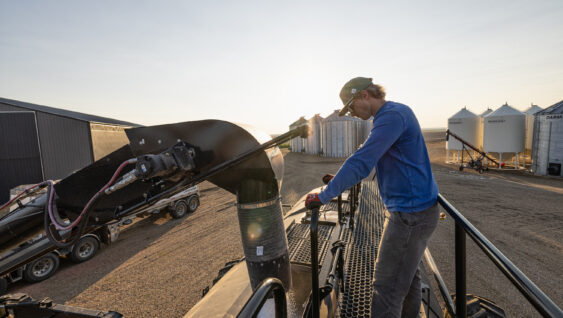
Our operation is a fairly small operation. We run about 600 acres of potatoes. This whole process, we do about a hundred loads per day, which is equivalent to about 200,000 pounds a day, is what we’re hauling out. It takes a crew of about 30 people. And we start about seven in the morning and go to about nine or 10 at night for those 10 days to get the harvest in.
Mike Howell (18:28):
I had no idea there was that kind of volume of potatoes coming out of a field. That’s astonishing to me. Let’s talk a little bit about storage. And you may not be an expert on the storage part of it, but how are the potatoes stored? I know some of them have to be stored for several months before they get to the consumer. How do we go about storing those potatoes?
Ryan Christensen (18:46):
The potato storage is a very high-tech system where depending on your location, if you’re in the South, where you are, the potato storages will most likely have refrigeration systems where they can keep the potatoes at a set temperature. If the potato is going to an end user like yourself, it will be kept at anywhere from 45 to 50 degrees. If it’s going to be a potato chip, they want it in that 48 to 52 degrees so that when it goes out of a storage into a frying pan, it fries at the right colour and it keeps the starch and sugar levels at the right balance. If it’s a fresh potato, it can be stored a little bit on the colder side. For us, seed potatoes, they’re stored at 38 to 40 degrees, because we don’t want them to break dormancy until they’re ready to be planted the next year.
(19:33):
If it’s in a hot climate or if they’re going to be stored for a year through a hot climate, they’ll have a refrigeration to keep them at that temperature. We were at five below zero this morning. Keeping them cold is not a problem. We have a system where it pumps air through the floor. There’s ventilation systems in the floor that allows the air to be forced through the pile. And we don’t have a refrigeration, but our systems will keep the humidity level at the right humidity as well. We have humidicells that will pull humidity out and we have humidifiers that will push humidity in. Because potato is very much water, and so if you don’t keep the humidity at the right level, it will shrink just like a corn, or a weed, or anything. And you don’t want that shrinkage to hurt your yield, your sold product.
(20:24):
Shrinkage and storage is part of the game, but you try to keep that at 5% or less. And to do that, you’re constantly monitoring them all winter long to make sure that the humidity levels stay right and the temperatures stay right. If it gets too hot, they’ll break dormancy and they’ll start to sprout in storage. If it gets too cold, they could freeze and start to break down in storage.
Mike Howell (20:45):
It sounds like a full-time job for multiple people to keep that operation running. Ryan, I’m in south Mississippi. It was 84 degrees today and I’ve mowed my yard twice already this year, so a little different than where you are.
Ryan Christensen (20:57):
Yes, yes, it is.
Mike Howell (20:58):
Ryan, we’ve talked a lot about potatoes and how they go from putting the seed in the ground and the requirements they need. And one thing I thought about during our conversation, this probably should have been something we mentioned right at the very beginning, but talk a little bit about the different kinds of potatoes. I’m familiar with the red potatoes that we grew in the garden. But I go to the store and I buy the big white potatoes for bacon potatoes, and I know there’s all different types. So if you would, take a minute and talk about the different types of potatoes and what they’re used for.
Ryan Christensen (21:24):
Oh, wow. That could be a whole conversation of itself. There’s so many different kinds of potatoes and every potato is bred for a different purpose. And your red potatoes are good for boiling, good for if you want to just throw them in the oven and put them with some oil and some onion or a crab oil, as you talked about. There’s yellow potatoes that are good for french fries or same thing, for boiling, depending on which kind of colour you’re going for. The standard is the Russet Burbank. That’s the potato that’s king. That’s the number one variety grown in the United States and definitely in the state of Idaho. And that’s kind of a universal potato. It’s not the best any one particular thing, but it can be used for anything and that’s why it’s so popular.
(22:09):
But then they have potatoes that are strictly for french fries. They grow long and are grown at the length that it looks good when it’s cut up into a fry when it sticks outside the box. And then there’s specific varieties that are grown for potato chips. On my farm, I have several chip varieties and each chip variety has its own little thing too. They have their own fry point. And they have their own storage temperature so that they can meet the year-round demands for potatoes, America’s number one favourite vegetable. And it’s the most diverse food, and that’s why it’s on about 82 to 83% of the menus across America.
(22:45):
When you go to a store and you see all of them, depending on what you want your recipe to be, whether you’re baking it, boiling it, frying it, grilling it, mashing it, whatever it is, they’re selling them for a specific reason. So it really does matter when you go to a store to pick out the variety. I have about nine different varieties. I also grow some fingerling varieties that look like fingers. And they come with red, and purple, and yellow, and all sorts of different colours. And when we eat potatoes during the winter, I bring home different ones depending on what my wife and I are cooking that night.
Mike Howell (23:18):
Ryan, growing up, we grew the potatoes in the garden and I would not go sit down at the table if mama didn’t have some kind of potatoes on the table. That was a staple in my house and I refused to eat supper if we didn’t have potatoes on the table of some kind. And I’m still that way to a great extent today. I love potatoes and love to eat them.
Ryan Christensen (23:34):
Well, good.
Mike Howell (23:35):
Ryan, we appreciate you being with us tonight. Is there anything else that we’ve missed, something else you want our listeners to take home before we wrap this up?
Ryan Christensen (23:42):
I’m grateful for this opportunity to share. I love listening to your podcast since you’ve started this, because I love learning about other crops. I grow a lot of small greens and oil seeds and potatoes, but it’s completely different from corn, soybeans or the different things that you grow in the South. So I love the podcast. And I feel like as people in the ag world, we need to learn about what others are doing and not just live inside our box, because that’s what’s helped me innovate is listening how guys do things in Mississippi, to Iowa, to California, to Canada. And if we’re not learning, then what are we doing?
Mike Howell (24:13):
That’s exactly right. Well, I appreciate you listening to the podcast. It’s hard for me to know exactly who we are reaching from time to time. I can see a number of people, but that doesn’t tell me where these people are or what they’re actually doing for a living. Glad to hear you’re enjoying it and that you’re listening to it and farmers are getting the message that we’re trying to get out. I’m really hoping that through all of this, you’re growing potatoes, but maybe you can pick up something from one of our cotton programmes that you could apply in the potato world.
Ryan Christensen (24:37):
Absolutely.
Mike Howell (24:38):
If that’s happening, we’re definitely meeting our goals here.
Ryan Christensen (24:41):
Yes, and that’s what I love about the podcast is being able to listen and hear, learn from others.
Mike Howell (24:46):
Ryan, once again, we appreciate you joining us tonight. We’re going to wrap up the portion of our programme talking about potatoes and move on to our next segment now.
(24:53):
Listeners, if you’ve been tuning in, you know that this season we’re talking about famous agronomists or famous people in the world of agriculture. And today we’re going to talk about a gentleman that if you have ever taken a soil fertility class or a basic soils class, you have heard this name, Dr. Justus von Liebig. Now, he is best known for Liebig’s Law of the Minimum and the staves in the barrel. I’m sure everybody has seen that. But Dr. Liebig was a chemist. He made significant contributions to analysts of organic compounds in the application of chemistry to biology and agriculture. He’s widely credited as one of the founders of agriculture or chemistry, and he has written several textbooks.
(25:34):
He discovered that nitrogen was an essential plant nutrient and presented his famous law of the minimum, which explained the effects of individual nutrients on crops. He’s described as the father of the fertiliser industry for emphasis on nitrogen and trace minerals, especially in plant nutrients. There’s a great list of things that he accomplished. Dr. Liebig had many great accomplishments, but one of the other things that he worked on was the belief that searing meats would help seal in the juices and help with the nutrition. That was proven to be true many years after his death, but he is credited with that idea.
(26:07):
And another thing is he developed a process for beef extracts. And with his consent, a company called Liebig Extract Meat Company was founded to exploit the concept. It later introduced a brand of beef bullion cubes, that is still, as I understand, it’s still being used today. Dr. Liebig has done a lot of work for agriculture and a man that we owe a lot of G gratitude to for our understanding of how these nutrients work in the system and how we have to have each one of these nutrients, not just a total package. We have to have each one at the right levels in order for the crops to produce like we want them to.
(26:41):
Listeners, we want to thank you for joining in again this week, and we’ll be back next week with another exciting episode. Until then, this has been Mike Howell with The Dirt.