Cristie L. Preston, Ph.D., CCA
Summary of what you'll find
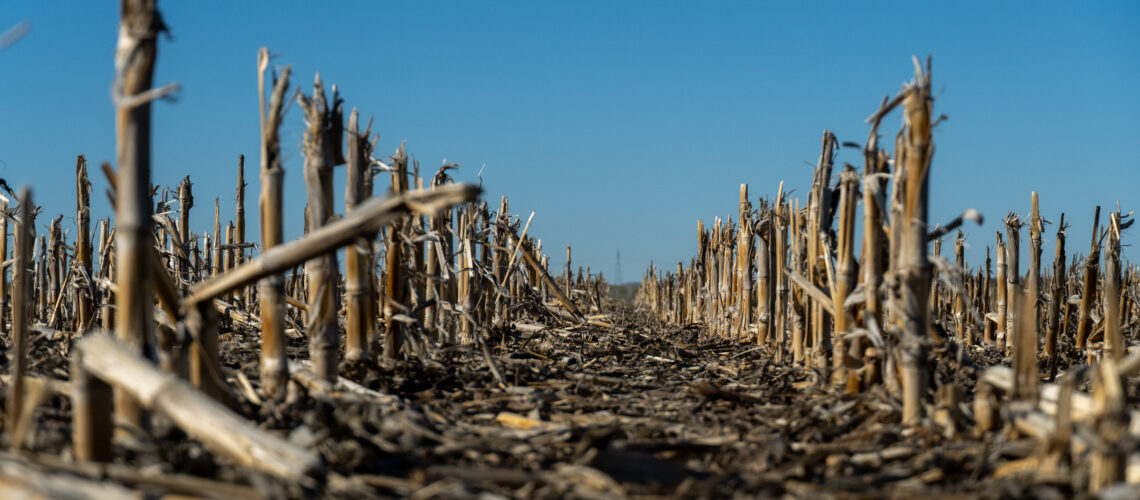
Long-term no-till does predictable things to soil potassium distribution. Broadcast potassium applied to the surface stays near the surface. Without tillage to incorporate and redistribute it, potassium accumulates in the top two to three inches of the soil profile while concentrations in the four-to-eight-inch zone – where the majority of corn and soybean root activity occurs during grain fill – remain static or decline. After a decade or more of no-till with surface-broadcast potassium, the stratification pattern is consistent and measurable.
The agronomic question is whether that pattern costs yield. The honest answer is that it depends. Potassium stratification matters more in some soils, in some environments, and in some growing seasons than in others.
The management response should be calibrated to the specific situation, soil type, and subsoil potassium level, not applied universally because stratification exists.
How potassium stratification develops
Potassium moves through the soil primarily by diffusion. Diffusion is slow under any conditions, moving millimeters per day in the field.
In a tilled system, broadcast potassium is incorporated mechanically into the tillage layer, distributing it through six to eight inches of soil and placing it within diffusion distance of actively growing roots throughout the profile.
In a no-till system, broadcast potassium stays where it lands. Rainfall moves it minimally on medium and fine-textured soils where it binds tightly to the exchange complex. The net effect over years and decades is a steep gradient – high potassium at the surface, declining sharply with depth.
A representative stratification profile from a long-term, no-till field in the Corn Belt might show soil test potassium levels of 180 to 220 parts per million (ppm) in the zero-to-two-inch layer, 130 to 160 ppm in the two-to-four-inch layer, and 90 to 110 ppm in the four-to-six-inch layer. If that field is sampled using a standard zero-to-six-inch composite, the average across all three zones may be 130 to 150 ppm (adequate by sufficiency criteria), while the subsoil zone where roots feed during reproductive growth reads below the critical level. The composite sample is not wrong; it is just answering a different question than the one that matters.
Broadcast potassium versus deep-band potassium
The agronomic community has been debating the yield consequences of potassium stratification in no-till systems for over 30 years, and the research remains genuinely mixed. This is not a diplomatic hedge; it reflects real variability in outcomes across environments, soils, and growing seasons.
Studies from Ohio State, Purdue, and Iowa State comparing broadcast potassium applications versus deep-banded potassium applications in long-term no-till systems show yield responses to deep banding that range from 10 to 20 bushels per acre in corn in some environments to statistically indistinguishable from broadcast in others. The trials showing the strongest responses share common characteristics: soils with moderate to low cation exchange capacity (CEC), growing seasons with significant mid-season drought that restrict root access to the moist surface zone, and fields where stratification has pushed subsoil potassium below the critical level. Remove any one of those conditions and the response to deep banding weakens or disappears.
The trials showing no significant difference also share common characteristics: high-CEC soils with substantial native potassium reserves in the subsoil, growing seasons with adequate and well-distributed rainfall supporting root activity throughout the profile, and fields where stratification, while present, has not pushed any zone severely below critical.
The risk of stratification in no-till systems
Potassium stratification in no-till is a risk factor. It increases the probability of yield loss in drought years and on lower-CEC soils.
But it is not a guaranteed yield drag that justifies remediation on every acre. Deep banding will not always deliver the same return on investment (ROI) and should not be over-recommended simply because stratification exists. At the same time, we cannot overlook stratification when composite samples read adequately as there is still a risk of potassium limitations under various conditions.
When potassium stratification actually matters
Three conditions, in combination, elevate potassium stratification from a theoretical concern to a practical yield risk.
The first is subsoil potassium testing below the critical level. The critical level for potassium in most Corn Belt states falls between 90 and 130 ppm by ammonium acetate extraction, with Iowa State placing the critical level for corn at approximately 130 ppm and Purdue’s Tri-State guidelines using similar thresholds. If depth-incremental sampling reveals that the four-to-six-inch zone tests below 100 ppm, while the composite reads adequate, the stratification pattern is severe enough to warrant management attention regardless of growing season conditions.
The second condition that elevates the yield risk of stratification is coarse to medium soil texture with low to moderate CEC. Stratification matters more on soils with limited buffering capacity. A silt loam soil with a CEC of 12 to 15 milliequivalents (meq) per 100 grams supplies potassium at rates determined largely by what is in the diffusion distance of active roots at the moment of uptake. A silty clay loam with a CEC of 22 to 28 meq has enough exchange capacity to supply potassium from deeper subsoil reserves, even when surface concentrations are high. In simple terms, higher CEC buffers against stratification effects while lower CEC amplifies them.
The third and final condition that elevates the yield risk of stratification is fields with a history of mid-season drought stress. This is because potassium uptake depends on root access to soil moisture. During dry periods, the surface two to three inches, where stratified potassium is concentrated, desiccates first and most severely. Roots in dry soil cannot take up potassium regardless of how much is present. Fields with documented histories of mid-season moisture stress, or in geographies where July and August drought is a regular risk, face elevated potassium supply limitations during key growth stages — grain fill in corn and seed fill in soybeans — when potassium demand is highest. If the same field shows up soft on the yield map every dry year, and solid in wet years, stratification is worth investigating before assuming it is a hybrid or a soil type issue.
Three management responses with honest tradeoffs
There are three common management options for potassium stratification.
Deep banding potassium
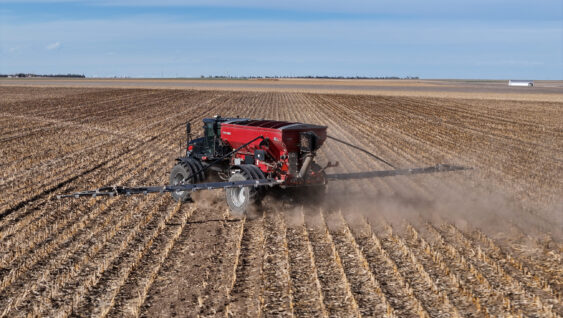
Deep banding places potassium in a concentrated subsurface band — typically four to six inches deep — that delivers potassium directly to the zone where roots are active during reproductive growth. It bypasses the stratification problem rather than solving it.
But the limitations are real. Dedicated deep-banding equipment adds capital costs that require enough acres for the investment to make economic sense. It is a slower operation than broadcasting, constraining the acres covered in a planting window. Plus, deep-banded potassium supplements subsoil availability without rebuilding the surface-to-subsoil balance – the stratification gradient remains. Deep banding manages the symptom, but it does not cure the condition.
Adjusting to periodic tillage
Periodic tillage, a single pass with a disk or chisel plow after years of no-till, mechanically redistributes accumulated surface potassium into the tillage layer. Illinois State University and University of Illinois research shows a single tillage event on long-term no-till ground can measurably reduce surface potassium concentrations and increase subsoil concentrations with effects persisting two to three years before the no-till stratification pattern re-establishes.
But again, the tradeoffs are significant. Tillage on long-term no-till operations can alter soil structure that took years to develop. It temporarily increases erosion risk, disrupts earthworm populations and macropore networks that support water infiltration, and may mobilize weed seed banks that no-till management had suppressed. Periodic tillage to address potassium stratification is defensible when stratification is severe, subsoil potassium is critically low, and deep-banding equipment is not available. But it is not a management strategy to recommend without clearly communicating the tradeoffs.
Changing your potassium application timing
Adjusting your application timing is one of the lowest-cost and most accessible responses to potassium stratification, and it is often underutilized. Fall application of broadcast potassium on no-till ground allows winter freeze-thaw cycles to facilitate some downward movement from the surface application zone. Not deep movement, but enough to moderately reduce the steepness of the stratification gradient compared to spring applications immediately before planting. On fields where deep banding is not practical and periodic tillage is not warranted, fall broadcast application is a low-cost improvement that accumulates agronomic benefits over multiple years. It will not eliminate stratification, but it slows the progression, and in lower-risk fields that is often enough.
Soil sampling strategy for stratified no-till fields
Standard zero-to-six-inch composite sampling systematically underestimates stratification severity in long-term no-till fields. If soil tests return adequate potassium on a field with 15 years of no-till and broadcast fertilizer history, we should ask whether that result reflects the actual soil profile or a high-surface zone that is averaging a deficient subsoil. Depth-incremental sampling, separate cores at zero-to-two-inch, two-to-four-inch, and four-to-six-inch depths, answers that question, but it adds cost and laboratory time, meaning it is not warranted on every field in every cycle. But it is warranted on fields with ten or more years of continuous no-till, fields with unexplained yield variability that don’t track with nitrogen or moisture patterns, and fields where a management change is being considered. Run it once, get the data, and make a decision based on what the profile actually looks like rather than what the composite suggests.
The practical framework
Potassium stratification in no-till systems is a real risk. As its yield consequences are variable, the management response should be proportional to your actual risk.
Fields with severe subsoil potassium depletion, coarse to medium texture, and a drought-prone environment justify the investment in deep banding or a diagnostic sampling program to quantify severity. Fields with high-CEC soils, adequate subsoil potassium, and reliable growing season moisture may show no measurable yield benefit from any stratification management intervention beyond continuing to apply potassium at removal rates.
Speaking to your agronomist can help you distinguish between the two situations for your fields and come up with the best management approach to protect your potassium investment and support the nutrients your crops need from planting to harvest.
Have questions about potassium stratification or management for your fields? Reach out to our team of agronomists to have your questions answered for free.
Dig deeper into potassium management in our online toolkit.
Sources:
Bordoli, J.M., and A.P. Mallarino. 1998. Deep and shallow banding of phosphorus and potassium as alternatives to broadcast fertilization for no-till corn. Agronomy Journal 90:27–33.
Mengel, D.B. 1995. Roots, Growth and Nutrient Uptake. Purdue University Extension. AGRY-95-08.
Randall, G.W., and J.A. Vetsch. 2008. Corn and soybean production as affected by tillage systems and applied phosphorus and potassium. Journal of Production Agriculture 11:469–475.
Tri-State Fertilizer Recommendations for Corn, Soybeans, Wheat, and Alfalfa. MSU, OSU, Purdue. Extension Bulletin E-2567.
Kaiser, D., and A. Mallarino. 2011. Potassium Management in No-Till Systems. University of Minnesota Extension.