Alan Blaylock, Ph.D.
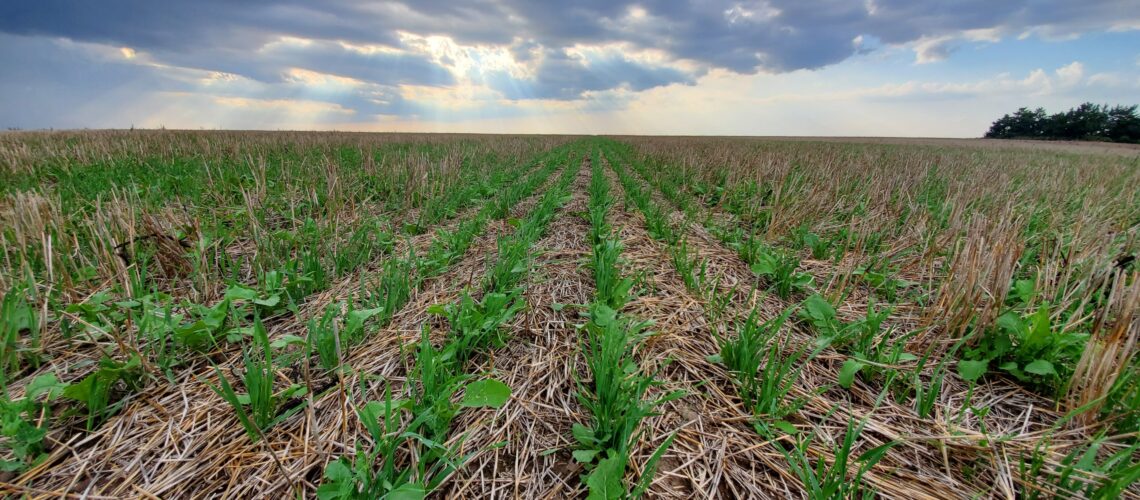
Growing concerns about soil quality, soil erosion, and nutrient losses by leaching and runoff have increased interest in management practices that improve soil quality and conserve nutrients in the landscape. Recent soil health initiatives from government agencies and others have drawn increasing attention to the use of cover crops to protect the soil and scavenge and immobilize nutrients remaining after harvest. Cover crops are a valuable soil-conservation practice when they can fit into the cropping system and are compatible with climate conditions.
Benefits of Cover Crops for Soil Health
Cover crops may increase soil organic matter by growing additional biomass and help maintain soil fertility by capturing excess nutrients after a crop is harvested. They may increase soil water-holding capacity, maintain a living cover to protect from erosion, reduce nutrient runoff, reduce soil compaction, improve soil structure, and can even help disrupt some pest cycles. (1,2)
Management Challenges and Risks of Cover Crops
Cover crops may also come with some disadvantages, and they add additional layers of complexity to a grower’s management. Growers must weigh cover crop benefits, especially long-term benefits, against such considerations as cost of establishment and termination and possible yield reductions in the short term. Cover crops consume soil moisture, which, in low rainfall areas, can reduce yields. Cover crops, while taking up nutrients not used by the previous crop, may not release those nutrients in time to be used by the following crop. Of special concern is immobilization, or “tie-up,” of nitrogen by non-legume cover crops.
Nutrient Cycling Differences Between Legume and Non-Legume Cover Crops
Non-legume cover crops are often the most effective scavengers of residual nitrogen but may not decompose and release that nitrogen in time for the subsequent crop. In recent research in Minnesota and Kansas, greater fertilizer nitrogen was needed to reach top yields in crops following a non-legume cover crop. (3,4)
Legume cover crops decompose more rapidly than non-legume cover crops (such as cereal rye) and may provide additional nitrogen to the subsequent crop, while grass cover crops decompose more slowly, but decomposition can be hastened if terminated and incorporated by tillage, keeping in mind that tillage may defeat some of the purposes of using cover crops. Note also that the extra nitrogen supplied by legume cover crops may contribute to greater nitrate leaching, so the cover crop and nitrogen for its subsequent crop need to be carefully managed to provide adequate but not excess nitrogen. (5)
Climate Impacts on Nitrogen Availability and Decomposition
In colder northern states, cover crops, while effectively scavenging residual soil nitrate-nitrogen, may not cycle that nitrogen in time to feed the following crop. In a North Dakota study, economic optimum nitrogen rate was greater, and yields lower, following non-legume cover crops than where no cover crop was used. Crop yields following the cover crop use did not reach the same yield level as without a cover crop even with greater nitrogen rates applied. Growers must plan carefully to make sure their nitrogen budget accounts for a difference in cover crop decomposition, nitrogen content, and nitrogen contribution to subsequent crops. (6) In warmer climates, decomposition rates can be faster, and nitrogen may become available in time for the subsequent crop. (7,8)
Nitrogen Management Strategies for Cover Crop Systems
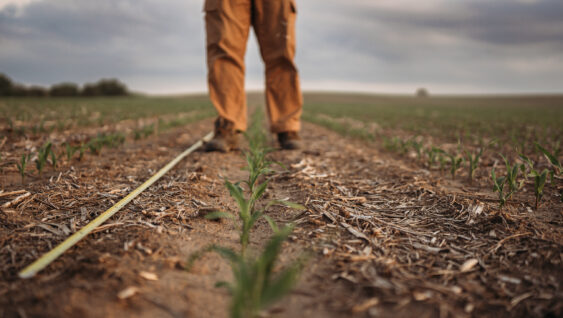
Growers should closely monitor crop nitrogen status to determine if supplemental nitrogen is needed. Splitting nitrogen application and watching for nitrogen need can improve nitrogen-use efficiency. Tools such as the pre-sidedress nitrate test (PSNT), color imagery, high nitrogen check strips, and/or tissue-testing can all help diagnose crop nitrogen status and help make informed decisions on potential in-season nitrogen applications.
Cover crops are not a new practice, but there are still many questions on how to manage them to get the greatest benefit while maintaining the productivity of the subsequent crop. Cropping systems and growing environments are highly varied and how cover crops are used will vary accordingly in every system. Growers should consult with local experts and do their own experimentation.
Growers should also keep in mind that many of the cover crop benefits are long-term benefits and may not be evident in a given season. Be cautious about interpreting results of a study from a single year. Improving soil health and building soil organic matter is a long-term process and requires patience. New research is ongoing to give additional guidance on cover crop management. As our scientific understanding and practical experience expands, management can improve and better use this important tool.
References:
- Cover Cropping to Improve Climate Resilience
- Cover Cropping to Improve Climate Resilience Factsheet (PDF)
- 2024 North Central Soil Fertility Conference proceedings (University of Minnesota)
- Fontes, Giovani P., P.J. Tomlinson, *K.L. Roozeboom, and D.A. Ruiz-Diaz. 2017. Grain Sorghum Response to Nitrogen Fertilizer Following Cover Crops. Agron. J. 109:2723–2737. https://acsess.onlinelibrary.wiley.com/doi/abs/10.2134/agronj2017.03.0180. *Corresponding author.
- 2024 North Central Soil Fertility Conference proceedings (Purdue University)
- 2024 North Central Soil Fertility Conference proceedings (North Dakota State University
- Sainju, Upendra M. *, B.P. Singh, W.F. Whitehead, and S.Wang. 2007. Accumulation and Crop Uptake of Soil Mineral Nitrogen as Influenced by Tillage, Cover Crops, and Nitrogen Fertilization. Agron. J. 99:682–691. https://doi.org/10.2134/agronj2006.0177. *Corresponding author.
- Andrews, J.S., Z.P. Sanders, M.L. Cabrera, U.K. Saha, N.S. Hill. 2018. Nitrogen Dynamics in Living Mulch and Annual Cover Crop Corn Production Systems. Agron. J. 110:1309–1317. https://doi.org/10.2134/agronj2017.10.0609