Ray Dowbenko has more than 30 years of experience working with research scientists, academics, industry groups and regulatory agencies on fertilizer and agricultural research, policy, and environmental and sustainability issues. He is also a member of the Prairie Certified Crop Advisor (CCA) Board and was also an original member of the Prairie CCA development committee. Dowbenko holds both a Bachelor of Science degree and a Master of Science degree from the University of Manitoba in Winnipeg, Manitoba, Canada, in Botany/Zoology, Soil Science, Soil Chemistry and Soil Fertility. Dowbenko recently retired from Nutrien, where his primary extension and training focus was with distribution and grower customers. He also worked in the area of new product and market development, product support and extension across Nutrien’s business units. In addition, he provided support on environmental and governmental policy issues to industry associations.
High yielding wheat and canola take up large amounts of nitrogen (N) to support yield and quality. Canola requires about 3 to 3.5 pounds (lb) per acre of available N per bushel of seed yield and wheat requires about 2 to 2.5 lb per acre of available N per bushel of seed yield (Canadian Fertilizer Institute, 2001).
This large demand can present handling, logistic, agronomic and environmental concerns related to N management. Avenues to improve N management need be considered in the context of increasing world food demand and production needs, and that higher yielding hybrids and varieties place greater emphasis on N management, to sustainably increase production of these two primary prairie crops.
Inefficient N fertilizer use or low N recovery may contribute significantly to environmental degradation and loss of profit in intensive agricultural systems (Haderlein et al., 2001). Estimates of N use efficiency (NUE) range, on a worldwide basis, from 33% (Raun and Johnson, 1999) to between 20 and 60% on the Canadian Prairies (Racz, 1979).
Much of the N not taken up by the crop is presumed to be lost to the environment through denitrification, leaching, volatilization, run-off, gaseous plant emissions, or temporarily withheld from the cropping system by immobilization (later released through mineralization).
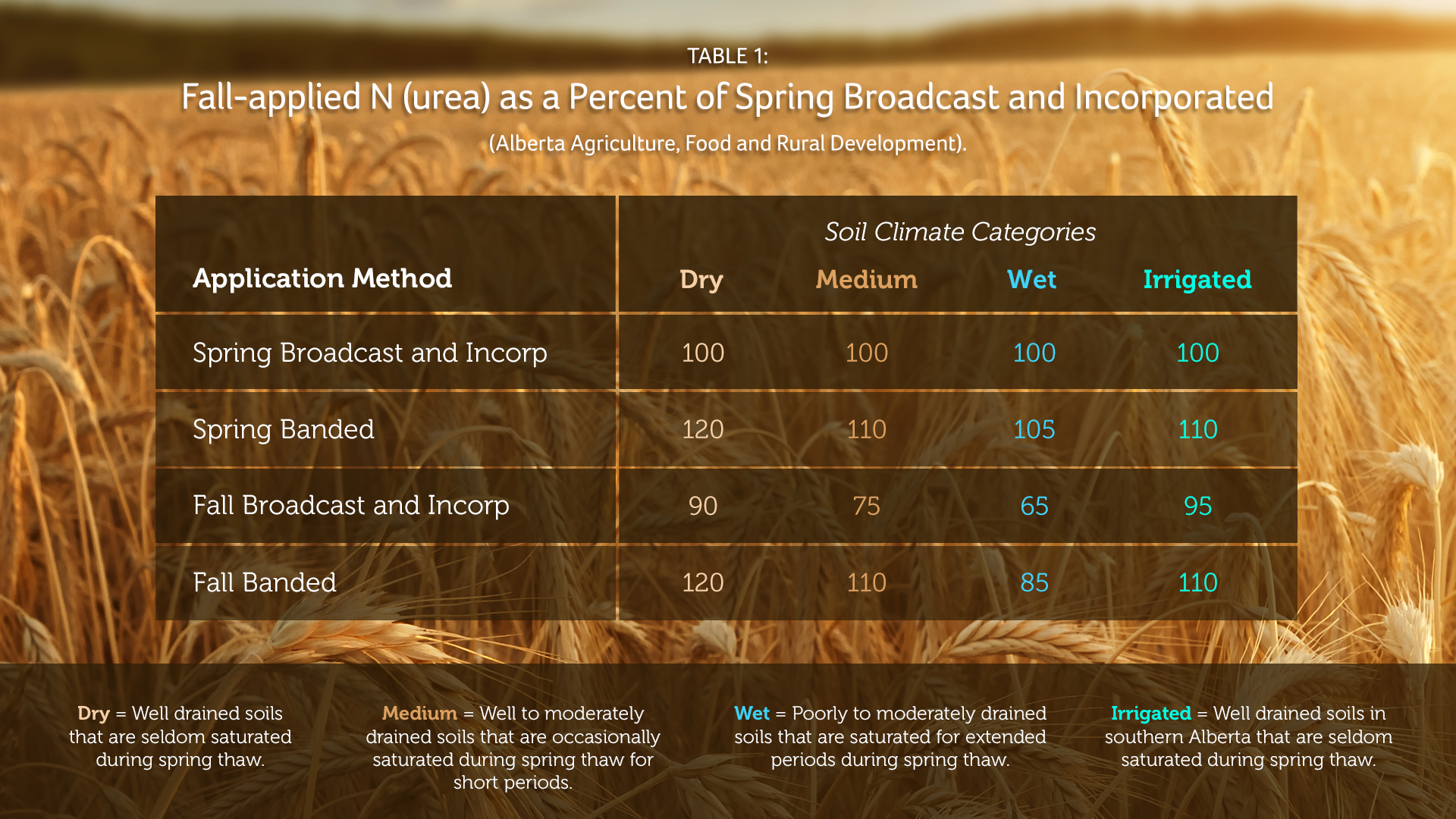
Losses of fertilizer N are potentially larger with fall application as opposed to spring application. Table 1 suggests an average efficiency of spring applied N as compared to other timings, dependent upon climatic conditions and application method. Within the same location, one may presume that losses across regions and environments may be significant one year, and insignificant the next. That efficiency will also vary with N source applied as well as the application method and time of application.
Efficient N application methods are dependent upon climatic and environmental influences, soil characteristics, economics, and farm management capability.
4R Nutrient Stewardship
The 4R Nutrient Stewardship program is a scientific principle predicated upon managing source, rate, time and placement of fertilizer to achieve increased fertilizer use efficiency, while minimizing the environmental impact of fertilizer application to the land, air and water, and improving the social and economic environment of society (IPNI, 2012).
Strategies for optimizing N management depend upon local environmental conditions and risk management practices. The management of N fertilizer may not be so much of what is right and what is wrong, as it is what is an acceptable trade-off given the N management strategy that is chosen for the prevailing environmental condition, and the management approach that fits acceptably with farm practice.
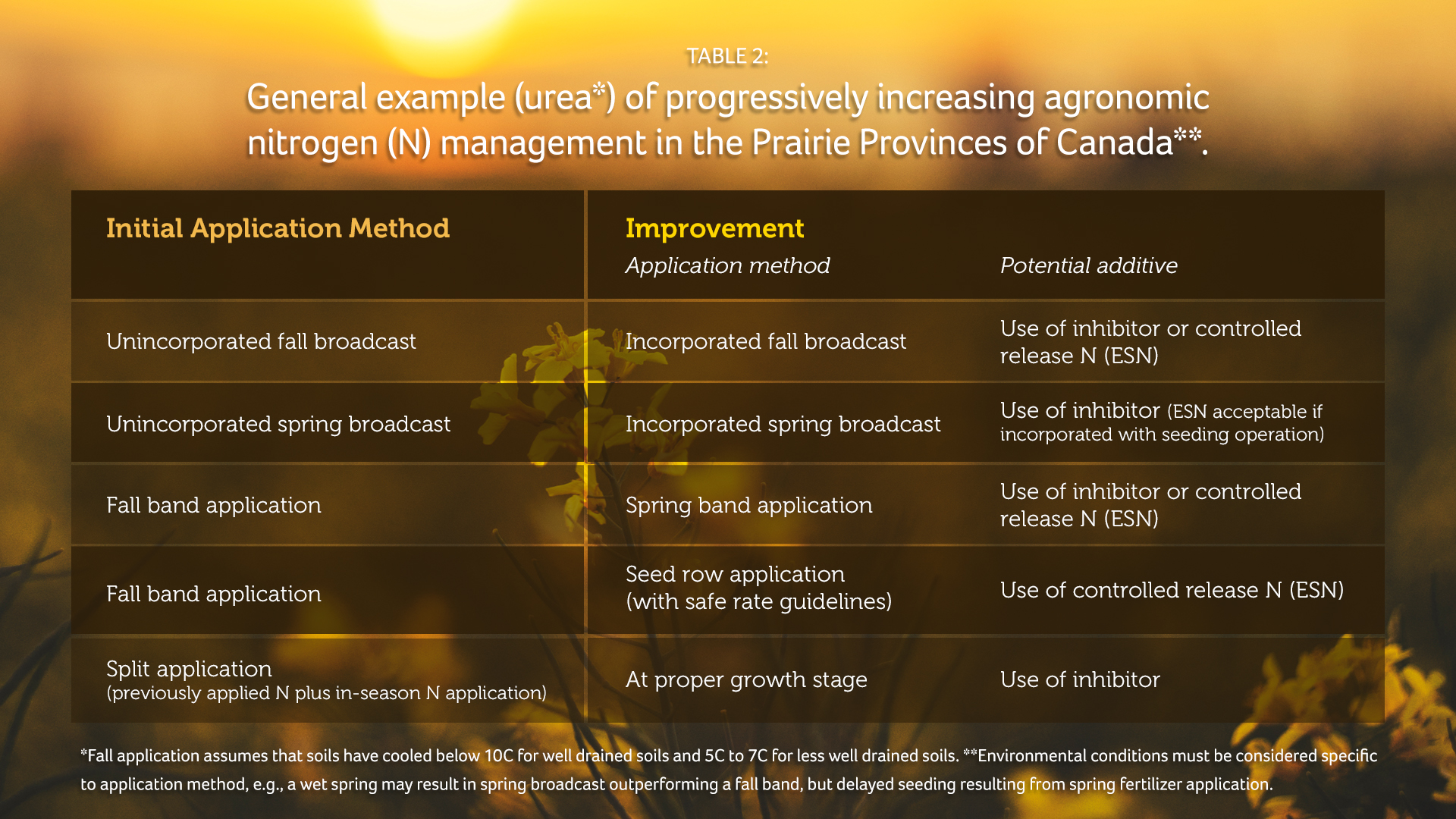
Optimizing N management for some, may mean applying N to attain the best possible NUE, while others may decide to accept some N loss, to gain an “efficiency” elsewhere (economic, time, etc.). Table 2 provides a relative comparison of application methods and potential improvements to agronomic efficiency.
Generally, spring band application provides the best positional and agronomic availability of N; this varies with source and environment, and economically and logistically with purchase decision timing and storage options. The 4R’s are interrelated and integrated, e.g., timing can dictate source and placement choice and placement option can dictate time of application. As well, environment can dictate source, timing and placement selection. One decision (“R”) must be considered in relation to each other “R”.
High yielding wheat and canola both require high amounts of nitrogen. Managing nitrogen to maximize availability can result in improved crop yields and profit. More “bang for your buck” on pounds of nitrogen.
References:
Canadian Fertilizer Institute, “Nutrient uptake and removal by field crops, Western Canada,” 2001.
Haderlein, L., Jensen, T. L., Dowbenko, R. E. and Blaylock, A. D. 2001. Controlled release urea is a nitrogen source for spring wheat in western Canada: yield, grain N content, and N use efficiency. Optimizing Nitrogen Management in Food and Energy Production and Environmental Protection. Proceedings of the 2nd International Nitrogen Conference on Science and Policy. The Scientific World 1 (S2), p. 114-121.
IPNI. 2012. 4R Plant Nutrition Manual: A Manual for Improving the Management of Plant Nutrition, T.W. Bruulsema, P.E. Fixen, and G.D. Sulewski (Eds), International Plant Nutrition Institute, Norcross, GA, USA.
Racz, G. J. 1979. Losses of fertilizer nitrogen as affected by time and method of application – Manitoba. Proceedings of 16th Annual Alberta Soil Science Workshop. Feruary 26-27, 1979. p. 9-25, Lethbridge, AB.
Raun, W. R. and Johnson, G.V. 1999. Improving nitrogen use efficiency for cereal production. Agron J. 91: 357-363.