Dr. Alan Blaylock brings extensive North American and international experience in nutrient management to the agronomy team. University studies and service as a university extension soils specialist prepared him for a long career in the fertilizer industry. Having managed both domestic and global research and education programs, Dr. Blaylock has a wealth of experience in applying science-based nutrient management principles and products to solving practical questions. Dr. Blaylock earned Bachelor of Science and Master of Science degrees in agronomy and horticulture from Brigham Young University and a Ph.D. in soil science from Iowa State University. He has been in agriculture his entire life — from his childhood on an irrigated farm in eastern Oregon to teaching soil science at Iowa State University to his current role as an agronomist at Nutrien. These diverse experiences helped Dr. Blaylock develop the skills to excel in translating complex scientific principles into practical solutions. Although early in his university studies he explored computer science as a profession, deep family roots in agriculture brought him back to the people and values of his heritage. His career satisfaction comes from helping others improve the performance of nutrients and cropping systems. Dr. Alan Blaylock is a recipient of the 2022 Great Plains Soil Fertility Conference Leadership Award. The Fluid Fertilizer Foundation also recognized Dr. Alan Blaylock with the Werner Nelson Award for his outstanding contributions in the development of soil fertility practices and plant nutrition management to increase crop yields for the benefit of North American farmers and consumers
Phosphorus is one of the primary essential plant nutrients and is required by all living organisms. Phosphorus deficiency limits the growth and productivity of plants in many parts of the world. Since many soils are low in phosphorus, additions are often needed to improve soil fertility and crop production. The most common phosphorus fertilizers are ammoniated phosphates such as monoammonium phosphate (MAP), diammonium phosphate (DAP), and ammonium polyphosphate solutions (APP).
Where Does Phosphate Come From?
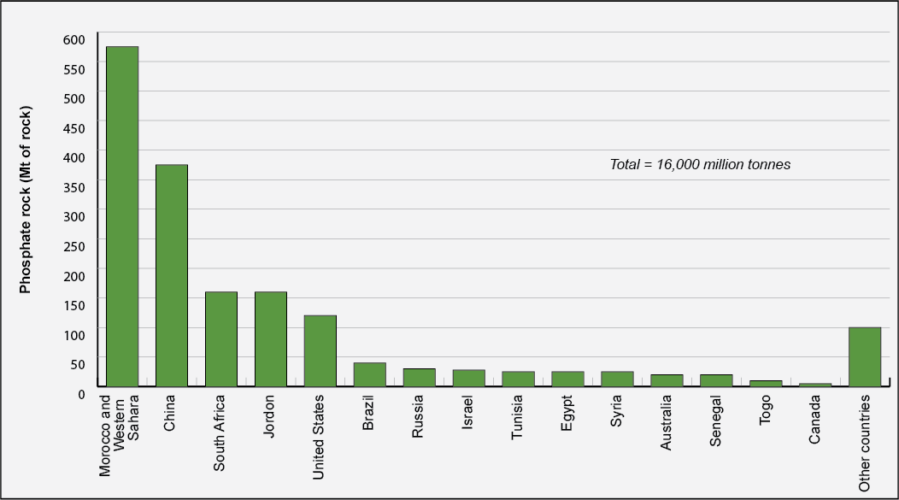
Phosphorus is derived from sedimentary or some igneous geologic deposits distributed across the globe. In North America, the largest deposits are in sedimentary materials in Florida, North Carolina, and in Eastern Idaho/Western Wyoming. The world’s largest phosphate reserves are found in Morocco. China and Russia are also major global suppliers of phosphate fertilizer. Apatite, a calcium phosphate mineral, is the primary phosphorus constituent in phosphate rock and is often mixed with clay, sand, and other minerals. Calcium phosphate, coincidentally, is also a key component of bones and teeth. Most phosphate rock is recovered through surface mining of these sedimentary deposits, although some is extracted from underground mines.
Source: Schroder, J. & Cordell, Dana & Smit, A. & Rosemarin, Arno. (2010). Sustainable use of phosphorus : EU tender ENV.B1/ETU/2009/0025. Biosystems Engineering – BIOSYST ENG.
Ammoniated phosphate fertilizer production begins with the mining and processing of phosphate rock into phosphoric acid. Rock phosphate is reacted with sulfuric acid producing phosphoric acid and calcium sulfate (gypsum). The acid can then be reacted with ammonia in different ratios and processes to form monoammonium phosphate, diammonium phosphate, or ammonium polyphosphate solution. Typical grades (N-P-K) of MAP are 11-52-0 and 12-51-0; DAP is 18-46-0; and APP may be either 10-34-0 or 11-37-0.
Why Do Phosphate Fertilizers Have Different Colors?
The global nature of modern fertilizer markets results in fertilizers of varying appearance from manufacturers around the world being sold in the same markets. For example, phosphate fertilizers from Florida and North Carolina are typically brown to black; Idaho and Wyoming phosphates are green; Moroccan phosphates brown; and Russian phosphates usually white to ivory colored. Although the same basic processes and chemical reactions are used in fertilizer manufacture, each ore body contains trace minerals and impurities that vary with location, deposit type (sedimentary versus igneous), and mineralogy. There may also be some minor variations in processing methods, calcination (removal of organic contaminates), source and color of sulfuric acid, and dust control agents that may be used by the manufacturer.
Color Differences Don’t Affect Product Performance
Variations in color of the final fertilizer product from different phosphate ore bodies and manufacturers may lead to questions about differences in product quality and performance. One may be assured, however, that because of the consistent basic chemistry of the various fertilizers, the chemical nature, behavior in the soil, and agronomic performance should be similar. One source of MAP or DAP may be equally substituted for another of the same grade.
It should also be noted that the fertilizer grade, or analysis (eg 11-52-0, 18-46-0), is regulated by government agencies to assure the consumer gets the product that is specified. The manufacturer and/or seller must state this guarantee on the product label, and the product must meet this guarantee within specified analytical tolerances. If a product is labeled as monoammonium phosphate, 11-52-0, the customer can know the product they are receiving is what is represented. Periodic inspections assure products are properly labeled and their analysis meets the stated guarantee.
You can learn more about many common fertilizers, including phosphates, in a series of fact sheets called Nutrient Source Specifics available from IPNI Canada at http://www.ipni.net/specifics-en.