





Read Full Transcript
[00:00:00] Mike Howell: The dirt with me, Mike Howell, an eKonomics podcast where I present the down and dirty agronomic science to help grow crops and bottom lines. Inspired by eKonomics.com farming’s go-to informational resource. I’m here to break down the latest crop nutrition research use, and issues helping farmers make better business decisions.
[00:00:30] Mike Howell: Through actionable insights. Let’s dig in.
[00:00:40] Mike Howell: Hello again everyone. Welcome back to the Dirt. Glad you’re tuning in. This week we’re doing an on location episode. We haven’t done one of those in a while, but I am in Oklahoma, El Reno, Oklahoma. To be more exact, we are out here for the National Land Home Site and Range Judging Contest. Now, this is a contest I participated in as a four H years ago, [00:01:00] had the opportunity to bring some kids out here as a coach, and always enjoyed coming out here and doing this.
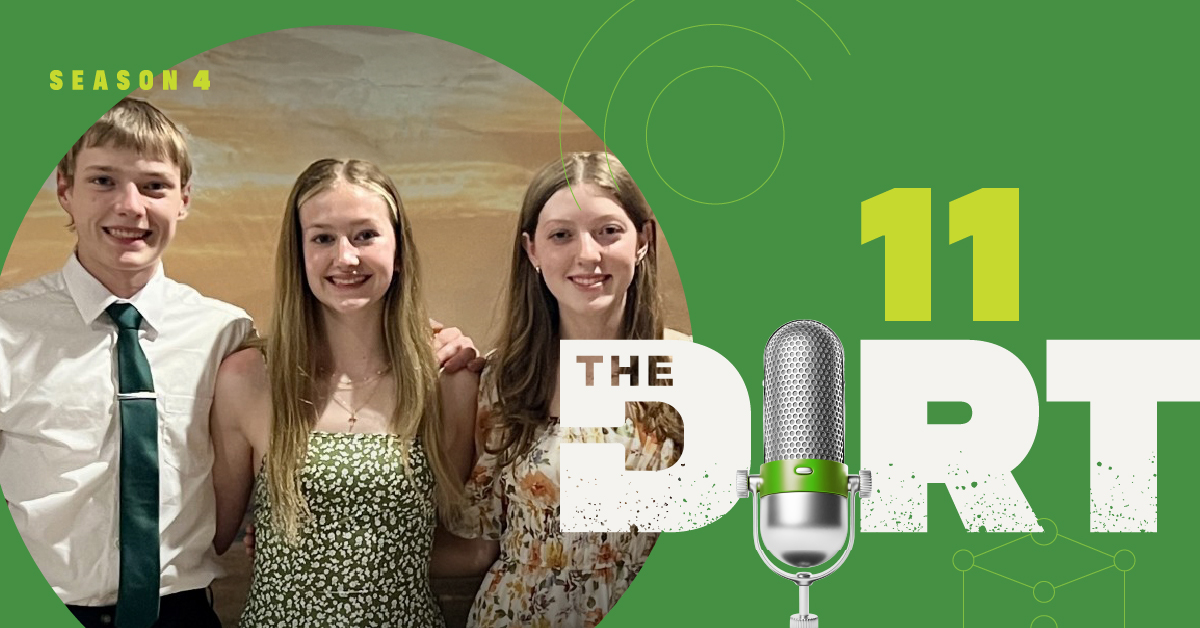
[00:01:05] Mike Howell: The dirt is actually sponsoring part of the contest this year, and we thought it would be great to get some of these young people involved and let them know what all is going on out here. Before we get started, I want to ask each one of them to introduce yourself and tell us a little bit about where they’re from and other things they’re working on, some of their hobbies, that kind of stuff.
[00:01:21] Mike Howell: We’re gonna start off with Levi. Stefan. Levi, welcome to the Dirt.
[00:01:25] Levi Steffan: Thank you. My name is Levi Steffen from North Dakota and. I like working on the farm and I, when I get older, I help take over the farm and farm with my brothers.
[00:01:35] Mike Howell: Okay, very good. Next we have Lily Donahue. Lily, welcome.
[00:01:39] Lily Donahue: My name is Lily Donahue.
[00:01:40] Lily Donahue: I live on a farm south of tall North Dakota. I’m active in a lot of things. I like reading, baking, horseback, riding, taking care of my animals, and when I’m older I wanna be a large animal veterinarian.
[00:01:52] Mike Howell: Very good. And next we have Laura. Stefan. Laura, welcome.
[00:01:55] Laura Steffan: Thank you. I’m from Michigan, North Dakota, [00:02:00] and I live on a farm by there.
[00:02:02] Laura Steffan: I like playing sports and I like reading.
[00:02:06] Mike Howell: So before we really get into the land judging part of it, let’s talk a little bit about your trip from North Dakota. I understand it took y’all a couple of days to get down. I know that’s quite a drive. Was it all work and no play or did y’all have a little fun along the way?
[00:02:19] Levi Steffan: We stopped in Sioux Falls and went. To look at the falls and took some pictures there. It was pretty cool to see the different rocks from the
[00:02:26] Mike Howell: falls there. I’ve never got to make that trip. That’s on my bucket list though. I’d love to get there one day. Anything else happening on the trip? I’m sure you had to do a little bit of studying along the way.
[00:02:37] Laura Steffan: Yeah, I did a little bit of studying for aging and I also had to work on some of my schoolwork since we’ll be missing a week of school while we’re here.
[00:02:45] Mike Howell: That’s always a challenge, making sure you keep up with that schoolwork as well. Let’s talk a little bit about how you got here. There’s teams from all over the United States that are participating in this event, and I know everybody’s path is a little different.
[00:02:57] Mike Howell: You have to do different things at home in order to get here. Some [00:03:00] states have to win a state contest, others send three or four teams. Lily, if you will, talk a little bit about y’all’s path to get here, what you had to do.
[00:03:08] Lily Donahue: We’ve been doing land judging for two years, so last year we went to the state competition August, and I believe we placed second as a team first year.
[00:03:17] Lily Donahue: And then this year we went to the competition again, and this time we placed first, we also placed top three individually, so then we qualified for nationals and we began fundraising.
[00:03:29] Mike Howell: That’s quite a feat. Most people end up doing this several years before they can qualify to come down. So y’all did it in two years.
[00:03:35] Mike Howell: That’s pretty impressive. So today was actually your first day of practice out here in Oklahoma. I know the weather wasn’t cooperating too well. It’s been raining most of the day and tornado watches out everywhere. Other than that, how was the first day of practice?
[00:03:49] Levi Steffan: It was pretty good. It was frustrating.
[00:03:51] Levi Steffan: Some of the pits were full of water and kind of. Scary to climb down it on just ’cause of how slippery the mud made it. And then so it made the [00:04:00] textures difficult too. ’cause you couldn’t get a dry sample of it. They were always wet. Some of ’em even were too wet. Other than that, it was pretty good.
[00:04:06] Levi Steffan: I.
[00:04:07] Mike Howell: Yeah, that’s always a challenge out here. I’ve been involved in the contest for I think nine different years when I was here and the weather’s always been a challenge every year. One thing, the very first time I came, they told me to put a hot dog in my pocket and I kinda looked funny. I said, wow, a hot dog.
[00:04:21] Mike Howell: They said That way the search and rescue dog can find you first. Anything else that was a surprise when you got out? Here are the soils different here than they are back in North Dakota?
[00:04:30] Laura Steffan: The dirt is much redder here than it is in North Dakota and it’s. A lot more clay texture than there’s a lot more coarse texture in North Dakota, I think compared to down here in Oklahoma.
[00:04:44] Mike Howell: That’s something else I was going to ask and you answered it there. Do y’all know what the word Oklahoma means? No, I don’t. Oklahoma means red dirt. Fun fact that very few people understand. Getting back to our topic here, let’s talk a [00:05:00] little bit about the contest itself. What actually happens when you go to the contest?
[00:05:04] Mike Howell: What are you evaluating? How do you evaluate different things for the land judging contest?
[00:05:09] Lily Donahue: There’s four different pits. We go to each pit. You get 20 minutes. There’s two stakes. You have to find the slope of the land. There’s two buckets. One has subsoil. And the other has top soil. You find the texture of the soil.
[00:05:22] Lily Donahue: Then you also go down in the pit. You find soil depth so you can find out the erosion ’cause they have a card with the original and then also like potassium and nitrogen and other stuff. You figure out if it’s sufficient or not, and then you fill out a card and you see what class of land it is, what treatments it needs, and what it’s suitable for.
[00:05:41] Mike Howell: Let’s talk a little bit about the texture. Y’all have mentioned that several times. How do you determine what the texture is? I know if I send a sample into the lab, they run it through some processes and they can tell me the sand, silt and clay percentages, and that’s what y’all are doing here, but you don’t have a machine to help you analyze that.
[00:05:56] Mike Howell: How do you determine the texture? I.
[00:05:58] Levi Steffan: In lounge judging, it’s classified [00:06:00] in five different categories, fine, moderately fine, medium, moderately coarse, and coarse, and we just grab a handful of soil and I like to squeeze it before I put water on it before it’s wet. And if it stays together, then I know that it’s fine.
[00:06:12] Levi Steffan: Coarse soils don’t stay together very well, then I’ll get it wet after that, and then I can form a ball. With it, and then I can see how the ball stays together. Then I know it’s on the fine side, or if it falls apart, it’s more coarse. And I try and make a ribbon, which is like pressing the dirt in between your thumb and your forefinger.
[00:06:31] Levi Steffan: See how long it is and the length determines, like if it’s mildly fine or medium. That kind of thing doesn’t really help with, and then I can. Put a little bit of soil in my palm and put a bunch of water in it and I can feel any grit in it. And the more grit, the more coarse it’d be, or less grit, it’d be fine.
[00:06:49] Levi Steffan: And I also like to see if I can make a fingerprint in the soil too. ’cause then that helps me determine if it’s fine too. It’s very sticky. And clay,
[00:06:59] Mike Howell: we mentioned [00:07:00] slope a few minutes ago. Talk about slope and how you determine the slope and why slope is so important.
[00:07:05] Laura Steffan: So there are two stakes that are set at a hundred feet apart from each other.
[00:07:09] Laura Steffan: So when you walk up, you determine which stake is the lower one, and you would walk to it. There’s a bunch of different ways you can measure slopes. So the most common one, I would say is hold out your arm. When you’re holding out your arm and you go eye level, then you can you’re looking down your arm at the other stake and whenever it hits.
[00:07:26] Laura Steffan: So like for example, I’m about five and a half, or actually no, I’m a little under five with my arm out. Five foot, then I determine where I’m hitting on the stake or the ground. And then if I hit the ground, then I would go up to the spot and let’s say there wasn’t very much distance in between there and the stake.
[00:07:46] Laura Steffan: Another thing I could do is kneel on the ground, and when I’m kneeling, I’m about three feet. And then if I hit the bottom of the stake, then I know I’m at eight feet. So you have to do some math to calculate how you do that. But the point of slope is just to see if [00:08:00] it’s. Suitable for farmland or if it’s more of a pasture land
[00:08:05] Mike Howell: slope is always one of the most challenging parts of the contest.
[00:08:09] Mike Howell: If you can get your slopes right, you’ll do really well in the contest on Thursday. Let’s move on a little bit and talk about how you think this event may help you down the road. You all indicated that you kinda wanted to be in the agriculture field in one way or the other, and all come from a farm background.
[00:08:23] Mike Howell: What do you think this event will do to help you down the road?
[00:08:26] Lily Donahue: I think it’d be great for anybody going into agricultural field, especially into farming or agronomy or something like that. Learn about the farmland. I’d say it’s a good thing to get into either way, just good to learn more and help out youth when you’re older too.
[00:08:42] Levi Steffan: I’d say it helps me determine what can be grown on different kinds of soil. Sure. And what the land can be used for to turn it on the slope. It’s interesting. When you’re driving around, you can see how many hills are in those compared to the farmland that’s more flat and doesn’t have as many rocks in it, or just [00:09:00] seems like it doesn’t erode as bad.
[00:09:02] Laura Steffan: I think it’s useful if you were trying to buy land and figure out if you wanted to buy land specifically for one reason, you can use the land judging skills to figure out if it would actually be good for what you want it for or not.
[00:09:16] Mike Howell: Okay. Some great answers there. And yes, you can use land judging to help you with all of that.
[00:09:21] Mike Howell: A lot of people get to come to Oklahoma for the land judging, and it’s not all about work and learning about soil. I think that’s probably one of the most important things. Something that you can learn and take with you for a lifetime. But talk a little bit about some of the fun things that you get to do while you’re here in Oklahoma.
[00:09:35] Levi Steffan: One thing we did was. In Oklahoma City, we went to the bombing museum. Learned a lot about that and who did it and how it happened. Didn’t know anything about it before came down here, so I was exciting to learn about
[00:09:48] Mike Howell: that. Gave fertilizer a bad name for a few years there. He used some fertilizer in making that bomb, but that’s a pretty impressive museum.
[00:09:55] Mike Howell: I’ve had the chance to go through that several times. Always enjoyed doing that. Anything else that’s been [00:10:00] happening?
[00:10:00] Laura Steffan: And we went on the water taxiing bricktown yesterday on the canal. It was really cool. There was a lot of art and things to learn in the city. I thought it was really pretty.
[00:10:11] Mike Howell: I’ve done that as well.
[00:10:12] Mike Howell: If you’ve never done that, I highly recommend that. Anything else you’ve done? Have you got to eat lunch at Brahms yet?
[00:10:18] Lily Donahue: No, not yet.
[00:10:20] Mike Howell: Any other events planned, and I highly encourage you to take time to go to Brahms. It’s an Oklahoma favorite and you’ve gotta go there. Any other events you have planned while you’re out here this week?
[00:10:29] Lily Donahue: We plan on going to the Cowboy Hall of Fame tomorrow. I.
[00:10:33] Mike Howell: That’s always a great place to go visit. They used to have the awards program there years ago. Spent several hours in there. A lot of great artifacts in there that need to spend some time looking at. Listeners, we really enjoyed bringing you this episode this week.
[00:10:46] Mike Howell: I hope you understand a little more about the land judging contest and what these young people have to do to get through it. I know this is the way I got started in agriculture, coming to the land Judging contest, and probably the main reason why I’m in the role I’m in today. [00:11:00] Do any of y’all have anything you want to add before we leave?
[00:11:02] Mike Howell: And one final question. How can you encourage other people to get involved in land judging? That just doesn’t seem like the popular thing to do. Any closing comments and how can you talk other people into being in land judging?
[00:11:14] Laura Steffan: I would like to thank our coaches for helping us out. Preston, Tracy and Caitlyn, they helped us a lot.
[00:11:20] Laura Steffan: I would say if you have a four H chapter or an FFA chapter, definitely look into that. There’s a lot of different ways you can get involved.
[00:11:29] Lily Donahue: Yeah, I would say it’s a really good thing to get into. People can look for their local four H clubs or schools, FFA chapter and just get involved. ’cause there’s a lot more activities other than land judging too, within those organizations.
[00:11:41] Levi Steffan: I would say if you wanna get interested in land judging, it’s just a lot. You can learn about it and it’s a fun competition to be in, especially if you’re not close to the competition site. Then you can go on some tourist attractions, which is fun. Like the museum that we went to.
[00:11:57] Mike Howell: Okay. We wish you luck in the contest this [00:12:00] week, and we appreciate you taking time outta your practice schedule to come by and visit with us.
[00:12:07] Mike Howell: I’m joined now by Mr. Larry Wright. Larry is one of the officials here at the Land Judging Contest. Larry, welcome to the Dirt.
[00:12:13] Larry Wright: Thank you. It’s. Good to be here today and be with you and talk a little bit about what we’re doing here at the National Land and Range Judging Contest.
[00:12:20] Mike Howell: Larry, we just had some young people on and they told us a little bit about the land judging part of the contest.
[00:12:25] Mike Howell: Tell our listeners a little bit about the home site part of it and the range judging contest.
[00:12:30] Larry Wright: The home site part of Contest I, I look at that one way as the experience these young men and women are coming through and. Taking that knowledge about soils and the land that we all can use. ’cause most of us, at one time or another, we hope to end up being a homeowner.
[00:12:47] Larry Wright: And what you can learn about the soils is your basic foundation for your, not only your house and the structural needs for to put a home in, but what if you’re putting in a septic field? What do you need? Don’t match your soils in [00:13:00] order to be able to handle the waste effluent coming out of a house or maybe a certain tree or top of grass you wanna plant.
[00:13:07] Larry Wright: So all this knowledge that these young people are learning about our land, if you will, in the soils particularly, that becomes very valuable when you’re talking about. How good is that gonna be for a home? Can I have a garden at my house? What kind of trees can I actually grow? And this information, say, no matter what career these young people go into, the knowledge and experience they’ve gained here, particularly under the home side evaluation, it’s going to be useful to ’em later on in life.
[00:13:34] Mike Howell: And what about the range judging contest? That’s one that I’ve never participated in and don’t know a whole lot about that one.
[00:13:40] Larry Wright: We actually have out of our 35 states that annually show up, at least that’s the number in our average. Some of our states do not have native grasses. If they had pasture land utilizing forage for grazing of livestock or wa even some places they’re losing that benefit of native grasses.
[00:13:57] Larry Wright: So our range land, and when we go out [00:14:00] to judge that they have to be able to identify these various native grasses. And all these native grasses and Forbes that make up our rangeland are very valuable and provide additional benefits even way beyond the livestock because these students will go out and they’ll determine, first of all, what kinda livestock can I raise?
[00:14:20] Larry Wright: Are they all beef animals? But in addition to that, we want them to understand what are the benefits for walleye? Can this grow or support a cove, a quail? Will Turkey come out here and be able to exist on this type of rangelands? Actually during the contest, they have to identify this and sometimes even, it includes being able to identify is there an invasive brush species coming in?
[00:14:44] Larry Wright: Or in noxious weed that might show up. It does get into a lot of other things besides what we would like to see on our rangelands.
[00:14:52] Mike Howell: Very good. Sounds like a really interesting contest, Larry. Let’s talk just a little bit about the history of the event. I know this is the 75th event that’s going [00:15:00] on. Talk a little bit about how it got started and some of the changes that have happened over the years.
[00:15:04] Larry Wright: I wasn’t around when it originally started, ’cause it started a few years before I was born, actually, when they started this back in 1951. And with the interest. That was going on with our agricultural lands and the production, and that’s where the emphasis came out of. But working through various ag programs, FFA and four H in particular, and teaching our students the importance of protecting our resources.
[00:15:28] Larry Wright: How do we manage our resource? How do we get the maximum capability out? These natural resources, our competition was developed. I’ve heard some stories that the competition between Texas and Oklahoma was pretty competitive. And so they said, Hey, let’s create a national contest. And it began to expand from there.
[00:15:47] Larry Wright: And like I say, when we’re bringing states and even bring, like Hawaii will come in and compete all the way from. Northwest into Washington, down to Florida, New Jersey, Vermont. You think about all the [00:16:00] different states that show up from all across this country and to make it a national contest. As we’ve grown this contest over the years and Oklahoma is when they began hosting it, and as we’ve grown this scope of it, of course, along with that cost and the amount of people it takes and the resources.
[00:16:18] Larry Wright: One of our important resource, of course, is people and finding the people with the technical expertise to be able to put on this contest and the time and the volunteers, we jokingly refer to our volunteers is once we get you on and you volunteer, even if you retire from your position, you don’t quit the National Land Raid Jji contest, not only until death.
[00:16:42] Mike Howell: I know it takes a small army to make this happen. We sure appreciate all the volunteers. A lot of people think this is a three day event, and you may have to spend a day before putting this together, but talk a little bit about the time it takes to put this event on and some of the resources you have to secure to make sure this is a successful event every year.
[00:16:58] Larry Wright: Maybe starting off [00:17:00] with just, you think about the financial cost being a national contest. We want our awards banquet to be worthy of the national competition that this really is, and to basically find a facility that can host this. We’re like our banquet. We’ll seat and feed 1200 people, so on the day of the contest as well.
[00:17:21] Larry Wright: Immediately following the contest, we’ll also feed 1200 for lunch. And because they all wanna be able to meet with our judges, our soil scientists, our rain scientists, and understand what the key was for the contest and what the official results of the sites, we don’t give ’em the official results of the placing until we’re in the banish.
[00:17:41] Larry Wright: We look at facilities and fine facilities and schedule that and arrange that to come up with the cost. Of course, what we do charge a registration fee for the teams that’ll cover just a part of our cost. We like to keep that as cheap as we can because these teams are coming from all these states.
[00:17:57] Larry Wright: They’ve got travel expense, [00:18:00] lodging expense, and that all goes with that. When they get here. So we wanna keep registration as reasonable as we can. So we are always out there seeking the sponsors that are willing to give us some sort of donation. We do this as a nonprofit, so we’re always open to receiving any donations to help cover the cost.
[00:18:18] Larry Wright: We really like to keep it reasonable for these teams ’cause we know they’ll have a lot of other costs just to get here. And time-wise, we’re planning the logistics that go on with. Finding caterers to do the food, the facilities, but then again, we have to have over 200 volunteers that come in to help with this, and a lot of retired people from the Natural Resources Conservation Service or the conservation districts.
[00:18:43] Larry Wright: They’re a great source of people. We do depend on the scientists out of the Natural Resource Conservation Service. Those are active employees. Of course, they’re governing a lot about some federal guidelines of when and how they can help us. And a little bit of the same way with Oklahoma State [00:19:00] University as our land grant University here in Oklahoma, and using their people to come out and providing some of people that had that experience and.
[00:19:10] Larry Wright: They’re able to come out and help us. So it’s a lot of time and spent, and we really get busy right after the first of the year. Calendar year in January, we begin a lot of correspondence. I have key members heading up various committees, and we all get together either late February, no later than March two, three or whatever, and all meet collectively to make sure everybody’s on the schedule and if there’s any gaps that we need to fill in.
[00:19:36] Larry Wright: And so we really, we stay busy all the way through March into April. Then we have our contest, and it’s always been the first Thursday in May.
[00:19:44] Mike Howell: Larry, we really appreciate you taking time to visit with us today. We appreciate all the hard work that you and the other volunteers are doing to make this event so successful every year.
[00:19:53] Mike Howell: Is there any closing message you want to leave with our listeners?
[00:19:56] Larry Wright: You gave me a question I hadn’t thought about, but far as I can [00:20:00] say the thing, I’m really impressed. I feel like we have some of the best young people. That gives me hope in the future. These young men and women, they’re all high school students to be able to compete.
[00:20:11] Larry Wright: They’re between ages of 14 and 18 years of age, but they are respective. They’re courteous, they’re kind, they’re trustworthy. It does encourage me a lot to see these young people and see ’em. They can give hope when you listen to too much news that’s come across media, and it sound like we’re a lot of doom going on.
[00:20:31] Larry Wright: But then I meet these young people that show up every year and just with that kind of faith and knowing that there’s a lot of good young people coming in, I.
[00:20:39] Mike Howell: Larry, I’m glad you mentioned that. That was one of the things that I’ve noticed in the few days I’ve been here. I’ve heard, sir, and please and thank you more than I have in the last six months put together while I’ve been here at this event.
[00:20:50] Mike Howell: Really appreciate these young people and the training they’ve had back home. We’ve got a lot of coaches and volunteers that put in countless hours and working with these people, but these are our future agriculture [00:21:00] leaders. And I encourage anybody, if you’ve ever been in the land and range judging contest, go to the website, check that out, see what’s happening these days, and if you can make a contribution to help out these young people.
[00:21:11] Mike Howell: Listeners, we want to thank you for tuning in this week. And as always, if you need more information, you can visit our website that’s nutrien dash eKonomics with a k.com. Wanna invite you to hang around just a moment and we’ll be right back with segment two. Farming isn’t farming without questions, and now there’s a place to go for answers.
[00:21:30] Mike Howell: At eKonomics, an entire team of agronomists is waiting and ready to help for free. No question is too big or too small. Visit Nutrien eKonomics with a k.com at submit your question with the ask an agronomist feature.
[00:21:48] Mike Howell: Karl, welcome back to the Dirt and thank you for having me, Karl. Today we have a asked the agronomist question we wanna throw out at you and see if you can enlighten us a little bit. Today’s question is, what factors [00:22:00] limit nutrient uptake by the plants and how do nutrient uptakes and nutrient removal rates impact
[00:22:07] Dr. Karl Wyant: nutrient management plans?
[00:22:09] Dr. Karl Wyant: Mike, solid set of questions there. In a perfect world, a hundred percent of your applied fertilizer would just go down in the soil or be applied fally and get absorbed right into the plant and then used to make yield and whatnot. That’d be a perfect world. Everyone would be super happy. But of course we have these challenges with efficiency and so that’s where understanding the loss pathways of your fertilizers can become a useful exercise because you can start to figure out where am I losing efficiency?
[00:22:38] Dr. Karl Wyant: Where am I going from a potential of a hundred percent uptake of my nitrogen fertilizer, for example? Where am I maybe dropping to 60% or what have you, and that’s where thinking about the behavior of that nitrogen fertilizer in the soil, how does it leach out nitrate leches out of lighter soil sandier soils?
[00:22:55] Dr. Karl Wyant: How does it run off when we have lots of snow melt or rainstorms as ammonium? How [00:23:00] does it volatilize or gas off as nitrogen gas or ammonia? Into the air, getting a good understanding of what conditions cause nitrogen loss. Or you can apply the same exercise down to other nutrients like phosphate and potassium.
[00:23:13] Dr. Karl Wyant: Sulfur really gives you a good way of maybe bringing in your fertilizer use efficiency to custom fit your field. And I think as a bonus, it gives you some action items on saying, Hey, if I’m at risk for leaching loss of nitrate, here’s the set of tools I can turn to like nitrogen inhibitor world for example.
[00:23:31] Dr. Karl Wyant: Where I can actually try to go combat my efficiency loss mechanisms and try to start pushing your efficiency back up.
[00:23:39] Mike Howell: Karl, I know you want to take just a second and reference our eKonomics website and talk about our calculators there and how that can help with our nutrient removal and uptake.
[00:23:48] Dr. Karl Wyant: Yeah, that’s right.
[00:23:49] Dr. Karl Wyant: If you go to nutrient dash eKonomics with a k.com, you can find a solid calculator that’ll help you take your yield information. Let’s just say corn bushels per acre. [00:24:00] On your farm, on your field, you can actually plug that number into our calculator and you can get an estimate of how much that crop is taking up over the season and pounds per acre, nitrogen, phosphate, and potassium.
[00:24:13] Dr. Karl Wyant: You can look at how much is going to be removed when you go across the field and at harvest time and start removing grain, and so you can use that information. To actually write your fertilizer plan ’cause you wanna be putting the nutrients back into the field that you’re taking off. And if you’re thinking about total uptake over the season, which is a pretty high number for a lot of these macronutrients, that’s where we start to think about these efficiencies.
[00:24:34] Dr. Karl Wyant: If I gotta hit such a big number for my total crop nutrition for the year, I need to know exactly what might get in my way and I need to know how to mitigate those factors so I can push as close to that higher, above 70% as I can for efficiency.
[00:24:48] Mike Howell: Great information call. Once again, we appreciate you taking time outta your busy schedule to answer these agronomy questions for us listeners, thank you for tuning in this week.
[00:24:58] Mike Howell: And as always, if you have any [00:25:00] questions about anything we’re talking about, you can visit our website. That’s Nutrien eKonomics with a k.com. Until next time, this has been Mike Cow with the Dirt. Hey guys. If you like what you heard today, do us a favor and share this podcast with someone else. It could be your neighbor, your friend, your crop advisor, or whoever you think would enjoy it.
[00:25:22] Mike Howell: Your support helps ensure future episodes, so please subscribe, share, and rate the show wherever you’re listening from.