






Read Full Transcript
Mike Howell (00:00):
The Dirt with me, Mike Howell. An eKonomics podcast where I present the down and dirty agronomic science to help grow crops and bottom lines. Inspired by ekonomics.com, farming’s go-to informational resource. I’m here to break down the latest crop nutrition research, news and issues, helping farmers make better business decisions through actionable insights. Let’s dig in.
(00:40):
Well, hello again everyone. Welcome back to The Dirt. Glad you’re tuning in with us today. We’ve got another topic that I’m sure everybody’s going to be interested in. We have two people here with us from Iowa State University today and we’re going to be talking about soil moisture, why that’s so important and how we can keep up with what our soil moisture is looking like. To help us do that, we’ve got Rebecca Vittetoe and Lee Burras with us. Rebecca, let’s start with you. If you will, introduce yourself and tell us exactly what you do there at Iowa State.
Rebecca Vittetoe (01:07):
My name’s Rebecca Vittetoe and I am a field agronomist for Iowa State University Extension and Outreach. I cover 10 counties over in east central Iowa as their field agronomist.
Mike Howell (01:19):
Lee, tell us a little bit about yourself.
Dr. Lee Burras (01:21):
Sure. I’m a [inaudible 00:01:22] professor of agronomy. I’m a soil scientist by specialty. I’ve been at Iowa State 29 years, and so what I really do is sit in my office, talk about soils, go to classroom, talk about soils, occasionally go out on the field, look at soils, but my graduate student do most of the work.
Mike Howell (01:36):
I remember those days well.
Dr. Lee Burras (01:38):
Exactly.
Mike Howell (01:40):
I was listening to a podcast and ironically it was from southeast Iowa, and it was two farmers there and they were talking about their corn crop last year, and they were talking about how little rain they got, and we definitely know what that’s all about. It was a widespread drought in 2023 and I’m tired of talking about the drought. Thank goodness everybody says the drought’s over and we have plenty of moisture now, but I don’t know if I agree with all of that, totally, and I think we’ll get into a little bit of that here in a few minutes. But they were saying they made the best corn crop they’ve ever made with as little rainfall as they ever had, and I was scratching my head on that because in my part of the world we need two things to make a good corn crop.
(02:15):
We need nitrogen fertilizer and we need rainfall. We can control one of those. We can’t control the other as well. We can do some irrigation in some places, but we really have to watch that rainfall and make sure we get enough rainfall to make the corn. I’m wondering if they had adequate subsurface moisture going in last year and that’s what supplemented that rainfall and what’s that situation going to look like this year, having to pull all of those reserves out to get through last year. And I’m hoping y’all can help us get a handle on that. So, I guess my first question is what is the situation with subsurface moisture and how can we measure that?
Dr. Lee Burras (02:50):
That’s a great question, Mike. So, ultimately, as we all realize, a corn root over a growing season will, if the soil conditions are right, good moisture, good iteration through the profile, can easily grow five, six or even, I’ve seen roots as deep as eight feet deep. Those deep roots are especially pulling up moisture. That’s one step in what we’re talking about here. The other step is, whenever it rains we get all this rain. Most of the rain water is going to percolate deeper and deeper into the profile. Basically, think of a sponge. When you start adding water to a sponge, you see the top of the sponge get wet and eventually the whole sponge gets wet. Then eventually you add so much water, the water pours through. Well, that free flowing water is basically called that. It’s the water that’s held between zero and one third bar tension.
(03:30):
Really, it’s not held in the soil. It’s being pulled down out of the profile by gravity. But all the other water that you’d keep in the sponge and it’d come out when you squeeze it, that’s actually held by adhesion in the soil and when the pores are nearly full, that’s at about one third bar tension, that water is held very nicely. When it rains and you get a pulse of water, it’s not like all that water either stays in the top or goes out the bottom. Most of it is redistributing through the profile, deeper and deeper in the profile, and as it goes deeper and deeper, it’s either becomes more plant available or less plant available, depending how moist the bottom of the profile is. Sub soil reserves, you’re talking about, that would be the water from two or three years ago, in many cases, that had sort of built up lower in the profile that last year’s crops hand used.
Mike Howell (04:15):
And I’m assuming that’s going to be different depending on what soil type you’re looking at. Here, where I am in south Mississippi, these deep sandy soils, I’m assuming that’s going to go straight to the bottom really quickly. In your part of the world, it’s probably going to be a little bit different with the higher organic matter and a little higher clay content in those soils.
Dr. Lee Burras (04:31):
We have high organic matter in many of our soils. We have fairly good clay content and actually we have a lot of silt in between size between the sand and the clay, and that silts really almost like a sponge. When you combine it with organic matter, we’re in great shape.
Mike Howell (04:46):
Rebecca, tell us a little bit about what the moisture situation is today. Did we get enough rainfall to replenish that subsurface moisture or are we still at a deficit?
Rebecca Vittetoe (04:55):
Well, we’re starting to see where that has been replenished and we’ve done a complete 180 from last growing season. So last year we were dry. We started out, at least in this part of the state that I cover, with a relatively full soil moisture. So we were lucky going into the growing season last year that we had a relatively full tank because our crops needed that because we did not get the rainfall we normally do throughout the growing season to help that crop along. This year though, totally different story. We started out in March, where we were a little bit on the dryer side, but since March 1st through the end of May here, we’ve had anywhere from 12 to 16 inches of rain in the counties that I cover.
(05:34):
And looking at rainfall during the entire growing season last year across Iowa, we saw anywhere from 10 to 20 inches, depending upon where you were in the state. We’re already basically at the rainfall that we saw last year and we’re only at the end of May. So we have seen where we are replenishing that sub soil moisture, which is a good thing. There’ll be some farmers that will tell you right now we’ve got too much rain because we have flooding from some of our rivers and they’re not able to get in and finish planting some of their fields.
Mike Howell (06:02):
Well, that was going to be my next question. We have essentially finished planting down here, but how is planting progressing in your part of the world?
Rebecca Vittetoe (06:09):
We’ve definitely made progress and we’ve had really short windows to get in the field this growing season. It seems like we’ll get two to maybe three days, where the soils are fit or relatively fit. They might not be 100% ideal, but given the spring we’ve had, relatively fit to get out there and do any of the field work that we need to, and then we get another round of rain that kicks people back out of the field. In general, I would say we’ve made progress on planting both the corn and the beans. Depending upon where you are in the state, some parts of the state, they are basically wrapping up corn and soybean planting, but there’s other parts of the state where that last 10 to 15% is still not in the ground. Depending upon where they are now and with some of the flooding, I’m not quite sure when it will get in the ground.
Mike Howell (06:53):
I used to keep up with the USDA planting updates, how much had been planted and one year I remember specifically it was at 80% planted in the state of Mississippi and we got two weeks of rain. It never quit raining. It went from 80% to 95% and I’m scratching my head, well, obviously those acres aren’t going to get planted. When is it too late for these guys to get back in the field and finish planting in your part of the world?
Rebecca Vittetoe (07:16):
Some of that goes off of crop insurance states. For corn, that’s May 31st is that last planting date. After that there’s a window for late planting, but crop insurance starts to decline after that. On soybeans, that doesn’t start until June 15th and then it starts to decline after that and there’s a 25-day late planting period, obviously, with yield potential declining for each day that it’s not being planted.
Mike Howell (07:43):
So, we’re getting to the critical stage now. We need to finish this crop up as soon as possible.
(07:49):
Like what you hear? Then you’ll really like what eKonomics has to offer as farming’s go-to information resource. You’ll find ROI calculators, crop guides and a whole lot more. Check it out at Nutrien-eKonomics with a K .com. Let’s get back to the soil moisture situation and see what else we need to learn about that. I understand that y’all have a program going in the state of Iowa. It’s the Soil Moisture Network. Tell us a little bit more about that program and what it entails.
Rebecca Vittetoe (08:17):
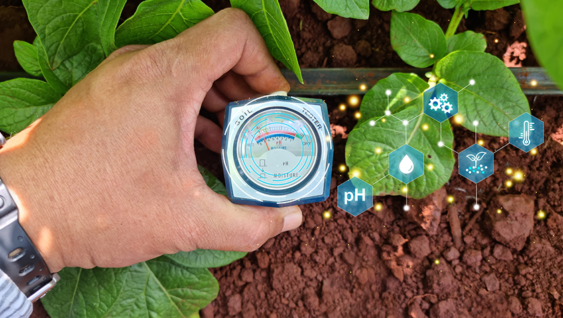
The Soil Moisture Network, we do have at our research farms, not just the one research farms that we have around Ames, but at our outlying research farms across the state. We do have weather stations. So, they’re not only collecting rainfall, wind speed temperature, but we also have sensors that go in the ground at 12 inches, 24 inches and 48 inches depth, and they are measuring soil moisture. And it measures it in volumetric soil moisture. So, it’s not telling us specifically this is the amount of moisture as far as inches. You can do a little bit of math and convert it, but it’s measuring it as volumetric soil moisture.
Dr. Lee Burras (08:55):
And in each case those field stations are working with a resistance or conductivity sensor. So, basically, it’s an electric pulse going through at the different depths. And then a few of the farms will have more depths. But Rebecca’s exactly right, we normally go three depths and then from that we calculate how many inches of water there is everywhere.
Mike Howell (09:13):
Okay. And this data is recorded with soil moisture sensors and I’m a little bit familiar with those. We’ve started using those a good bit here in the Mississippi Delta in the last, I’d say 10 years. And we’re using them more to schedule our irrigations, to see when we need to put out irrigation events and we can actually save one or two irrigations a year using these sensors. Is it the same type sensors that we’re using in the delta that you’re using in your program?
Dr. Lee Burras (09:35):
It is. It’s the same type of sensors that are routinely used for irrigation. We don’t use much irrigation in Iowa. A few places, but the exact same type of sensors. They work really well.
Mike Howell (09:45):
So, what all can your system tell us? I know you have a website and growers can go on there and find all kind of information and graphs. I haven’t had a chance to play around on it a whole lot, but I did visit it for a little bit. What all information is available to producers?
Rebecca Vittetoe (09:58):
You can find basically any type of weather data that you want to be able to find. So, obviously, we’ve got the soil moisture network that is capturing rainfall, wind speed, temperature highs and lows for the days. We also will monitor soil temperature, which that’s a really important one for us in the spring as we think about planting, are the soils warm enough for us to want to start planting. Or in the fall, when we think about fertilizer application, specifically, nitrogen and Hydrus ammonia or we also have a lot of hog manure that gets applied in the state as well.
(10:31):
So, watching those soil temperatures to see, okay, is it fit? Should we be thinking about starting to put that on now or do we need to wait a little bit? And then obviously it collects that soil moisture data as well. The other nice thing is it has the historic data, so you can go back and if I want to compare how the 2023 growing season was to say the 2020, 2012 growing season, because that was another really big drought year for us across Iowa. It’s a nice way to be able to compare the different growing seasons and see are there similarities, differences between them as well.
Dr. Lee Burras (11:04):
To extend on that a little bit, because Rebecca is exactly right, it has everything about atmospheric conditions, soil conditions, but I want to extend. Sometimes in some of the research I’m doing, I’m not interested in what last year was like. I’m interested in the past 120 years. And some of our field stations have going back more than 100 years. So, you can really start seeing how the moisture has changed from one time or another, how it’s differed, what the temperature has been. Wind conditions are not as consistent everywhere, but again, there’s all these properties that we can work with as producers, working with producers as they’re trying to optimize their yields next year.
Mike Howell (11:37):
Now, Lee, I know a lot of states have weather stations set out around. I grew up on a research farm in Mississippi and that was one of the daily tasks you had to go out and read the weather. Now, I’m sure all of that is automated now and it’s captured automatically, nobody has to go out there and reset the soil thermometer every morning. But how is this program around the country? I know Mississippi has the weather stations, we have soil moisture sensors that are going out in different counties around and we can look at those on the internet. And I heard something not too long ago that Oklahoma State had gotten a big grant, I believe to update their system and I think theirs is considered one of the best in the country. But how can other people in different parts of the country utilize this system?
Dr. Lee Burras (12:14):
Wow, great question and you’re absolutely right, Mike. More and more states are using these systems. More and more private sector groups are using it as well. Some of our big companies are putting out their own weather stations. I know farmers who have their own weather stations. In the case of Iowa, at least, we’ll tie them into our Mesonet, if they’re the right type of system, so that way all the data’s available to everyone always. But I’m always a huge proponent, you ask how people can use other ones, whether data is just like anything else. If you have a gap, the goal is to work with the surrounding stations. So, if I didn’t have something and say I was working somewhere in Iowa or even outside of Iowa, I would work with all the nearest stations and try to work back to where I’m at.
(12:51):
But in the end for $2,000 more or less, you can buy a really nice above ground sensor system that will capture rainfall, capture temperatures, wind speed, all those sorts of things and not too much more of investment, you can put it below ground too. I don’t think I answered your question very well, but I’m seeing what we call Mesonet in Iowa and some other states are calling it too, we’re seeing that system become more and more common and more and more powerful everywhere. But I’m not as familiar with what some of the states are doing, but I know everyone is getting better at it all the time. And what I would say if someone listening to your podcast, if their location doesn’t have a system like this, encourage their land grant university to invest in one, it will be worth it.
Mike Howell (13:28):
Hey guys, Mike here and I want to personally thank you for listening to today’s episode. If you like the show and want to continue hearing it, please like, subscribe, share and rate it. The future of The Dirt depends on your support. We’ve got plenty of big things coming up this season, so as always, stay tuned.
(13:51):
We’ve talked a lot about the data that we’re collecting and monitoring the weather data from 120 years back. As a researcher, that’s really exciting. We need that information and we can compare that, but what’s that going to do for the average farmers out there? We can go kick the dirt and understand that it’s dry or we can put in a moisture sensor and we know it’s dry, but if we don’t have irrigation capacity, how are we going to make a management decision based off of this information?
Rebecca Vittetoe (14:14):
I guess, specifically, thinking here in Iowa where there’s pretty limited irrigation, there’s pockets. If you get over by Muscatine, Iowa, there’s some irrigation, but widespread in general, Iowa is mostly dryland. But knowing that soil moisture status might change a little bit, what type of hybrids they may choose to plant. There are some hybrids that are going to be more drought tolerant, so they may talk with their seed dealers and try to pick out hybrids that are going to be a little more drought tolerant. If it’s looking like we’re going to be going into a drier growing season, they may adjust planting rates slightly.
(14:46):
Obviously, we still need to get plants out there, but they may back off planting rates or depending upon the soil types in their field, adjust seeding rates for that with thinking about soil moisture in mind as well. Another thing, and this one we don’t necessarily have control over as much, but the drier we are during the growing season, we can see some of our herbicides that we spray on our crops carry over to the next growing season, and so obviously nothing we can do, but just being aware of that and just know what to maybe look for. I know that was one thing we were worried a little bit after last year, how dry we were throughout the growing season, seeing more herbicide carry over. I think some of the moisture we’ve had now is going to alleviate some of what we may otherwise have seen. Not saying we won’t see any, but I think it’s definitely helped to alleviate some of that.
(15:33):
And I would say the other thing too, you mentioned nitrogen at the beginning is a big one for growing, especially corn, and that’s an important nutrient for us here in Iowa as well. And so, obviously, we worry about potentially losing some nitrogen when we have excess moisture. So, keeping an eye on where we are as far as monitoring rainfall totals, we can also do what they call the late spring soil nitrate tests. It’s the only test we have here in Iowa that we can test for nitrogen levels, but that can help farmers then plan to determine, okay, do we potentially need to add some additional nitrogen? A lot of them already do side dress, but they might adjust that side dressing rate as well.
Dr. Lee Burras (16:11):
I liked everything Rebecca said. I agree with it entirely. That’s where we have great field agronomists in Iowa. Professors slow us up, but the field agronomists do well. Two other things I’ll say is, with all the sensors and soil moisture, it’s not so much directly to the producer yet, but our modelers here at Iowa State are now being able to use this sort of information, and they’re starting to get to the point where by now they can almost predict what the yields will be this fall. And we’re getting really close to being able to predict on a real time basis, yield shortly after people plant.
(16:39):
And then the other thing of course that this is really useful for at the producer level is, everyone knew in Iowa that if we had another drought year, our corn yields, our soybean yields were going to plummet. We weren’t going to have anything. We used all of our soil moisture last year. This is telling us how much soil moisture is being replenished from this year into next year and whether we’ll need more replenishment the year after that. So, it lets people better predict their year out and then make all the adjustments as Rebecca was saying.
Mike Howell (17:04):
Well, I’m kind of going to throw you a curve ball. I wasn’t going to go down this road, but Rebecca brought it up, so let’s dive into it a little bit. Nitrogen management is something that’s on top of everybody’s mind these days. We know that we can lose that nitrogen when we put it out in the field. And with the 12 to 20 inches of rainfall that you were talking about in southeast Iowa there, how much nitrogen have growers lost and what do they need to do to see how much they’ve lost and how can they fix that problem?
Rebecca Vittetoe (17:29):
That is the question all the farmers want to know, but typical extension answer, it depends. When did they put some nitrogen on? Was it put on early last fall? Later last fall? Did they have a cover crop out there? Did they put it on this spring? Did they use the stabilizer? There’s a lot of different dynamics out there. But the late spring soil nitrate test, so that is one that they can go out and actually collect soil samples. Usually here in Iowa, we recommend when we think about taking soil samples for PK or pH levels and we’re taking six inch depth samples, but with the late spring soil nitrate test, we actually take 12 inch or foot samples, and we want to go out and do that throughout the field. We usually look at a row and divide it up into eight, so that way if people banded fertilizer or projected hog manure, we’re not just getting it right in that band or totally missing that.
(18:20):
But we can use that late spring soil nitrate test. The ideal time to do that is when the corn is between six to 12 inches tall and then we can send those soil tests off to a lab, and based off of those lab results, then we can see if we maybe need to add some additional nitrogen. Another way we can use, and this is a really rough rule of thumb, at least here in Iowa, is we can look at rainfall totals. So, in southeast Iowa, and this was some research that John Sawyer did for Iowa State, and he’s now retired, but he was our nitrogen specialist. But in southeast Iowa, which is typically south of I80 in Iowa and east of I35, that quadrant of the state, we have rainfall from March 1st through the end of June that is over 18 inches of rain.
(19:04):
We’re going to need some additional nitrogen or based off of the data that John collected, we would need some additional nitrogen. For the rest of the state, that is more from April 1st through the end of June, and I believe that there is 16 inches. If we have more than 16 inches then we need some additional nitrogen. And as far as the amount of additional nitrogen, some of that depends a little bit on how much did they put on. But usually we’re thinking about maybe 50, probably 75 pounds at most, depending upon how much they’ve already put on.
Mike Howell (19:34):
Okay. Well, I know we have covered an awful lot today in just a short period of time. Do either of you have any take home messages you want to leave our listeners with? Anything else that we may have missed?
Dr. Lee Burras (19:43):
I’ll just say, people should never confuse an atmospheric drought with a soil drought. Last year, in Iowa, we had an atmospheric drought. We didn’t have a soil drought. This year, we would’ve had both. And likewise, it can even be if you have a lot of rain, but the water can’t infiltrate for some reason. You can still have a soil drought and then your flooding in your rivers, but you don’t necessarily build up your soil. So, it’s always important to think about both.
Rebecca Vittetoe (20:06):
I guess, the one thing I would add is, obviously, soil texture plays a big role in this, so if we have sandier soils, they’re not going to be able to hold as much, compared to if we have silty soils or clay soils. And oftentimes, our clay soils can hold a lot of moisture, but not all of that moisture is plant available. It really is, as Dr. Burras said earlier, the silt is like that perfect, where it’s able to hold a lot and it’s also more available to our crops compared to if we have really clay soils.
Mike Howell (20:34):
Okay. Well, listeners, we appreciate you tuning in this week. We hope you’ve got a lot out of this segment. I want to remind everyone to hang on for segment two, and we’ll have that here in a few moments.
(20:44):
Listeners, I hope you enjoyed the first segment of today’s show. If you did, please take a minute and give us a rating on your favorite podcast channel or app, and give us some feedback as well. We want to hear from you to help make the show even better. And don’t keep it to yourself. Please share these episodes with coworkers, family, friends, anyone you think may benefit from the information we’re sharing here. Don’t forget to visit our website, Nutrien-eKonomics with a K .com to help find the latest crop nutrition news and research information, as well as market updates, a growing degree day calculator, a Nutrien use calculator, a rainfall tracker, and much more. It’s all at Nutrien-eKonomics with a K .com. Most episodes of The Dirt are now available for CCA credits. Visit our website and click on the agronomics tab to find these CCA credit opportunities. If you have a question you can ask one of our agronomy team members. Simply ask your question and one of us will get back with you. Thanks for listening. Now segment two of The Dirt
(21:52):
Well, listeners, we’re glad you’re joining us back here for segment two as we continue our tour around the country talking about different land-grant university research farms. Today we have Rachel Stevens with us, and she is going to be spotlighting a research farm with the University of Purdue. Rachel, if you would, start off by introducing yourself and tell us a little bit about what you do.
Rachel Stevens (22:11):
My name is Rachel Stevens and I’m the farm manager here at Purdue’s Agronomy Center for Research and Education. We are one of several different research farms that operate across the state, all serving the research faculty of Purdue. So, I get the privilege of managing this facility. We’re located about 10 miles away from campus. So, very convenient for our researchers to come out to the farm, and yeah, excited to talk about the farm today.
Mike Howell (22:40):
Rachel, let’s start off and talk a little bit about the history of the farm. How long has it been there and what kind of research do you do?
Rachel Stevens (22:46):
The farm actually started in 1949 with about 375 acres. This is actually a pretty big year for us. This is our 75th birthday for the farm, so we are very excited. Good timing to talk about the farm. We’re planning a lot of celebrations this year, and have been reflecting back on all the research that has been done here at the farm across the years. Like I said, started in 1949. Currently, we sit at about 1600 acres. So we’ve grown significantly across those 75 years. We accommodate researchers, over 80 different researchers from 14 different departments. So, a little bit of a change from the original days of the farm.
(23:26):
So, the original days of the farm we’re looking a lot of that really, initial research in things like soil fertility. We had a very strong plant breeding community. A lot of the genetics that were developed at the farm were genetics that were then being planted by farmers across the state. So, a little bit different type of research environment in the early days versus what we do now. We really have a lot of the same goals of serving our farmer clientele across the state, but seeing quite a few changes when we first started here. They made the hard decision to leave the horses at the old farm, some changes from infrastructure and changes from horsepower to all the research we now do in technology and digital agriculture and things like that.
Mike Howell (24:13):
Well, Rachel, what are some of the most significant contributions that the center has had over the last 50 years? You talked about a lot of the research going on, but what stands out as being some of the most important things?
Rachel Stevens (24:23):
Oh, gosh, that’s a great question. So, a few of the things that I can think of, we still have a very strong plant breeding community. That has been something that has been a priority since day one. I think at one point, something like 96% of the oats and maybe something like 80 or 90% of the wheat grown in the state of Indiana came from varieties that were developed here at Purdue. We also been very significant in breeding of popcorn and high lysine corn. The universal soil loss equation was actually developed in conjunction with USDA at Purdue in the 1950s. So, that was something that has been a foundational topic for soil science ever since. That was a very significant development that came from the farm.
(25:10):
In the ’60s, we had a lot of work in soil fertility. So some very groundbreaking work looking at appropriate soil fertilization based on soil tests, and working with farmers to help explain the concept of soil testing and then talking through different fertilizer sources and rates. So, some very groundbreaking, particularly I would say for the Tri-state region, groundbreaking work in soil fertility. The long-term tillage plots, those are actually in their 50th year of research here at the farm. Those are looking at four tillage types, three crop rotations and looking at the impact of what are those tillage types and crop rotations that impact through the years, impact on crop yield, impact on soil health. And more recently a lot of discussion about what is the impact of those on soil carbon.
(26:04):
Brown Midrib Sorghum was developed at Purdue, and that’s a very significant sorghum variety that is ubiquitous across the US now. Dr. Gebisa Ejeta developed his varieties of sorghum that are resistant to the parasitic weed, striga, here at the farm. And his work went on to win him the World Food Prize and feed millions of people across Africa. So, again, some very significant work in plant breeding here across the years. And soil science, I feel like I’m just rolling from one to the next here, but remote sensing. The Laboratory for Applied Remote Sensing was developed in the 1960s here. And that was one of the first really big pushes into the area of remote sensing.
(26:53):
So, this was looking initially at how do we use multi-spectral imagery? Can we use that for making decisions about the crops or understanding what’s going on? So, that was really one of the foundational test beds for what remote sensing is today, and a lot has been built off of that since. And it’s snowballed into, we do a lot of work with remote sensing, digital agriculture, ag technologies and robotics. So, very cool to see how that has progressed through the years.
Mike Howell (27:26):
Rachel, we’ve talked a lot about the history and what about the recent history? What kind of work is going on at the research farm today?
Rachel Stevens (27:33):
Yeah. So, still doing a lot of work in some of those areas that I talked about, as foundational areas in agriculture, but we’re looking a lot into more hot topics of climate resilient practices and things like that. So, some of our projects we have going on in that area are looking at things like agrovoltaics. So the intersection of solar and farming. So, looking at how can we more optimally bring those two together. We’ve got projects in drainage water recycling. So, looking at collecting tile drainage from the farm and then using that, storing it until we need to irrigate then on fields.
(28:12):
So, we’re trying to focus a lot more on things that are, of questions to the farmers in the state. How can we be better stewards of our resources? How can we utilize some of our land better? And then questions that they’re having from solar and wind companies and things like that. So, a lot of work in those climate resilient areas. But then also a lot of work in, I’m going to term it the digital ag technology space. So, looking at things like remote sensing, ag technology, robotics, automation, we’ve got all of that going on here at the farm as well.
Mike Howell (28:50):
Yeah. That seems to be a key thing that everybody’s working on these days. I can’t stress the importance of this robotics in agriculture. That’s groundbreaking technology, and I’m excited to see it develop. Rachel, that’s quite a history and a huge significance, not only to the people there in the state of Indiana, but as you mentioned, worldwide. Some of the varieties are being placed all over the world these days. We really appreciate the work that’s been going on there at Purdue over the last 75 years. This is a tough question and it’s one that I’m asking everybody we talk to about on this segment. Where do you see the farm going in the next 50 years? We talk about urban sprawl a lot. We talk about all the advances in agriculture and how that’s affecting these research farms, and sources of funding. We know we have to have operating capital to keep these farms going. So, what do you see as the future of the farm and what changes are they going to have to make to keep up with the change in pace in agriculture?
Rachel Stevens (29:41):
Yeah. You’re right. That is a very difficult question. As you were talking about that, it made me think, I am the third farm manager at this location. So, in the last 75 years, I’m only the third farm manager. The first farm manager was here for 37 years, the second, 34, and I’ve been here for about four years now. I sometimes reflect back on the amount of changes that we have seen from that first farm manager to now, just a dramatic amount of change. And it just makes me very curious what are the changes we are going to see in the next 50 years, and how the face of agriculture is going to change? I think really being a part of a land-grant university, our goal is really to address the problems that are being faced by society, by our stakeholders, and that’s really our core mission here at the farm too, is to continue to be responsive to the challenges that our farmer and stakeholder clientele are dealing with, and then developing novel research that meets those challenges.
(30:46):
Like you said, we see significant issues across the country with, particularly for research farms, and given where we are placed with urban sprawl and encroachment, and I will say Purdue has placed a very high priority on making sure that we are able to maintain our resources here, make sure that we are staying nimble and able to still conduct the research that is serving the state, serving the country and the world, really, like we mentioned before. So yes, I feel like we’re very lucky in that aspect that we have an administration that is very aware of that and prioritizes the impact that the farms are having for the state and the country.
Mike Howell (31:30):
Okay, Rachel. Well, we really appreciate you taking a few minutes to visit with us today and talk about the research farm there associated with Purdue. We appreciate all the hard work that’s been going on there for the last 75 years and know we’re going to keep seeing great things for the future.
(31:45):
Listeners, we appreciate you tuning in this week. As always, if you have any questions about anything we’ve discussed here today, you can find out more at our website. That’s Nutrien-eKonomics with a K .com. Until next time, this has been Mike Howell with the dirt.