






Read Full Transcript
[00:00:00] Mike Howell: The Dirt with me, Mike Howell, an ekonomics podcast where I present the down and dirty agronomic science to help grow crops and bottom lines. Inspired by ekonomics.com farming’s go-to informational resource. I’m here to break down the latest crop nutrition research use, and issues helping farmers make better business decisions through actionable insights. Let’s dig in.
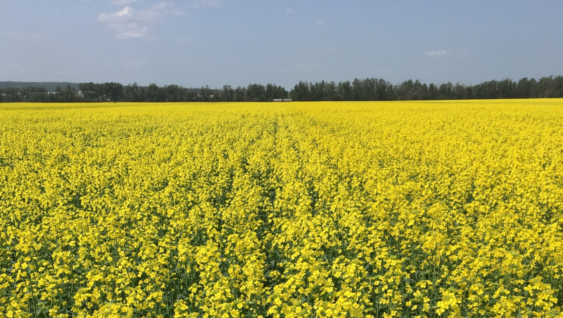
Listeners, welcome back to the Dirt. I’m glad you’re tuning in. Today we’ve got another continuation of our series from the Western Prairies of Canada. We’ve got Ray Dowbenko in the studio with us. Today we’re gonna talk about the importance of sulfur in crop production. Now, we’ve done several episodes in the past talking about sulfur, but I wanted to get Ray on and talk about this primarily because Ray is going to give us a different perspective. He’s been in that western Canadian area for a long time. He knows about the need for sulfur, and especially with canola, a crop that really needs that sulfur to complete its lifecycle. Ray, welcome to the Dirt.
[00:01:12] Ray Dowbenko: Hey, Mike
[00:01:13] Mike Howell: Ray, take just a moment and tell ’em who you are and what you did for most of your career.
[00:01:17] Ray Dowbenko: Sure thing. And thanks, Mike. I did my graduate work at University of Manitoba, and I finished that up in 1989 and went straight into the fertilizer industry. One of the companies was one of the predecessor companies of what is now Nutrien. So I, I’ve lived and worked in Saskatchewan in different parts of.
Alberta. I’m currently based in Calgary, Alberta. I’ve had a pretty much a 30 year long career with Nutrien. I started out doing field research, being a research and extension agronomist, new product development, market development, market support, working with crop nutrition and soil fertility, soil chemistry issues.
So mostly educating, learning, and then sharing information that I accumulated with growers and retailers and hoping to help them move ahead in their farm operations.
[00:02:00] Mike Howell: Okay, Ray. Well, let’s dive right in and talk about the importance of sulfur. We’ve had several episodes of the dirt where we talked about sulfur and why we need it for crop production.
Let’s take just a minute, if you will, and remind our listeners why sulfur is so important in crop production.
[00:02:14] Ray Dowbenko: Sure, and I’m sure from previous podcasts, your guests have talked about the importance of sulfur and amino acid production. So things like cysteine and methionine require sulfur, and that’s involved in protein synthesis.
We’re looking to make more efficient use of the nitrogen for protein. So if you don’t have. Adequate sulfur, you’re not gonna have adequate nitrogen use sufficiency and inadequate protein production. What’s involved in photosynthesis? As I mentioned, nitrogen use. Nitrogen use sufficiency, nodule formation for legume crops that are fixed your own nitrogen, important for things like soybeans and peas, lentils, that type of thing.
It’s also important in pod fill and grain fill, so it plays a number of different roles and it has many different interactions with other nutrients in the crop. And one of the things that really came apparent to me early, early in my career, especially here in Alberta, when we were growing canola and people were putting a lot of nitrogen on and the canola was not growing very well, it was actually going backwards with high nitrogen rates.
And it was back in the eighties, 1983, 1985, that the light bulb went off for most people in Western Canada is we didn’t have enough sulfur and it’s completely different. When you travel into parts of the United States and where I’ve traveled in northeastern United States, southeastern sulfur wasn’t so much of an issue 30 years ago, but it certainly is today.
And you know, it speaks to the environmental issues and the cleanup of sulfur in the atmosphere, atmospheric deposition, but we never really had that issue in Canada. To your comment, Mike. Yeah, we’ve had a lot more experience with sulfur management in the Canadian prairies than in most parts of North America.
[00:03:43] Mike Howell: That’s exactly right, Ray. We cleaned up this emissions and we were getting free sulfur up until then, and there was so much sulfur deposited in some areas that they’re still reaping the benefits of that. Today. I’m hearing some of those last holdout areas are really getting depleted now, and they’re gonna have to start making some sulfur applications in the near future.
We didn’t have a lot of sulfur nutrition work going on here in the US until probably the last 10 or 12 years I think there in Canada. Y’all have been doing research a lot longer than that. Talk a little bit about why sulfur is needed more in canola than some of the other crops. Seems like everybody is worried about sulfur in canola.
[00:04:20] Ray Dowbenko: Yeah, typically. That’s very true. I mean, it’s not to disparage or. Dismiss other crops ’cause all the crops that I said have a need for sulfur. And generally most crops require as much sulfur as they do phosphorus. But for canola, canola has a very high protein content and a high percentage of oil. And that means a high percentage of amino acids.
And again, that means cystine and methionine, and they need sulfur to form those two amino acids. And typically a bushel of canola is gonna take about half a pound of sulfur for every bushel. So we need to recognize if we’re growing. They’re between 35 and 70 bushel canola in some areas, depending upon what area the prairies we’re talking about.
We have very significant sulfur demands, and it’s not all necessarily gonna come from fertilizer application. We get mineralization from soil organic matter. We get leftover sulfur from past applications, but we’re generally looking at at least 35 pounds of sulfur going on per acre. And after that. It’s tough to say from research that there’s more than 35 pounds of actual sulfur needed in a growing season or not, and it’s kind of a diminishing return type of thing.
Usually with regular nitrogen applications, 30 to 35 pounds of sulfur is the upper limit of what we seem to need.
[00:05:33] Mike Howell: Ray, we always want to keep the four Rs in mind when we’re talking about fertilizer recommendation. You just mentioned rates, but today I wanted to focus on two of the other Rs. I wanted to really spend a little time talking about the time and the source of this sulfur nutrition.
As far as timing goes, when do plants need the sulfur to be the most available?
[00:05:52] Ray Dowbenko: Yeah, that’s a good question, Mike. And I’m actually gonna, not hijack just yet, but I will. ’cause I want to talk about time in two respects. Time, as you said in the crop, and then time. With respect to the source of nitrogen, but with respect to the crop, most crops have a season long requirement for sulfur.
Again, much like phosphorus. So start taking it up early and take it out through season long. If I look at something like canola, probably if we had to address sulfur deficiency in canola, we can go up to the early flower stage, unlike nitrogen, which we should get on prior to bolting sulfur. We’ve got a little bit more time, we can go up to the flower stage, but we do wanna have that sulfur in the soil and available for the growing season.
One reason for that is that sulfur is not mobile in the crop. So as the crop is growing, it needs a continuous supply of sulfur. It can’t be translocated from lower leaves to new growth. We’re gonna need season long available sulfur for that. And then that speaks to the time of application and the source, which I’m sure we’ll touch on in a little bit.
[00:06:51] Mike Howell: That’s exactly where I wanted to go next. Right? When we think about sulfur sources, there’s really two buckets. We’ve got the elemental sulfur or then we’ve got the sulfate sulfur. Talk a little bit about the differences in those two and when we should use one versus the other.
[00:07:05] Ray Dowbenko: Things like ammonium sulfate, so that might be 20.5 0 0 24, or 21 0 24. The first number being. Percent nitrogen. The last number being percent sulfur is ammonium sulfate. And typically we think about that as being immediately plant available when it gets put in the soil. So it’s immediately plant available, and that’s great for the plant. But sulfate sulfur is also mobile in the soil, which depending upon your environment.
May not be so great because it’s predisposed to leaching if you have heavy rainfall or water moving through the soil profile. If you are in a dryer area where you don’t have a lot of potential for leaching ammonium sulfate is typically used. We do have some areas that have significant moisture where we may be looking, as you say, at elemental sulfur product, depending upon the application method and the time that.
Maybe applied the previous fall, get some chance to break apart the granules to get some oxidation of the elemental sulfur to the sulfate form so that we have some sulfate available in the spring at the start of the season. And the balance of that oxidation is happening during the growing season. And then it depends on the type of.
Product, and we have different types of products out there. Certainly there’s pure elemental, and then there’s what I will refer to as sort of hybrids like the map, MST, that has a portion of elemental and a portion of sulfate. Sort of get the crop started with available source and have that oxidation going on through the season from the elemental.
And there’s. Pros and cons for all of this, and the pros for the sulfate is immediately available. The con is it, it’s also a potentially leachable source and the benefit of the elemental is that it’s a protected source, but the negative may be the not getting the oxidation when you need it for crop availability.
So it’s a balancing act.
[00:08:48] Mike Howell: Ray, I’ve heard for a long time that we really wanted to stay away from elemental sulfur just because it’s not gonna be all available in that first year. That’s gonna be another, it depends situation. If we’re looking at your part of the world, it may take it two or three years before all of that sulfur is available for the plant.
We look in a situation like that I’m in, it may be available within the first year just because of the heat difference there. Talk a little bit about what has to happen for that elemental sulfur to be oxidized and be available for the plant to take it up.
[00:09:17] Ray Dowbenko: I think I’ll start with the geographical separation that you just mentioned.
Like here in Western Canada back in the eighties, we have gas plants, oil plants, producing brick sulfur, people chopping it up into chunks and making elemental sulfur and putting it on as a fertilizer and putting it on in the spring and it’s not working and people say, well, you can’t use elemental. Well, it wasn’t that the product was necessarily no good, it was a time of application needed that oxidation.
So applying it for us in the fall. Having some dissolution of the granule, some fracturing, exposing more of the surface area to microbial breakdown in that oxidation that you mentioned is what we need. If I’m in Mississippi, Louisiana, theoretically, there’s probably cases where I could put out my elemental sulfur in the spring and have available sulfur for the growing season.
Because you do have that humidity, you have that microbial community. The activity is so much better. The other thing that we look at with elemental sulfur, not just the time giving it oxidation, is we can build up, when we’ve seen this in research, build up oxidizing bacteria communities in the soil by repeated applications of elemental sulfur.
We start to feed microbial communities and we see a buildup over time with repeated elemental sulfur applications, and then some work Mike McLaughlin did in Australia looking at multiple applications of elemental sulfur and seeing this community. Buildup of microbial oxidizers of elemental, but also a staircase like effect where you have year one’s oxidation occurring and producing some oxidized elemental sulfur to sulfate.
And then you have year two application on top of that and year three and year four, and you get a continued cycle, if you will, of continuously releasing elemental sulfur and a continuous source of ammonium sulfate sulfur or sulfate sulfur in that application situation.
[00:11:08] Mike Howell: Ray, you kinda mentioned it a few minutes ago.
You talked about some of these new forms of sulfur that is a combination of elemental sulfur, the micronized sulfur, as well as the sulfate sulfur. Talk a little bit about how these products work and how they’re different than either the sulfate sulfur or the elemental sulfur.
[00:11:24] Ray Dowbenko: Yeah, the combination products or the pure elemental, I referenced the chunk, which maybe was unfair, but that’s what it really was like 30 or 40 years ago.
People didn’t recognize that we needed certain micron size, a certain small size to start to break down fracture, and as I said earlier, expose multiple surface areas for oxidation by the microbial community. If we have very large particle sizes, it’s a very small surface area, and we don’t get. Very quick oxidation or breakdown of the particle.
It used to be we would tell people that we wanna see sub 200 or 100 micron particle size to get relatively effective breakdown of the granule, that elemental sulfur particle and exposure of large surface area for the microbial community. We’re seeing some of the newer products now that. Have sub 30 micron, 20 micron particle size, extremely small particles that break down very quickly, expose themselves to that microbial community.
So that’s very important in the elemental sulfur aspect, is to have small particle size for rapid breakdown, dissolution of the granule, and also exposure to surface area.
[00:12:34] Mike Howell: I don’t wanna put words in your mouth, but it seems like that type of product, it would also help protect against some of those leaching losses while that product is being broken down.
Is that right?
[00:12:43] Ray Dowbenko: I think that would be a fair comment because you’re gonna have relatively quick oxidation, but it’s not oxidation of everything all at once. It’s oxidation and a progression through time, much like a controlled release nitrogen source, not as precise as a polymer coated nitrogen like ESN in terms of release rates, but a similar idea can be applied to an elemental sulfur product, as such as you mentioned.
[00:13:06] Mike Howell: Okay, Ray, well I really appreciate you going through this with us, helping us understand these different products and when and how to use them. Is there anything else we need to realize about Sulfur before we sign off today?
[00:13:17] Ray Dowbenko: Well with respect to sulfur, as you started out at the top of the podcast, we look at four R nutrition source rate and time. And if you’re looking at the four R nutrition, I think the people who are listeners, retailers, growers, need to understand that you don’t look at four Rs. In isolation. All of the Rs are interconnected, and so we brought that out in the podcast.
I think when we talked about time, well, it depends on the product. We talk about the application method, it depends on the product, and we talk about the availability of each product, and that depends on the product. So you have to consider what product you’re using. For your environment, how is it best applied and when is it best applied to get the best benefit?
And I know you’re gonna have other podcasts with people talking about Sulfur nutrition. I know you’ve had other researchers and university people talking about sulfur. I again, just wanna reiterate the podcasts and the dirt is just a tremendous resource that UNE provides. And you’d provide Mike to the guests and the listeners.
I just think, again, retailers, growers. Crop consultants need to access this type of resource as needed and just check out the websites and get all the benefit of the downloads that are available.
[00:14:28] Mike Howell: Ray, we really appreciate that. Listeners, I hope you’ve enjoyed this episode as we refreshed our memory and dived into a few new topics in the world of Sulfur.
And if you will, hang around for just a couple of moments and we’ll be right back with segment two. Farming isn’t farming without questions, and now there’s a place to go for answers. At economics, an entire team of agronomists is waiting and ready to help for free. No question is too big or too small.
Visit Nutrien-ekonomics.com at submit your question with the ask an agronomist feature.
Listeners, welcome back for segment two, and now’s the time where we asked one of our agronomists our question of the week. Today we have Dr. Karl Wyant, director of Agronomy with Nutrien back in the studio with us. Karl, welcome back. All right. Thank you for having me, Karl. Today we wanted to talk a little bit about magnesium and the role it plays in crop production.
Also, we wanted to know if there’s any relationship between magnesium and nitrogen. Can you help us out with this?
[00:15:28] Dr. Karl Wyant: Sure thing. Let’s just go back to what makes plants so unique. That is they can take that sunlight, all that energy that’s hitting the earth every single day. They can grab that sunlight and they can transform it into a form of energy that’s actually usable by the plant.
It’s a very unique set of reactions. We can’t do that. Go late in your driveway. You’re just gonna get a sunburn, but your plant or your crop. Can actually do something with all that sunlight. Start making energy. The thing that makes the energy, like the translation sort of mechanism is chlorophyll. And if you were to break down that structure of chlorophyll, you would find magnesium sitting right in the center of that green pigment.
So magnesium helps to translate sun. To plant available energy. If you see plants without enough magnesium, they start to turn yellow on you. Stunted growth. They can’t use the energy from the sun like you want them to. So big, big reason to have magnesium in a program or be looking for any challenges with magnesium supply.
There’s some other examples of why we need magnesium serves as the building blocks when we’re trying to build protein. They help build the workbench, the ribosome, to make that protein. They also help to make that. In the cellular machinery, they start to make that currency that’s used to pay for biological work.
So lots of reasons to get excited about magnesium. One thing we also get excited about in the agronomy world is interactions. Now we’re not talking about antagonisms. What we’re talking about is the synergism. So we see that between magnesium and nitrogen. When we have a good magnesium program, it typically adds more efficiency to your nitrogen program.
Your plant is healthy. Your plant is well fed with the nutrients it needs and it can take in more nitrogen as a result and you get more uptake on your fertilizer program.
[00:17:14] Mike Howell: Karl, that’s something we definitely need to check out. Anything we can do to help with our nitrogen use efficiency, that’s going to be money back in the grower’s pocket, so we need to pay special attention to this.
[00:17:24] Dr. Karl Wyant: That’s right.
[00:17:24] Mike Howell: Karl, thanks for joining us today. We really appreciate you taking time out to enlighten us a little bit more about magnesium and the role it plays in crop production listeners, thanks for tuning in this week. As always, if you need any more information on anything we’ve talked about today, you can visit our website.
That’s Nutrien-ekonomics.com. Until next time, this has been Mike Howell with the Dirt. Hey, guys, if you like what you heard today. Do us a favor and share this podcast with someone else. It could be your neighbor, your friend, your crop advisor, or whoever you think would enjoy it. Your support helps ensure future episodes, so please like, subscribe, share, and rate the show wherever you’re listening from.