Stacie Yaremko, Agronomic Innovation Manager, Nutrien Ag Solutions
Stacie Yaremko, Agronomic Innovation Manager, Nutrien Ag Solutions
Stacie Yaremko is an Agronomic Innovation Manager with Nutrien Ag Solutions, based in the Peace Region of Northern Alberta. Stacie is working on a master’s degree in soil science at the University of Alberta, studying rejuvenation of forage stands using multi-nutrient fertilizer products containing elemental sulfur.
Elemental sulfur is no stranger to the Canadian Prairies; it has been researched extensively and used here for decades. The types of elemental sulfur products available, however, have evolved in recent years, and there is renewed interest from producers in their promise of increased operational ease and plant use efficiency.
An overview of elemental sulfur oxidation
Regardless of advances in product formulation, elemental sulfur will always have to oxidize into the sulfate form (SO4–) to become available for plant uptake. Oxidation of elemental sulfur is a biological process performed by specialized bacteria in the soil. The rate of this process is strongly influenced by the particle size of the elemental sulfur and soil temperature. Finer particles have greater surface area, providing more sites for soil microbes to access and oxidize the elemental sulfur.
The importance of soil temperature
Soil microbes oxidize elemental sulfur quicker under warm soil conditions. In the Canadian Prairies, where soils remain frozen for nearly half of the year, this presents a challenge for elemental sulfur oxidation.
A wide range of moisture conditions will support elemental sulfur oxidation; if soils are not exceedingly dry or saturated, sulfur oxidizing bacteria are able to function. Soil temperatures, however, have a significant impact on the rate of sulfur oxidation. Growth chamber research has shown that elemental sulfur oxidation essentially slows to a halt at soil temperatures at or below 3°C but increases rapidly with warming temperatures up to 30°C, with each five degree increase within this range nearly doubling the oxidation rate (Janzen & Bettany, 1987).
Why particle size matters
We cannot control the climate, but we can opt for elemental sulfur products with finer particle sizes to maximize elemental sulfur oxidation during the growing season. New manufacturing technologies have allowed for finer particle sizes than were possible in the past, improving elemental sulfur oxidation rates. When comparing multiple elemental sulfur products, particle size is very important to consider as there is a wide range available in the marketplace. Some products are below 20 microns in diameter and can oxide quicker, while others may contain very large chunks of elemental sulfur that can take decades to fully break down.
Sulfate sulfur versus elemental sulfur
Unlike elemental sulfur, sulfate fertilizer forms do not need to oxidize prior to plant uptake. This is both an advantage and a disadvantage. Although immediately available and readily taken up by plants, the sulfate form of sulfur may leach in conditions of excess soil moisture as water and leachable nutrients move down the soil profile beyond the plant rooting zone. Given the semi-arid climate of the Canadian Prairies, this is a relatively small risk, but coarse soils in areas that do receive very high amounts of rainfall face the potential for leaching losses. The elemental form of sulfur is insoluble in water and therefore protected from leaching.
How elemental sulfur addresses the challenges with sulfate
Sulfate fertilizers have been used with great success and have become integrated into many well-rounded farm fertility programs. However, the “bulkiness” of sulfate fertilizer is often identified as a barrier to increasing operational efficiency as these fertilizers generally contain a relatively low percentage of sulfur. For example, it would require approximately four pounds of ammonium sulfate to provide one pound of sulfur (plus just under a pound of nitrogen). Conversely, elemental sulfur is pure sulfur and can be added to combination fertilizer products with no extra bulk. With higher-analysis fertilizers, the seed drill is filled less frequently, and more acres can be covered per fill, which can make a very meaningful difference in our condensed spring seeding seasons.
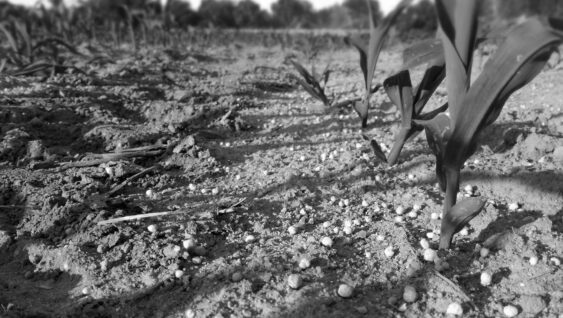
Aside from the added bulk, there are limits to how much sulfate fertilizer can safely be placed in the seed row. Ammonium sulfate fertilizers in the seed row can harm germinating seedlings through ammonia toxicity and salt effect; small amounts can be applied in the seed row safely, but higher rates may be damaging and should be placed away from the seed (i.e., in a side band, mid row band, or broadcast). Elemental sulfur, on the other hand, does not harm seedlings, providing greater flexibility in application rates and placement.
Another application challenge posed by sulfate fertilizers is their propensity to absorb water. Blends of multiple fertilizers are prone to absorbing moisture from the atmosphere; generally, the more products that are combined, the greater the risk. Ammonium sulfate and urea are especially prone to absorbing water from the atmosphere when blended together, resulting in clumping and caking in storage and/or during application. Elemental sulfur does not have the same tendency to absorb water, making it an excellent choice for blending or in products where multiple nutrients are combined in one granule.
Incorporating elemental sulfur into your fertility plan
Farmers and agronomists who are interested in incorporating elemental sulfur into their fertility plans may wonder exactly how quickly they can expect the elemental sulfur to oxidize. Unfortunately, this is one of those frustrating scenarios where the answer is “it depends.” Soil factors like pH, texture, organic matter, moisture, temperature, and history of elemental sulfur use on that soil all interact and influence the rate of elemental sulfur oxidation, making the question far too complex for a simple answer. Although sulfate release from elemental sulfur can be significant, especially if conditions are favorable and the elemental sulfur particle size is very small, a cautious elemental sulfur fertility plan will assume that a relatively small portion of elemental sulfur will be oxidized in the year of application.
If a strong sulfur fertility program has been in place and application rates have historically exceeded removal, there may be enough background sulfate-sulfur to span the gap until sufficient elemental sulfur is oxidized. If this cannot be guaranteed, some sulfate fertilizer may be applied alongside elemental sulfur to ensure there is sufficient sulfate available for young plants, especially for crops with higher sulfur demands like canola and alfalfa.
Figure 1: Dispersion of elemental sulfur over time and soil characteristics strongly influence oxidation rates (Janzen, 1990). Luvisolic soils tend to have lower pH, finer texture, and lower organic matter than Chernozemic soils, which contribute to slower oxidation rates compared to Chernozemic soils. Differences in soil characteristics within the same soil order, and even within individual fields, will also influence the rate of oxidation.
Choosing the right source of elemental sulfur
Producers and agronomists considering switching to elemental sulfur should consider a multi-year strategy. Repeated applications of elemental sulfur in subsequent years will ensure a more consistent supply of sulfate-sulfur as elemental sulfur applied in previous years breaks down further and disperses more thoroughly in the soil, leading to more complete oxidation and reducing the need for sulfate-sulfur fertilizer. Over time, dispersal of elemental sulfur in soil allows for improved access to sulfur oxidizing bacteria. The localized reduction in soil pH around an elemental sulfur granule may also suppress the activity of sulfur oxidizing bacteria (Gupta et al., 1988). This effect is reduced as the granules disperse over a growing season or multiple seasons.
The elemental sulfur product should be chosen with care. Because of the strong influence particle fineness has on oxidation rate, products with fine particle sizes are preferred. Elemental sulfur dust has the unfortunate quality of being explosive, so formulations are carefully developed with dust reduction in mind to ensure safety at manufacturing facilities, during storage, and on the farm. Some elemental sulfur products have a clay carrier, which reduces the risk of explosion while also promoting expansion and dispersal when the product comes in contact with water in the soil. Others are co-formulated with other nutrients, creating a homogenous granule for safe and easy handling, and a nutrient ratio compatible with crop needs.
Although the dynamics of sulfur oxidation are somewhat complex, elemental sulfur can and has been used in many successful operations across the Canadian Prairies. With a little thoughtful planning and consideration, elemental sulfur can be a great fit for both crop and farm efficiency needs.
Learn more about managing the sulfur in your fields with the following eKonomics resources:
Janzen, H., & Bettany, J. (1987). Oxidation of Elemental Sulphur Under Field Conditions in Central Saskatchewan. Canadian Journal of Soil Science 67, 609-618.
Janzen, H. (1990). Elemental Sulfur Oxidation As Influenced By Plant Growth and Dispersion Within Soil. Canadian Journal of Soil Science 66, 91-103.
Gupta, V., Lawrence, J., Germida, J. 1988. Impact of Elemental Sulfur Fertilization on Agricultural Soils. II. Effects on Microbial Biomass and Enzyme Activities. Canadian Journal of Soil Science 68:3, 463-473.