





Read Full Transcript
[00:00:00] Mike Howell: The Dirt with me, Mike Howell, an economics podcast where I present the down and dirty agronomic science to help grow crops and bottom lines. Inspired by economics.com farming’s go-to informational resource. I’m here to break down the latest crop nutrition research use, and issues helping farmers make better business decisions through actionable insights. Let’s dig in.
Well, hello again everyone. Welcome back to the Dirt. If you’ve been listening for very long, you know, we’ve been doing a tour around Canada and talking about Canadian agriculture. While I was in Calgary doing these episodes, I was fortunate enough to meet someone associated with Vivent and they introduced me to Nigel Wallbridge.
Nigel is gonna talk to us a little bit about Vivent and some of the technology that they have. Nigel, welcome to the Dirt. Thanks, Mike. It’s great to be here. Nigel, if you will introduce yourself to our listeners and tell us a little bit about Vivent and what y’all are doing.
[00:01:10] Nigel Wallbridge: Vivent is a company which was set up to look at signals inside a plants.
I’m a engineer from telecom’s background, and halfway through my time with my last company, I saw a way of networking that I thought must be present in plants. So I went out and started looking for these networks inside plants. Turns out they’re relatively easy to find. There’s lots of communication going on inside plants.
And then we kind of focused on an area and started to try and develop technology that would turn these signals into something useful for. Farmers.
[00:01:47] Mike Howell: So Nigel, I have learned over the course of my career, I’ve heard it a long time that people can actually talk to plants, and plants will respond to that. And I’ve heard that it’s because of the CO2.
I’ve heard this because of the different pitch that it makes the plants respond to the different pitch and the frequency of that pitch. But you’re telling me that we can actually listen to what the crops are saying. The plants can talk back to us and tell us what they need. Is that right?
[00:02:10] Nigel Wallbridge: Absolutely.
When you spend some time with this technology, you begin to realize that plants live. Although they appear to be sitting there and going very slowly, in fact, they’re living very active lives. And so to me, it’s not so surprising that. We can sometimes observe plants reacting to people. I’m not so convinced about the sound story, but I think that they changed the lighting conditions for plants and a sophisticated plant, A healthy active plant will respond very quickly to changes in lighting their photon machines.
On the other hand, inside the plant, individual cells need lots of information to make their decisions, and it’s that network that we tap into to help farmers.
[00:02:55] Mike Howell: Nigel, tell us a little bit about how you tap into that network. Tell us about the signals and how we can listen to what these plants are saying.
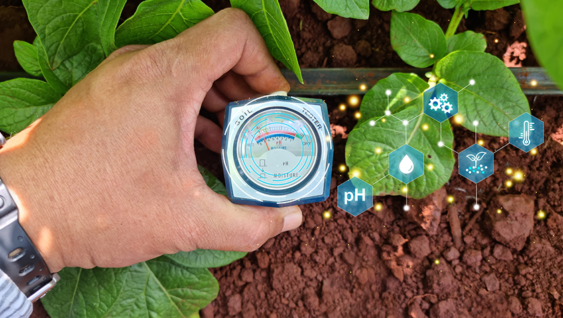
[00:03:02] Nigel Wallbridge: We spent a long time evolving technology, which is appropriate for farmers, and today we have a little device. It looks very like a small walkie talkie. You tie, wrap it to a steak next to your plant, probably put eight across a field and this device uses. Two little electrodes inside the plant to record these signals and then the signals get sent to the cloud where we interpret them using machine learning.
And we can tell you stuff like the crop is about to have an attack of mildew or the crop is short of nitrogen, much more your world might that. What do we need to give this plant right now so that it has the best possible conditions for growing.
[00:03:44] Mike Howell: Nigel Farmers can walk in their fields and they’re consultants and agronomists.
They can walk in the fields, they can see some signs and symptoms of what’s going on with these crops. How can these signals be detected with your sensors and can we see these symptoms earlier? What’s the advantage of these sensors?
[00:04:00] Nigel Wallbridge: Yeah, you’re exactly right, Mike. It’s all about getting early information from the plants.
If you think about mildew spores landing on a plant, if you get enough spores on the plant, eventually the plant might become infected, and maybe 10 days later you will see the symptoms of mildew on the plant. What we see using our technology is maybe even two days after the spores landed on the plant.
We see the plant’s systems kicking in gear, trying to fight the mildew infection, and so the big advantage of our technology is early diagnosis. Whether it’s early diagnosis of a biotic stressor like mildew or nematodes, we can see nematodes attacking the roots or whether it’s an abiotic stress or like a nutrient deficiency or a shortage of water, those kinds of things.
So Nigel, will the technology work with any crop? It will work with any crop. In practical terms, it’s much more effective on row crops, on permanent crops like trees, almonds, top fruit, those kinds of things. It’ll work on soy, it’ll work on corn, any kind. Big, robust plant is fine. Really fine plants like wheat or barley or oats, it’s kind of very fine grasses.
It’s a bit difficult to stick the electrodes in those plants, so we don’t have so many farmers using it for those crops, but all the other crops, it works well.
[00:05:23] Mike Howell: So Nigel, you mentioned that we could see the stresses earlier with this technology. What type of stresses can you detect with the technology?
[00:05:30] Nigel Wallbridge: So there’s this amazing internal network with all this information inside, and it’s taking us time to gradually pull out the words we’re decoding this signal one word at a time. So today we’ve got models, we’ve got algorithms for six nutrients. We’ve got two or three algorithms for water, and maybe four or five algorithms for different biotic stresses.
Like for example, aphids. And we’re gradually building up our library of algorithms for extracting information from these signals. But today, I would say 10, 15 different algorithms for things that we can give you predictions much earlier than you can see through visual symptoms.
[00:06:13] Mike Howell: I was looking at your website and I was looking at things like nutrient deficiencies.
You can pick up nitrogen, phosphorus, potassium, several of the secondary nutrients and micronutrients, drought, stress, some diseases, things like that. Quite a impressive list of things that you can detect
[00:06:29] Nigel Wallbridge: sometimes it just amazes me. So in the very early days, we did experiments with two of the micronutrients, calcium and iron, and the data scientists came back and said, look, nice.
We can see the difference. Between calcium and I and I said, come on, that’s just too good. But no, we’ve seen it. We’ve had that result reconfirmed by universities in several places around the world. We can see amazingly fine differences like in micronutrients from these internal signals. So
[00:06:57] Mike Howell: Nigel, by being able to detect these differences, what kind of practical benefits can it bring to farm management?
[00:07:03] Nigel Wallbridge: I think it makes much more difference where a farmer can. Pull some levers in response. If there’s no levers that you can pull in response, then if it’s just plant and forget, then our technology’s not gonna add a whole lot. The more levers you can pull, like irrigation, if you irrigate our technology, gives you a great chance.
To optimize your irrigation. If you Nutri Gate, we can shift your nutrition mix and just do much better by responding to the crop’s real-time needs. If you spray and if you’re doing preventative spraying. We can give you a really good way of reducing the number of sprays in a season by just spraying when we see the crop.
The crop’s a great sensor. The crop knows when there’s a disease in the field. The crop knows better than anyone when there’s a disease in the field. So if you can get that early sign, then you can save on your spray.
[00:07:57] Mike Howell: So Nigel, this system, is it gonna fit into everyday farm and operations? Are they easy to install?
And what other kind of technology do we have to have to be able to communicate with your sensors?
[00:08:07] Nigel Wallbridge: Sure. So I think that it’s a really good point. It isn’t an edge of network device right now. It does rely on transferring data to the cloud. So we use an iot network to transmit the data to the cloud. And so it may be that you need to install a LoRa network, a LoRa gateway, something of that kind, a long distance IOT network.
It’s fast and simple to install. The interpretation of the signals is getting easier and easier as we build better dashboards. But I have to admit, Mike, that it’s a journey. You know, in 20 years time, this technology could just be brilliant today. It’s interesting, um, for the farmers who want to know these things.
It’s amazing once they have it, very few farmers give up on our technology, but I have to admit, we’re at the start of a journey. It’s not the end of a journey.
[00:08:56] Mike Howell: So what kind of training is needed? How can somebody interpret the result? Is it pretty self-explanatory, or do you need some in-depth training to know what you’re looking at?
[00:09:05] Nigel Wallbridge: In general, the farmers who want this kind of thing, who want this kind of information, they look at it and they just self stop. They can see the changes. They can see, wow, I just made a change to my irrigation strategy and it didn’t work. I need to go back to what I was doing two or three weeks ago. So.
Yes, they can benefit from it immediately, but we do also provide tons of support. There’s tons of tools and you have access to people. You can have a video conference with us and say, okay, well what happened? I can see something’s happening at night. The last two or three nights, something was happening.
Do you have any explanation for what that could possibly be? So you can discuss that with our experts and find out. But one of the things I’ve learned coming into this industry as farmers are short of time. They’re really short of time. They’re people under pressure, and so we have to make this as slick as possible so that they can understand what the plant is saying to them as quickly as possible and make corrections.
[00:10:01] Mike Howell: Nigel, there’s never enough time to get anything done on a farm. Anything we can do to help save time is going to be a benefit. I’m really excited about this technology. I hope it’s going to be as good as it can be. Nigel, what does the future look like? You know, you said it’s in its infancy. What’s the next stages and how do you see it progressing?
[00:10:19] Nigel Wallbridge: Right. If you think about it from a kind of technology developer’s perspective for a few seconds, rather than a farmer’s perspective, we didn’t know if this thing would work at all. And so we’ve had a long period where we’ve grown the technology to where it is today, and that’s been done. In general directly with farmers.
Farmers who we met, farmers who we saw at shows, farmers who just got interested in the technology. But it’s been kind of direct. That isn’t the way that we’re gonna be able to sell this in the future. We need to be working with trusted distributors, trusted advisors in different countries, and that’s what we’re building right now.
We’re building distribution networks in different countries. Canada. We’ve made better progress on, as you can tell, from being up there. We’re just starting to make progress in the us. There’s certain countries in Europe where it’s going really fast. That’s our journey for the next three or four years,
[00:11:08] Mike Howell: Nigel, and this technology is available, it’s ready to go.
How can farmers, if they’re interested, how can they get in touch with you? What can they do to take advantage of this technology?
[00:11:17] Nigel Wallbridge: We just delighted just go to the website. Fill in the form, give me a call, send me an email. As you know, Mike, we’ve only just met relatively recently and I think you and I have got tons of things to discuss, so happy to have conversations with anyone.
Well,
[00:11:30] Mike Howell: Nigel, I really appreciate you taking time to visit with us today. I know I’ve learned a lot in our short time together today. I hope our growers have learned a lot from listening to this as well at least sparks some curiosity and investigate this technology a little more. Nigel, before we sign off, is there any closing message that you wanna leave our listeners with today?
[00:11:48] Nigel Wallbridge: I would hope that just from the few minutes that you’ve allowed me to have, Mike, people will look at their crops and just think those plants are living very active lives. They’re not just doing things hour to hour. They’re definitely doing things every five seconds. They’re adjusting themselves to be as biologically successful as they can, and if we can start to learn about how they’re doing it, then this is potentially the start of a agricultural revolution.
[00:12:17] Mike Howell: Very good. Well, Nigel, we sure appreciate it. Listeners, we appreciate you tuning in this week. If you will, hang around for just a couple of moments and we’ll be right back with segment two. Farming Isn’t farming without questions, and now there’s a place to go for answers. At economics. An entire team of agronomists is waiting and ready to help for free.
No question is too big or too small. Visit Nutrien-ekonomics.com. And submit your question with the Ask an agronomist feature.
Listeners, welcome back for segment two, where we talk about an agronomy question of the week. To help us do that this week we’ve got Alan Blaylock back in the studio with us. Alan, welcome back.
[00:12:59] Alan Blaylock: Thanks, Mike. Good to be here.
[00:13:00] Mike Howell: Alan, last time we had you on, we started a conversation about fall fertility. To continue that theme, this week’s question is when is it appropriate to make nitrogen applications in the fall, and when do we need to avoid these nitrogen applications?
[00:13:14] Alan Blaylock: This question always comes up as growers are trying to balance the workload, the time demands of their operations, and getting things done with good agronomy and applying nutrients at the right time. This is one of our four R principles. What is the right time? In many situations, applying nitrogen in the fall is not a recommended practice.
Now, there are some environments where applying nitrogen in the fall is acceptable. For example, low rainfall regions where we don’t have significant loss potential over winter, or an environment where we can usually apply nitrogen in the fall, particularly if we use say a nitrification inhibitor with that nitrogen to minimize our risk.
But for most of the eastern half of North America. We have too much rainfall through the winter and early spring that creates risk of nitrogen loss. And as weather data shows that in many parts of our geographies, the winter temperatures are becoming a bit warmer, we’re seeing a bit more precipitation.
And a great example of this is Minnesota. There’s been some great data there that’s been put together showing how the winters have become warmer, and our precipitation over winter has increased. So when we look at these environments where we have potential for over winter loss, either leaching or denitrification would be the main losses we’d be concerned about.
We don’t really want to apply nitrogen in the fall. It’s not the most efficient way to use that resource, and that’s a concern not only for the environmental impacts, that nitrogen that leaves the soil and goes into water or air, that’s obviously having an environmental impact. That’s not a good thing.
But also consider that every pound of nitrogen the grower buys that doesn’t go to producing his crop. Crop is a wasted resource. We want to get that nitrogen into the crop and if it’s going to be lost, that’s not very efficient. Use of nitrogen, take a look at those conditions, and in a lot of the eastern half of North America, we really want to be applying our nitrogen.
It’s certainly the majority of our nitrogen in the spring, and even as split applications, pre-plant plus a side risk kind of thing. Having said that, there are some cases where modest or small amounts of nitrogen applied. Planting may be beneficial, and let’s take winter wheat as an example, and wheat grows quite late into the fall when soils are quite cool and it will take up some nitrogen in the fall.
We’re talking small amounts, maybe 20, 30, 40 pounds of nitrogen per acre. Maximum and that nitrogen is essential for a good establishment of the crop. Getting your tillers established and getting that crop in good health going into the winter now too much nitrogen makes the crop a bit too succulent. It grows a bit too much and may not be as winter hardy, so we have to get the right amount, but a small amount applied in the fall at seeding may be beneficial just enough.
That the crop will use it. We don’t want excess nitrogen residing in the soil over winter and into the spring when the crop can’t use it. These are considerations we wanna look at. Forage grasses also are a case where we might be able to put some nitrogen on in the fall. These forage grasses, perennial grasses are pretty aggressive nitrogen feeders.
They utilize that nitrogen, those nutrients to help store energy reserves, carbohydrates in the root system. To give it strength over winter and start stronger in the spring. So again, a small amount of nitrogen in the fall can be beneficial for those crops. But in general, we don’t want to be applying nitrogen in the fall where it’s just going to be sitting in the soil not utilized by a crop.
Being exposed to the various loss mechanisms that may take place in an environment. So consider your rainfall, your loss potential, the type of soil you have. Certainly sandy soils, we should never be applying nitrogen in the fall. Consider those variables and the potential for losses, our main driver there, and we just don’t wanna set ourselves up to waste that resource and put nitrogen out that’s gonna be lost and not contribute to the crop the next year.
For those growers that are going to be applying nitrogen in the fall, let’s say for a spring planted crop setting aside those conditions I talked about like forage grasses and maybe winter wheat and other winter crops, we’re not talking about those. We’re talking about applying nitrogen that’s gonna sit there in the soil.
Until the crop uses it next spring, if they are going to be applying nitrogen in the fall, it is strongly advised to use a nitrification inhibitor or some kind of enhanced efficiency fertilizer like our ESN is slow release material that’s going to protect that nitrogen from much of the loss over winter, for example.
Anhydrous ammonia used with nerv. If you’re going to apply nitrogen in the fall, that’s a best practice. Use anhydrous ammonia and use nerv or an ESN product, or at the very least, use some kind of inhibitor to stabilize that. But anhydrous ammonia with nerv, that would be one of your first choices for fall application because you’re stabilizing that nitrogen.
If you’re in a situation where you do. Need to or want, put that nitrogen in the fall, take that extra step, that extra precaution. Now the other thing that goes along with that is applying nitrogen late when soil temperatures have cooled down. Keep it in mind that nitrate is the form that we’re going to be most concerned about, and ammonium will convert to nitrate if we apply that.
Ammonium form like anhydrous ammonia. Late in the fall when soil temperatures have cooled off, typically recommended below 50 degrees and cooling, then those bacteria that convert ammonium nitrogen to nitrate will start to shut down. They’ll be much less active, and the nitrogen will be. Retained in the ammonium form much longer.
So if we can keep it in the ammonium form through the winter, it’s gonna be much safer than if we apply it too early. The soil’s warm and it converts to nitrate where it’s going to be susceptible to those various losses using the proper form of nitrogen and using an inhibitor or stabilizer or some enhanced deficiency and applying it late when the soils are cooled to retard the transformation of ammonium nitrogen to nitrate.
These are things that the growers should be doing if they’re going to be applying nitrogen in the fall.
[00:19:11] Mike Howell: Alan, great advice. We know a lot of people wanna try to get this nitrogen out in the fall, but need to make sure we’re not losing that nitrogen before we make those applications. Listeners, if you have any questions about anything we’ve talked about today, please visit our website.
That’s Nutrien-ekonomics.com. Until next time, this has been Mike Howell with the Dirt. Hey, guys, if you like what you heard today, do us a favor and share this podcast with someone else. It could be your neighbor. Your friend, your crop advisor, or whoever you think would enjoy it. Your support helps ensure future episodes.
So please like, subscribe, share, and rate the show wherever you’re listening from.