






Read Full Transcript
The dirt with me, Mike Howell, an eKonomics podcast where I present the down and dirty agronomic science to help grow crops and bottom lines. Inspired by eKonomics.com farming’s go-to informational resource. I’m here to break down the latest crop nutrition research use, and issues helping farmers make better business decisions.
Through actionable insights. Let’s dig in.
Well, hello again everyone. Welcome back to the dirt. Spring is in full swing now and people are starting to get in the field. We’re starting to get some crops planted around. Thought it would be a good time to make sure everybody is up to date on their recommendations. As far as fertilizer goes, we’ve done a couple of episodes on this in the past.
We know some states have changed their recommendations. I was at a meeting last December back at the. North Central Soil Fertility Conference, and I met Dr. John Grove with the University of Kentucky. He was talking about some changes that the university has made to their nutrient management recommendations, and we wanted to visit with him a little bit today and see what changes have been made.
Dr. Grove, welcome to the Dirt. If you would, take just a moment and introduce yourself to our listeners.
Thank you, Mike. My name is John Grove. I’m a full professor in the Plant and Soil Sciences Department here at the University of Kentucky. For the last 40 years, I’ve been doing soil fertility, soil chemistry, and nutrient management research, and lately extension work.
And in the past year and a half, we’ve spent a great deal of effort updating at least some of our fertilizer rate recommendations. Those are embodied in a document called AG r dash one, which is the university’s guide in this area.
Dr. Grove, I mentioned a minute ago that I met you last December up in Des Moines at the North Central Soil Fertility meeting, and I think you mentioned that you were the only person at the University of Kentucky working in soil fertility.
Now I know several people that used to be working at the university in soil fertility, but it looks like you’ve ran everybody else off and you’re there working on it by yourself now.
Well, technically I’m not the only one working, at least broadly in the area. Dr. Richie, who’s my co-chair on this committee, is heavily involved in so fertility work.
There is some work being done by some of the other specialists and research faculty usually as a part of larger objectives in larger programs, but we can take that data and use it. As part of fertilizer rate. Recommendations. Updates. So if I said I was the only one, I may have Overp spoke that situation.
Maybe I misunderstood. But I do recognize the University of Kentucky and a lot of the people that have been there in the past, a lot of great work that’s came out of that university over the years. Dr. Grove, let’s go ahead and jump in, and I wanted to focus in on some of the things that you talked about in your presentation up there.
You mentioned that you’ve made some changes to the fertility recommendations, especially for grain crops there in Kentucky. Obviously you’ve got plenty of work to do and you don’t want to just make these changes to have something else to do. Talk a little bit about why the change was necessary and what research went into these changes that you made here
in the green crops area, there were three major areas in which we.
Looked at the data that we had and decided we needed to make a change. One of them was nitrogen for corn, strictly for corn. We haven’t had any big changes for the small grains that we grow here. It’s also true that we looked at phosphate and potash for all the grain crops, with the exception of grain, sorghum, and canola.
So we looked at p and K for corn, for soybean, and for the small grains. The reasons for that, of course, were that it seemed that we were faced with, at least in terms of phosphate and potash, even those who were good clients and following our recommendations were experiencing a decline in their salt test levels in their fields over time.
And we realized that. In part because that’s the nature of our good clients, that it’s on us to try to figure that out. On the nitrogen side, there was some consideration for the fact that some of the research was showing that some of the nitrogen rates that we were recommending were insufficient, but there were contradictory data.
In terms of when you used more loss prevention techniques, as part of the research, you tended to end up with a lower agronomic or economically optimum nitrogen rate. So there was some contradictory evidence there, and these situations called for a reexamination. Not least of which also is the final reason, which in the grain crops arena, we had not made major changes to NP and K recommendations probably in the last 10 to 15 years.
So it was time to take a look.
I. Well, we have been talking about that a good bit. In my travels. Everybody seems to be recognizing that we need to take a look at these. We’ve done a couple of episodes on the dirt looking at that. A lot of people are reevaluating their recommendations and taking a deeper dive into it.
Dr. Grove, let’s dig a little deeper and talk a little bit about what changes actually took place. I guess let’s take it by individual nutrient and start with the nitrogen recommendations first. You talked about some deficiencies there and some contradictory information. What actually changed on your nitrogen rec?
Recommendations.
Well, we looked at the research data over the past 11 years. Because that window encompasses a fair range in our climate across the state without getting into 2012, which was a very severe drought. We didn’t really want data from 12. So starting with data from 13 going all the way through.
23, and we actually ended up with some 24 data in there as well. The bottom line was we gathered response data in order to get a full shape to a response, we need at least three, and it’s better to have three rates in the field. The sites could be on farm tests, that could be research station tests, and there was about one third on farm and two third our environment, two thirds research stations.
And we looked at that data in terms of. What was the optimum nitrogen rate that was observed? Now we parsed the data. I call it Benning. We bend the data according to a number of parameters. Was the trial irrigated or not? Was the trial a no-till trial or not? Was the previous crop? Corn grain, sorghum, wheat, wheat, soybean, soybean itself, things like that.
We also bend the data for things like, was a nitrogen loss inhibitor used for the nitrogen in the trial or no, it was not used. Also was placement used was the fertilizer, let’s say side dress, but injected versus side dress, but placed onto the surface. The of the data permits us to do what I call a meta-analysis, where we can group this very diverse and large group.
There were 150 some odd sites, site year and com management combinations that we got from the investigators, and we were able to bend those appropriately. We could look at these questions as long as we had enough representatives in any given bin and as long as, and they were, most of the time those things were normally distributed, then we could compare the mean or median values between one pile of data and the other pile of data that were separated according to a bin parameter.
It doesn’t mean that we had equal amounts that we needed for all the questions we had. We discovered at the end of this process that there were some questions that we still don’t have good answers to, and therefore we did not change AG R one nitrogen recommendations for corn in general. What happened was that.
The top end of the recommendations went up a little bit, especially wherever we have corn. After corn, the bottom end came up a lot. In other words, we had always recommended what we called a rate range of about 30 pounds of end per acre. The bottom end shifted up a bit and some of the bins that we had, and then the.
Top end went up more modestly. The other thing that changed was we no longer been in exactly the same way. We had, let’s say, three classifications of soil drainage. Now we only have two where we make a nitrogen rate distinction Between the two, we have the wells and moderately wells versus the poorly and somewhat poorly drained.
There’s a separate nitrogen recommendation. Previous to this version of AGR one, we never really separated corn or grain sorghum as previous crops. From wheat, soybean, wheat, or full season soybean by itself. Now we do. We’ve always had a separation for things like a previous crop of alfalfa or grass sod, so that was no different.
Although we didn’t test that very much in the past 10 or 11 years of data, I. We’ve also now got a table where we take into account whether or not a serial cover crop, particularly a heavy one, was in place, because that affects the nitrogen rate. It tends to go up in terms of the need. And the final table factor we now have that we never had before was the use of a urease inhibitor where.
At least two thirds to three quarters of the nitrogen is applied after V four. In other words, we’re split applying or delayed applying nitrogen. And if we’ve got certain situations, there’s a major difference in the nitrogen rate range that we’re gonna recommend. It’s at 20 15, 20, 30 pounds higher if you don’t have that urease inhibitor to decrease the loss of nitrogen from that application.
Dr. Grove, I wanna go back and touch on a couple of points you mentioned there. First, let me make sure I understood you right. You said that there was an increased need for nitrogen where you had the heavy cover crops. I know Kentucky is doing a lot of work with cover crops, and a lot of people seem to think that cover crops are the cure all for everything but.
I’m not in that ship yet. I think cover crops have a place and we still need to do a lot more investigation around them, but I’m not gonna say cover crops are the answer for all our problems. Did I understand right that you said that the nitrogen needs are increased where you have a heavy cover crop and if I heard that right, explain that a little more to us.
Why do we need more nitrogen? It only
applies when it’s a heavy cereal cover crop like cereal rye, wheat, barley. Then we see, and by heavy we mean 1500 pounds or more dry matter. That’s a whole lot of cover crop at that point. If you’ve got a cover crop, even if it’s a cereal cover crop and you kill it when it’s short.
Doesn’t have a lot of dry matter. You don’t get a lot of tie up of nitrogen as the cover crop decomposes, and that’s what we observed in these trials. It just seemed like the nitrogen was being immobilized or lost due to volatilization in certain cases that that nitrogen was being tied up by that cover crop.
The microbial community as that cover crop was decomposing, but that only seems to matter when you’ve got a very high C to end ratio type cover crop, like a rye, a barley, a wheat, and you’ve got a lot of it. In other words, it’s fairly, rank is the word I would use. Then you’re gonna need some extra nitrogen, at least according to the data that we had at the time we were making this evaluation.
Another point I wanted to follow up on, you mentioned that you would need to use another 10 to 20 pounds of nitrogen if you didn’t use an inhibitor. Now we’ve talked about the urease inhibitors a lot. We wanna do everything we can to protect this nitrogen. We know that if we don’t get that nitrogen incorporated, we can lose that nitrogen.
That seems like some pretty easy math there. If we’ve narrowed it down to 15 to 20 pounds increase where we’re not using an inhibitor, doesn’t take much math to calculate whether that’s gonna be an economic return to us or not.
That’s correct. Again, it takes specific situations. If you inject the UAN or.
You could even inject urea if you wanted to. It does not apply. You do not need a urease inhibitor in that situation. But if you’re putting it particularly UAN over the surface of residues, like heavy corn residues or heavy cereal rye, or these other residues, then yes, we can get a significant benefit from including a urease inhibitor, which protects the urea component of UAN and the urea in the prills.
All, all over. As long as it doesn’t have to protect for three weeks or more because then it plays out. The inhibitor is good for a couple weeks for sure, in our environment. Occasionally three weeks, but you need a ring to really incorporate. The URE inhibitor will not last forever, but if you have it and you have that situation, you’re right.
It is pretty easy. Take 15, 20 pounds times the cost of your end. That amount per acre. If you can get a urease inhibitor in the mix for significantly less than the cost of the nitrogen, then definitely it’s a practice to consider as a economic benefit as well, in some cases as an environmental benefit.
Well, Dr. Grove, we could sit here and talk about nitrogen and nitrogen management all day, but let’s move on away from nitrogen and talk about phosphorus a little bit. Uh, what, what kind of changes did you make in the phosphorus recommendations?
Basically because the salt test P was declining, even when our good clients were following our SALT test recommendations, we decided that the major problem had one of two possible causes.
The first cause was over this time period. We look back all the way to 1992 when. Frankly, maintenance fertilizer rates were part of our recommendation. We got looking and we saw that decline went all the way back to that time period. So we decided then that there was one of two things going on, which was that we either had a major expansion.
Grain crops and that new land coming into grain crops was coming from relatively less fertile pastures, hay fields, things like that, which in Kentucky, that’s where it would’ve come from. Or simply that maintenance fertilizer rates were inadequate. In other words, it’s not an area where you expect a lot of immediate bang for the buck in terms of it’s not.
High probability that you’re gonna get a real big ROI for maintenance fertility. It’s there to maintain an optimal level to minimize the possibility of nutrient deficiency anywhere in a given field. That’s what maintenance is all about. First thing we looked at were our acreage changes and where those acres came from.
Corn and wheat did not experience a great deal of acreage change. The big acreage difference was in soybean, but yet when we looked at the soybean salt test data, where these new acres were coming in against corn and against wheat, the declines were effectively the same. So over that time period, even though soybeans experienced a major expansion, we added about a half a million acres of soybean during that time period.
We didn’t see any blo or bloop in the decline of soil test P during that time. That put us in the middle of our second thought, which was that, okay, what have yields been doing in this 30, 35 year period? And sure enough, as we all know, yields have been increasing. P and Q removal in the grain also had to be increasing.
It turned out though that when we examined the new Danda on grain composition, there’s a recent paper out from the University of Illinois by IL and co-authors. It turned out that the changes in grain pea and grain Kaley also were not the same for cereals IE corn and wheat as they were for soybean.
Soybean nutrient concentrations had been increasing relative to what we had as norms. When we developed AG R one recommendations, cereal grain composition, p and k levels declined significantly between what we had and where we are now. I don’t know why, but the scuttlebutt I get from plant breeders is that plant breeders.
For the cereals have been very focused on increasing the amount of starch and other content, and that is why p and K levels have declined a bit. Whereas for soybean, that hadn’t happened. And I don’t even have any sense of why soybean went the opposite direction from wheat and corn, but it certainly did.
So when we incorporate that data and we take the yields we have multiplied by the new. P and K at grain levels. We discovered we were under recommending for our maintenance rate, part of our salt test region. We looked at salt test P versus yield response data, and our cutoffs are still gonna remain the same.
If you’ve got a 300 pound K per acre, 60 pound phosphorus per acre soil test, we’re not gonna recommend any fertilizer. We go to zero at that point, but we have expanded the maintenance recommendation. In some cases it doubled for soybeans. Our maintenance recommendation was only 30 pounds. K two O. Per acre.
It’s now 60 others went up more modestly for weed. It went up from 30 to 40. But the same thing is happening. The problem is we don’t have good response. The probability of an economic response, even to a maintenance rate, is not very high in that region. ’cause we’re right at that. Between the medium soil test and the high soil test, but yet we know we need to maintain it or we’re going to incur a larger penalty and a larger fertilizer rate recommendation in the next season.
And because some people only soil test once every two or once every. Three years in our state. That’s where the maintenance gets to be critical. You don’t want them going into that second or third season woefully under fertilized, where their potential for a nutrient deficiency in some part of the field may be very significant.
Dr. Grove, I guess the next big nutrient we need to talk about is potash. What kind of changes did you make in your pot Ash recommendations?
For the same reasons as we discussed earlier. For phosphate, we discovered that our pot ash. Recommendations in the maintenance part of our tables was inadequate.
Yields have gone up, potash removal has gone up, and the recommended maintenance rate was too low. Again, it was expanded. It didn’t go up quite as much for the cereals, for corn and for wheat because the grain composition has shifted to a slightly lower percentage for K in terms of wheat and corn grain, but it got higher for soybeans.
So we have a major increase. In the K two O maintenance recommendation for soybean, and we have modest increases. For both wheat and corn. Corn yields, of course, are quite a bit higher, and they’ve been growing at a faster rate than wheat yields. So again, that one went up more than wheat did. But the bottom line is our wheat, small grain potash recommendation went from 30 to 40 for corn.
It went from 30 to 50, and for. Soybean. It went from 30 to 60 pounds, K two O per acre. But like I said, it’s not like we’re promising a big ROI for this. It’s more like it’s protecting against a deficiency. If you’re not soil testing every year because you’re putting on that maintenance rate, then you’re protected better against a very significant loss in fertility before you get back to pull cell test again.
Dr. Grove, we did a podcast a week or two ago with John Jones with the University of Illinois, and he kinda said about the same thing you’re saying, we can’t let these levels get too low because it’s just too hard to bring them back to that optimum range if we let ’em get too low. I didn’t prep you for this question, and you may get mad at me for throwing it out there.
If so, we’ll just cut it out. What about Sulfur nutrition? Did you make any changes to your sulfur recommendations? The reason I ask this is. That’s an issue I’ve been seeing in my travels across the country. It seems like sulfur is needed more and more these days. Can you talk a little bit about that?
Sure. That’s really not a problem to talk about. Kentucky came late to the sulfur party, frankly, because of the number of coal fired power plants. We still have several in operation. Actually. We had one paradise. It was called. That’s an interesting name for a power plant, but the bottom line is it was literally permitted to release 10,000 tons of SOX per year.
Well, if you’re downwind of paradise, and two thirds of the grain production region in Kentucky is downwind of paradise, there was never much of a problem with sulfur. It is true in fact that it was the upwind side of paradise because those plants were shut down earlier. Also because they didn’t admit nearly as much legally, we started to see a spot here, a spot there, and we knew it was sulfur because we could confirm it with tissue tests.
But it was really hard to get larger land areas where you could do field research and then come up with a kind of numbers where you could make a recommendation. Recently, about three or four, five years ago, paradise was shut down. The last boiler was shut down. So now that major source has ended and we’re starting to see more sulfur across the state.
We do have regional differences in central Kentucky where the soils are naturally high in phosphate. Because of the nature of the limestone that these soils formed in had a fair bit of appetite in them. They seemed to be struggling with sulfate. Deficiency more and more quickly than some other parts of the state.
We are working hard. Dr. Richie, myself, Dr. Berger in Lexington, working hard to understand what we need to know in order to make a sulfur recommendation. I don’t know what other states have seen, but in our state we have trouble with Maleic three, for example, being a good extraction. In terms of the number we get as a predictor of the need for sulfur in the soil, we’re thinking of trying a calcium phosphate procedure on the next couple trials we do, but it’s an active area of research.
We anticipate that we will probably have a sulfur recommendation for weed in a year or two for corn and soybean. It may be a year or two after that. But sulfur is indeed an emerging issue in the state. Finally, because we’re not getting as much sulfur from atmospheric deposition, and frankly, we’re not getting much from other sources like contaminants and phosphate fertilizer and stuff like that.
That’s probably a good thing. We don’t wanna be getting any contaminated products. That’s just a side effect of the Clean Air Act. That was a great act, and we’ve talked a lot about sulfur over the years on this program. Just wanted to mention that while we had the opportunity, Dr. Grove, what about any micronutrient changes?
Did you make any changes to the micronutrients?
No, but we anticipate, again, in the next year or two, we’re gonna add a boron recommendation, probably first for wheat, but maybe also for the other two major grain crops. We’ve always had a boron recommendation for forages, at least in the seeding year. I. In Kentucky, we’ve now seen boron deficiency in tobacco, and tobacco is still a significant crop for us.
So we do have a boron recommendation for tobacco that was added this year. It’s not a grain crop and it’s not a big area crop in the rest of the country, but for us it’s still represents an important. Component of Kentucky’s agriculture, and we did add a boron recommendation there.
So Dr. Grove, we’ve looked at all these changes to the recommendations, and when you make these changes, you’re hoping that this is going to increase the returns back to the producers.
How are the changes going to affect the producers economically and agronomic when they start implementing these changes?
On a high value crop like tobacco. Even a little change like adding boron and making sure they test for it as part of it could be very significant. I mean, you could be looking at several hundred to $500 an acre in terms of each acre of tobacco for the grain crops.
I think the nitrogen recommendation does two things. Number one, it encourages a better concept of what the right rate is. It also encourages in terms of. The management options that are available encourages producers to think about the trade-offs. Nobody here is telling the producer they have to inject UAN, for example, but if they’re not going to inject it because they want to cover more acres per day or something like that, they need to think about another investment in something like additional N, which is not the best idea, or they’re gonna have to think about having a urease inhibitor with it.
I’m not going to predict exactly how this is going to go. I think we’re looking for more economic efficiency in a year like this, when at least at the start of the year, it looked like grain prices were gonna be down a bit and input prices were gonna be the same, maybe a little bit high as they come out of the fall anyway.
So in that kind of a setting, I think our. Recommendations are encouraging producers to do the right thing to look at their prices, their cost of doing business, and make trade-offs between more of this, less of that as they move forward in the 25 production season.
Well, Dr. Grove, we have covered a lot of information here in just a short time today, but I wanted to ask you a final question and see if there was anything else that you felt we needed to talk about before we sign off today.
No, I mean, I really do encourage producers to soil test as regularly as they can. I encourage them to consult not only with the private lab they may be using, but split a few samples, send ’em to the nearest public lab. Take a look at those recommendations. This is a year to look at your input cost relative to what you think your yield potential might be.
I think there’s something to be said for plant tissue analysis as a tool to understand your nutrient management plan. In other words, fields that don’t look like they’re having problems might still be fields to get a few of these plant tissue samples in and get ’em analyzed and make sure you don’t have a hidden hunger problem with one or more of the nutrients.
I’m not. Saying I’m, in fact, I’m not a big fan of taking plant tissues once a week from like V four to Ling and corn. That’s not what I’m talking about. I do think though, that when you do have a problem area or a problem field, you might wanna start earlier and you wanna might try good spot, bad spot analysis with plant tissue and take a soil sample with it to try to understand what might be the problem and try to better understand what’s driving the problem.
Recently, because of the wet springs that we’ve. Suffered through, we found more potassium deficiency, and it turns out it’s not related to soil test potassium. It’s because of compaction, sidewall, compaction in when it was planted, hitting wheel tracks in some of our silage fields, and we’ve got a lot more wheel tracks and heavier wheel tracks in silage fields by tissue analysis in conjunction with a soil test, can be a real good tool to understand what’s going on here and why is there a problem here.
So I recommend that. And the other thing that I strongly recommend in a year like this is the other stuff that folks are tempted to try out. Maybe this isn’t the year for that. If $30 an acre represents is, let’s say it’s one third of the family income, you might not want to spend 30 bucks an acre on stuff you’re not really quite sure of.
I’m not saying you shouldn’t try an on-farm trial. I love farmers doing on-farm trials, but that’s not doing. 30 bucks an acre on your whole acreage. Gee, that’s just 30 bucks an acre on the a hundred acres you wanted to test it on. And that’s a whole lot different experiment.
Yes, it is. Well, Dr. Grove, we really appreciate you taking time to visit with us today.
I know I learned a lot from talking with you. I’m sure our listeners will as well. Listeners, we appreciate you tuning in today and if you will, stick around for just a couple of moments and we’ll be right back with segment two. Farming isn’t farming without questions, and now there’s a place to go for answers.
At eKonomics, an entire team of agronomists is waiting and ready to help for free. No question is too big or too small. Visit Nutrien eKonomics with a k.com at submit your question with the ask an agronomist feature.
Listeners, welcome back to segment two. As you know, this is where we ask one of our agronomists a question of the week. We have Dr. Karl Wyatt with us today. Karl, welcome back to the Dirt. Hey, thank you for having me, Karl. Remind everyone, it’s been a while since we’ve had you on remind everyone who you are and what you do.
Yeah, thanks Mike. I’m the director of agronomy here at Nutrien, and I help with fertilizer training and fertilizer safety, and really everything that has to do with crop nutrition and fertilizer use.
Well, Karl, today our question is dealing with starter fertilizers, and we wanted to ask you, what are starter fertilizers, when should they be applied, and what crops or situations benefit most from a starter fertilizer?
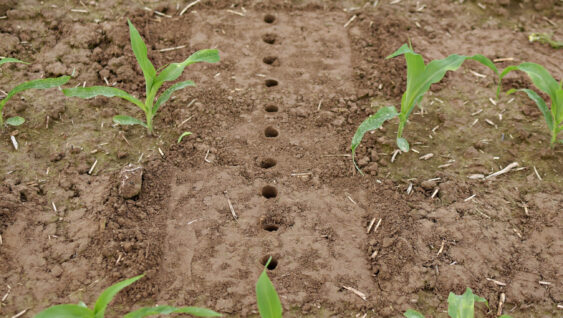
Yeah, great question, Mike. Starter fertilizers are generally fertilizers applied in small quantities, usually around planting or with the planter itself. And the idea is that these starter or popup fertilizers can be applied with the seed. Give that crop an early boost in crop nutrition, where we see these fertilizers work very well.
You know, let’s just say, uh, with phosphorus, which starter fertilizers are typically high in phosphorus, when we have low phosphate soil conditions on soil supply, we see starter fertilizers work very well. We also see these starter fertilizers work well under conditions that limit phosphorus availability, like cool wet soils, soils that are slow to warm up in the spring that can slow down your phosphorus travel pathway to the plant.
And so you starter fertilizers and popups help just provide that little bit of boost, get that crop out of the gate. And get it off to a good start.
Okay. Karl, what about certain crops? Do some crops respond better to starter fertilizers than other crops?
Yeah, I’ve seen starter fertilizers used. I live out here in the western US where we have very low phosphate soils, so we use starter fertilizers often because we have such poor soil phosphorus supplies in general, so people are using them on cotton, they use ’em on corn.
We don’t grow a lot of soybeans out here, which might surprise some of the listeners, but we’ve also got folks that are running a starter like fertilizer, so a liquid. High phosphorus analysis fertilizer on things like bell peppers and cucumbers and melons. So really, in my experience, I wouldn’t say these crops can only have a starter fertilizer applied.
Rather, we just have these conditions, low phosphate in the soil that really warrants the use of a starter fertilizer and to a pretty good degree of success as well across this crop spectrum.
Karl, we really appreciate you joining us today. Listeners. Thanks for tuning in. And as always, if you have any questions about anything we’ve talked about today, you can visit our website.
That’s Nutrien eKonomics with a k.com. Until next time, this has been Mike Cowell with the Dirk. Hey guys. If you like what you heard today, do us a favor and share this podcast with someone else. It could be your neighbor, your friend, your crop advisor, or whoever you think would enjoy it. Your support helps ensure future episodes, so please like, subscribe, share, and rate the show wherever you’re listening from.