Dr. Karl Wyant currently serves as the Director of Agronomy at Nutrien. In this position, Dr. Wyant contributes proven agronomic leadership in growing the Nutrien commodity and premium fertilizer product lines and promotes advanced sustainability initiatives. Before working at Nutrien, Dr. Wyant served as the Vice President of Ag Science for Heliae Agriculture (2019-2022) and as an agronomist for Helena Agri-Enterprises in California and Arizona (2014-2019). Dr. Wyant earned his advanced degrees at Arizona State University (PhD – 2014) and Colorado State University (MS – 2008). Dr. Wyant is a Certified Crop Advisor and Certified Professional Agronomist (CPAg) and has his CA and AZ Pest Control Advisor licenses. He is chair of the WRCCA Executive Committee for 2022 and 2023. He has received an industry mark of distinction as one of Fruit and Vegetable Growers’ Forty Under Forty.
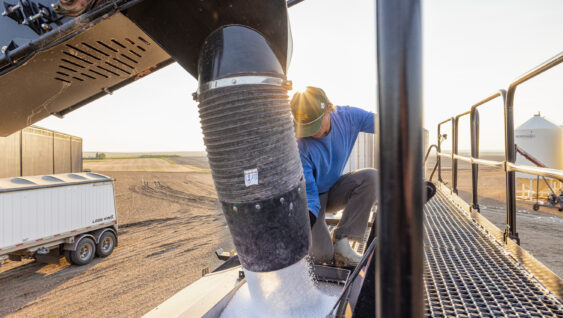
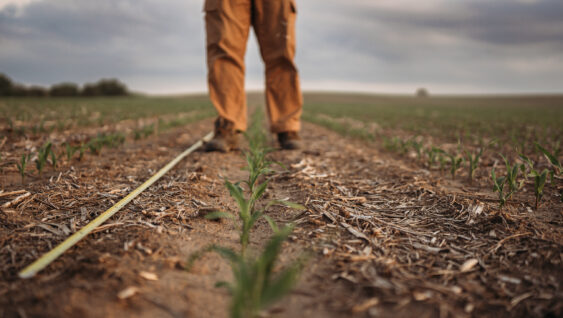
Safe and efficient application of anhydrous ammonia is top of mind for growers this season. Photo Credit: Lyle Cowell.
Drought and Fall Soil Moisture Conditions
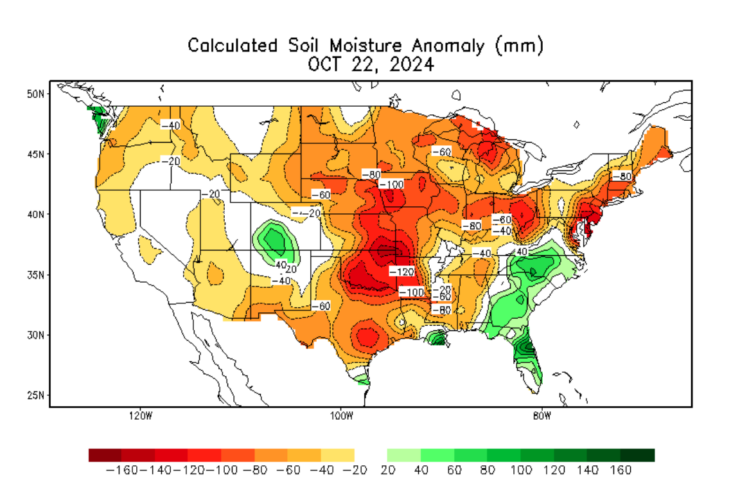
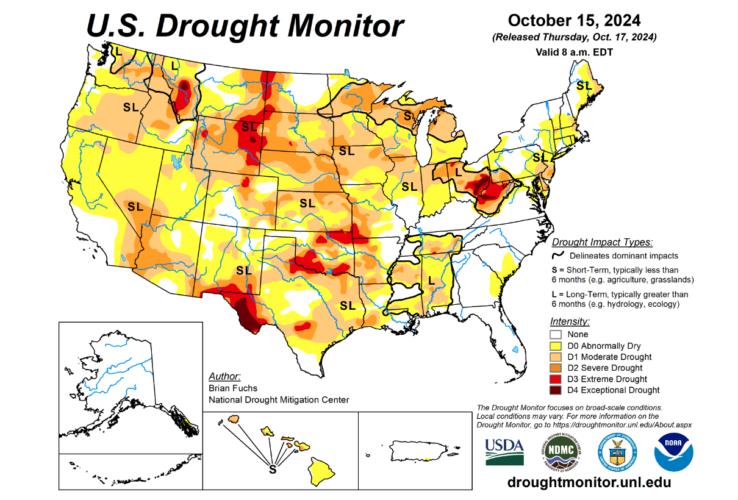
Many agricultural areas across the United States and Canada experienced considerable drought during the 2024 growing season and are coming into the fall fertilizer application period with dry soil conditions (Figure 1). Growers have asked if they can apply their fall anhydrous ammonia (82-0-0) into soils with such low moisture values. Below are some helpful tips to answer that question.
Figure 1 & 2 – Dry soil conditions (shades of red) are observed across much of the growing areas in the United States. Source: Climate Prediction Center
Dry Soil Can Hold Anhydrous Ammonia
It might be surprising but dry soils are suitable candidates for anhydrous ammonia injection if considerations are made beforehand due to how anhydrous ammonia is ‘held’ in the soil and conserved for future crop use. According to Sawyer (2011), anhydrous ammonia dissolves readily in water but is held in the soil by clay and organic matter. So, the moisture is not doing the hard work of keeping your fertilizer investment in place. However, soil moisture is an important temporary hold for the ammonia before it attaches to clay and organic matter. Dry soils may not have an adequate temporary hold due to depleted soil moisture, and dry soils can present structural issues (e.g., clods and large pores) that prevent proper sealing of the injection trench after application. If the soil is not sealed properly, ammonia can be lost from the soil.
Sawyer (2011) offers the following tips for dealing with anhydrous ammonia application and dry soil conditions.
Application Tips
Establish a 50˚F (10˚C) and cooling 4-inch soil temperature trend before applying
Apply anhydrous ammonia at proper depth (at least 4 to 8 inches in spacings suitable to the region and local practice). Dry soils will likely need a deeper application to reduce ammonia escape
Use covering disks behind the knives or sealing wings (“beaver tails”) to address structural issues associated with dry soil (clods and large pore spaces)
Wait: Apply ammonia at least one to four weeks before spring planting if soils are very dry or risk of plant damage is expected due to poor anhydrous ammonia conversion into crop safe forms (NH4+ and NO3–)
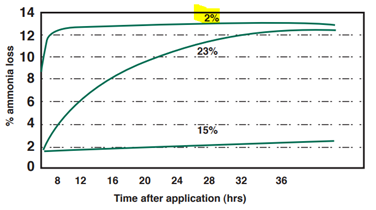
Potential Range of Anhydrous Ammonia Loss from Dry Soil
Research shows a 2-12 percent ammonia loss under dry soil conditions (yellow area below). When in doubt, inject the anhydrous ammonia at a deeper depth if losses are a concern. Most of the losses occur within the first six to eight hours after application and losses will eventually stabilize.
Figure 2 – Total losses (TOP) and rates of loss (Bottom) of anhydrous ammonia from soil is influenced by soil moisture conditions and injection depth (Stanley and Smith 1956)
Dry soil conditions are top of mind for many this time of year as harvest and fall field operations move forward. Anhydrous ammonia applications can still be done but additional considerations should be made to minimize losses of the fertilizer investment and promote fertilizer safety.
Anhydrous Ammonia Calculators
eKonomics offers several calculators to help you determine time, rate and distance of your anhydrous ammonia applications.