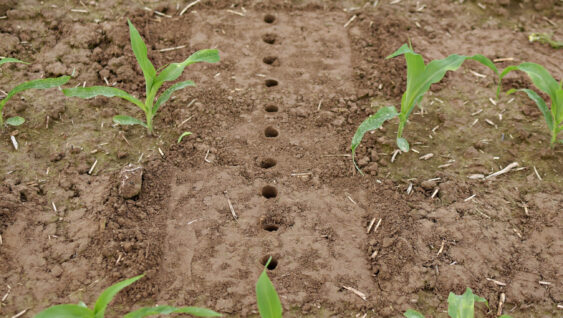




Liebig’s Law of the Minimum

Nutrient management is one of the most important aspects to a successful crop. Understanding Liebig’s law of the minimum can help you maximize the results of your fertilizer investment and achieve the highest possible yields. Make certain you know just how much yield – and economic return – you are leaving out in the field before you make decisions for any crop.
What is Liebig’s Law?

Liebig’s Law states that the crop yield achievable is dictated by the nutrient that is most limiting. The traditional illustration of Liebig’s Law of the Minimum uses a barrel with unequal staves (Figure 1) to demonstrate how nutrient supply can limit plant growth. It demonstrates that your crop’s nutrition is limited by the nutrient in the smallest supply; the same way that the water in the barrel is limited by the length of the shortest piece of wood. While this is the traditional way to illustrate Liebig’s Law of the Minimum, there is a stronger metaphor that encourages a more comprehensive approach to nutrient management.
Another way to visualize this concept is to illustrate it with a dam. The water being held back by the dam represents yield potential. Holes in the dam represent yield limiting factors that decrease yield potential as they leak. The goal is to identify which holes are leaking and plug them to maintain as much yield potential as possible.
Non-Legume Crops
For most non-legume crops (corn and wheat as examples), nitrogen is often considered the most important leak to plug, and that is generally a correct thought. But simply plugging the nitrogen leak without considering other leaks in the dam can lead to considerable yield loss. As illustrated in the figure above, the nitrogen leak has been securely plugged, but there are considerable leaks coming from inadequate potassium and phosphorus. To get the most out of your fertilizer investment, it is important to ensure you are addressing as many leaks as possible.
Watch the video to learn more about this modern model of Liebig’s Law and listen to Dr. Robert Mullen explain the importance of not ignoring other yield-limiting factors.
For those who have attended a soil fertility meeting or a crop nutrient-management class, you have seen the barrel concept used to illustrate Liebig’s Law of the Minimum before. While the dam illustration is more holistic, the barrel analogy (Figure 1) is a simple way to understand Liebig’s Law.

Let us assume that potassium is the most limiting factor. If a field’s yield potential is 220 bushels per acre (with adequate potassium nutrition), but soil test potassium level will only allow yield to reach 80 percent of the maximum, the actual yield achievable is 176 bushels per acre. This scenario assumes that all other nutrients are supplied at 100 percent sufficient levels (an assumption most forget to include when discussing the law of the minimum). This scenario also assumes the most limiting factor, potassium deficiency, is not affecting the performance of other yield-determining factors — an assumption that is not often correct. Individual nutrients often affect the use and efficiency of other nutrients.
Remember, the goal of any agronomist is to proactively identify and remove yield-limiting factors. This concept applies to soil fertility, weed management, pathology, entomology, and other agronomic considerations.
Your Fertilizer Dollar
How does this apply to allocating your fertilizer dollar? Blindly cutting potassium or phosphorus and focusing the bulk of your fertilizer investment on nitrogen can be a yield-limiting, and profit-decreasing, decision. This is especially true if potassium or phosphorus are below optimum levels in the soil. The crop will respond to applying nitrogen fertilizer, but the yield achieved may be limited by the inadequacy of other nutrients.
Figure 2 is a simple visualization of ‘Liebig’s Dam’ concept in action. Notice the light green line (representing corn yield with inadequate phosphorus) does increase as nitrogen application increases. However, also note that the dark green line (representing corn yield with adequate phosphorus) allows for a higher maximum achievable yield when nitrogen and phosphorus are supplied. In this example, the yield achievable with both adequate phosphorus and nitrogen is 20 bushels higher than with adequate nitrogen alone. Higher yield potential is realized because we ‘plugged’ two holes in the dam (N and P) and were able to improve performance with holistic nutrient management.
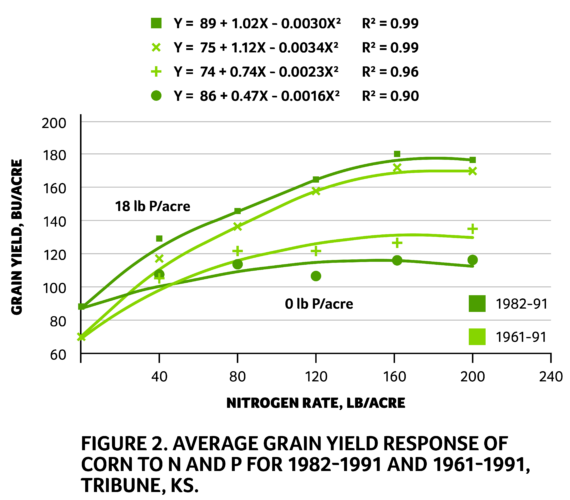
Source: Journal of Production Agriculture – April-June 1995 – Schlegel – Corn Response to Long‐Term Nitrogen and Phosphorus
Liebig’s Law: Tools to Manage Yield
Tools like Liebig’s Law of the Minimum help growers manage inputs and yield potential, but what is the difference between the barrel and stave theory or the dam theory? Which one is better? Dr. Alan Blaylock explains in this episode of The Dirt podKast. Listen now:
More Nutrient Interactions
Some nutrient inadequacies can actually affect the crop’s ability to utilize other nutrients supplied.
Nitrogen and Potassium Interactions
The most commonly mentioned nutrient interaction is nitrogen and potassium.
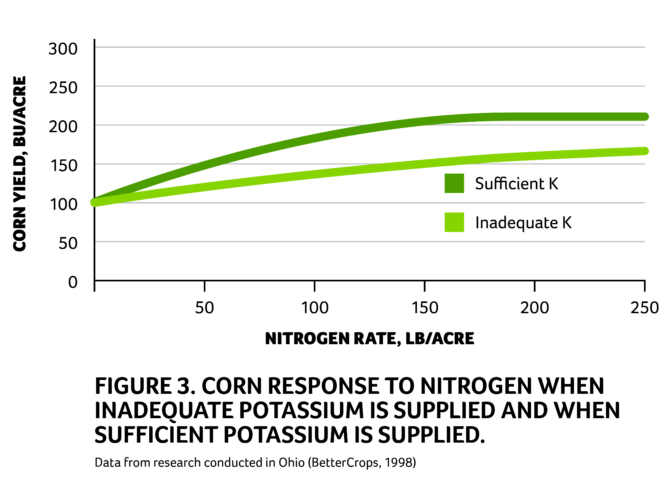
Many people operate under the assumption that each individual nutrient operates independently from one another. When looking at Liebig’s Law using the dam illustration, we can see that this is simply not true. The nature of the interaction between nitrogen and potassium is that whenever potassium is inadequate, the crop may require more nitrogen to achieve the optimal nitrogen rate (the rate where yield is maximized) and typically at a lower yield level.
In Figure 3, the light green line represents corn response to nitrogen whenever potassium is not adequately supplied. Note how corn yield never quite reaches a maximum, i.e., the yield is still increasing in response to an increased supply of nitrogen. The dark green line represents a scenario where adequate potassium has been supplied. Notice how the corn crop achieves a higher yield, and reaches it at a lower nitrogen rate, than when potassium is inadequate. Understanding Liebig’s Law can help you better manage your fertility plan as you uncover the relationships between the nutrients in your soil.
Potassium and Phosphorus Interactions
Another benefit of maintaining adequate potassium availability in soil is the potential interaction with phosphorus. Unpublished field research conducted at Ohio State University from 1994-1999 revealed that in situations where soil test potassium was below the established critical level, corn and soybean yields could decrease by increasing the phosphorus fertilization rate. This yield decrease occurred in three out of seven research years in both corn and soybeans. The exact physiological mechanism that would cause a crop’s yield to decrease — as a result of increasing the phosphorus application rate in a soil environment with inadequate potassium — is not well understood.
Research conducted on alfalfa reveals a similar interaction between phosphorus and potassium. This study was conducted over seven years at Purdue University (Berg et al., 2005). During the final two years of the study, it was noted that plots receiving no potassium fertilization produced lower alfalfa yield when the phosphorus fertilization rate increased. Therefore, forgoing potassium fertilization not only limits production, but supplying additional phosphorus combined with poor potassium fertility can decrease productivity.
Nitrogen and Phosphorus Interactions
For corn farmers, it is well known that phosphorus and nitrogen fertilizers are crucial for increasing yields. Farmers typically focus resources on nitrogen applications to their fields, but research findings show that applying both phosphorus and nitrogen together is far more effective – potentially increasing yields up to 225 percent.
Dr. Alan Schlegel, former Agronomist-in-charge at the Southwest Research-Extension Center at Kansas State University, was one of the lead researchers of a 50-year study conducted at the Southwest Research-Extension Center near Tribune. Per Schlegel, the interaction between phosphorus and nitrogen provides greater yield benefit than applying either nitrogen or phosphorus alone.
These examples point to the importance of identifying and removing each yield-limiting factor because nutrient interactions can and do occur.
Making the Agronomic… Economic
These agronomic concepts and realities obviously have an economic impact on the farming operation. Opting to skip the fertilization of potassium or phosphorus (or any limiting nutrient) to save money can decrease total economic profit.
Try the eKonomics Nutrient ROI (return on investment) Tool to help you understand how much average return is generated from your fertilizer investment.
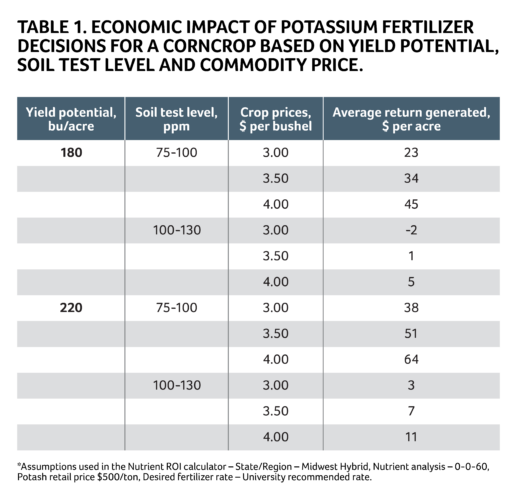
Table 1 illustrates how yield potential, soil test level, and commodity pricing influence the average economic return from potassium fertilization. Cutting potassium fertilization when soil-test potassium is below 100 parts per million (ppm) represents considerable lost economic return especially as commodity price increases. The economic penalty for cutting potassium fertilization decreases as soil-test level climbs above 100 parts per million, but as the commodity price increases the profit loss if fertilization is skipped also increases.
Allocating Your Fertilizer Dollar, Where Should You Invest?
There are annually several articles published in trade magazines and University bulletins discussing how farmers should make adjustments to input purchases (specifically fertilizer) to increase the profitability of their farming operations.
When budgets get tighter, one common recommendation is cutting back on potassium and phosphorus. This may be an option if you have an adequate supply of these nutrients in your soil. However, cutting back without evaluating soil test levels, and considering the agronomic and economic implications, is likely not a good decision.
For further reading on this topic, visit the articles below:
Science-Based Nutrient Management in Times of High Fertilizer Prices
Potassium vs. Phosphorus: What Your Crops Need Most — and When
Prioritizing Potassium: Why We Should Start Calling It “NKP”, not NPK
Manage Nutrients AND High Fertilizer Prices
References
Berg, W.K, S.M. Cunningham, S.M. Brouder, B.C. Joern, K.D. Johnson, J. Santini, and J.J. Volenec. Influence of phosphorus and potassium on alfalfa yield and yield components. Crop Science Society of America Journal 45:297-304.
Potassium interactions with other nutrients. 1998. Better Crops 82:12-13.
Schlegel, A.J. and J.L. Havlin. 2017. Corn Yield and Grain Nutrient Uptake from 50 Years of Nitrogen and Phosphorus Fertilization. Agronomy Journal. 109:1. p. 335-342.