



Liquid Fertilizers – Compatibility And Safety

Liquid fertilizers are prized because of their flexibility – especially the freedom to blend nutrients together to create customized products for growers. Nutrien Director of Agronomy Dr. Karl Wyant offers guidance on compatibility and safety, two key concerns when blending and handling liquid fertilizers, in the November/December issue of Fertilizer International. Below is a summary of the article.
The fertilizer industry has met the demand for innovation in crop nutrition through the development of new products, with a notable shift being the introduction of liquid fertilizers. Liquid fertilizers, gaining popularity in agriculture, horticulture, and turf markets, offer flexibility in applications such as fertigation and foliar sprays, catering to diverse crops.
Divided into two broad categories: suspensions of very fine solids and solutions of dissolved nutrients, liquid fertilizers provide advantages like the ability to combine nutrients, secondary nutrients, and micronutrients. Their popularity marks a departure from traditional granular fertilizers like urea and monoammonium phosphate.
Benefits and limitations
Liquid fertilizers present benefits such as blending flexibility, application placement and timing, and rapid nutrient availability, making them suitable for various crops. However, they also have limitations, including lower nutrient density compared to granular fertilizers, specialized storage and application equipment, and long-term storage challenges.
Storage guidelines and tank maintenance
Liquid fertilizers have distinct storage requirements versus dry fertilizers. Guidance on storage tank maintenance and advice on how to manage ‘salt out’ is set out in the full article on Fertilizer International.
Compatibility and safety
Compatibility and safety are key concerns when blending liquid fertilizers. A ‘traffic light’ system categorizes compatibility, emphasizing the importance of safe blends.
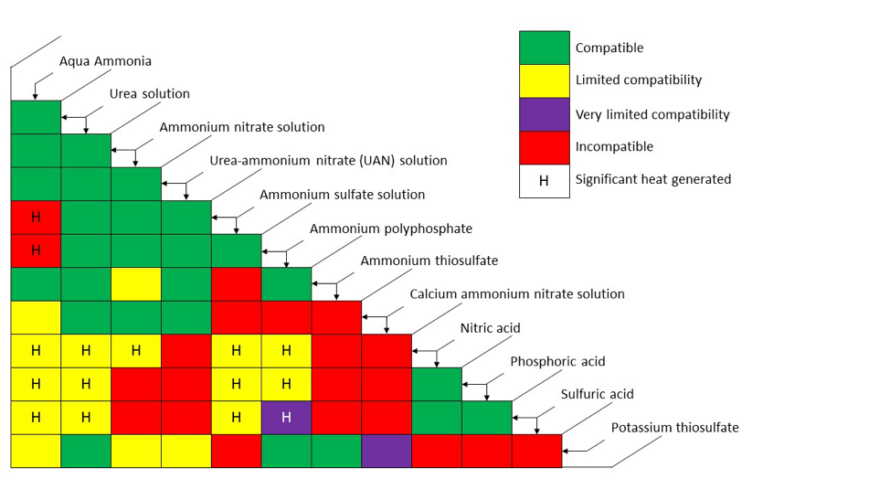
Safety practices, including following label instructions and performing jar tests, are crucial to avoid hazards and ensure successful liquid fertilizer application.

As liquid fertilizer blends continue to gain popularity, understanding their strengths and limitations is vital for successful integration into crop nutrient programs. Growers must consider factors such as nutrient needs, logistics, and realistic crop performance expectations to optimize the supply chain.
To learn more about liquid fertilizer compatibility and safety, read the November/December issue of Fertilizer International.