



Managing Phosphorus Loss – The Challenge
If we have learned anything from the challenges of managing phosphorus in the Lake Erie Watershed of northwestern Ohio it is this – you cannot just focus on one form of phosphorus when thinking about nutrient impairment of a water body.
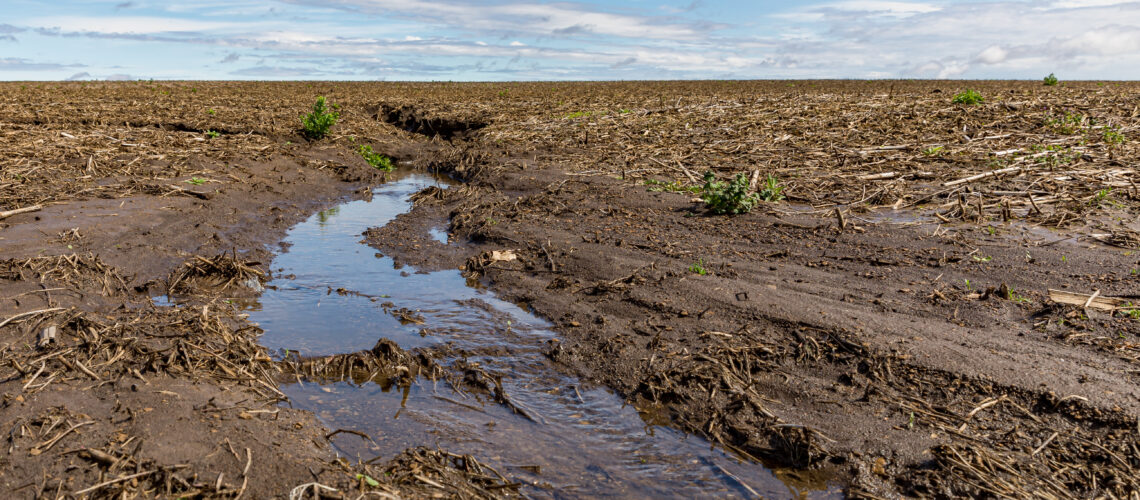
There are two forms of phosphorus that concern us environmentally – phosphorus sorbed to soil particles (particulate phosphorus/sediment bound phosphorus – same thing) and phosphorus that is in solution (dissolved reactive phosphorus/dissolved phosphorus/soluble phosphorus – again, all convey the same thing). Particulate phosphorus losses occur when soil is transported by erosion to a water body. The good news (if we are looking for a bright spot) is that the bioavailability of particulate phosphorus is estimated to be around 30 percent (this is the fraction that desorbs from the sediment). Dissolved phosphorus loss occurs when phosphorus from a recent fertilizer application (including manure sources) moves across the soil surface with water or when phosphorus moves through the soil profile to subsurface drainage. Dissolved phosphorus is 100 percent bioavailable the day it hits a water body, meaning it has higher potential impact to increase algal growth.
The question is – how do you manage these two different fractions to minimize loss? Dr. Nathan Nelson at Kansas State University has been evaluating the use of cover crops as a tool to manage phosphorus transport. His findings suggest that cover crops do a better job of managing particulate phosphorus loss than no-till alone. That should not be surprising. One of the main reasons to establish cover crops is to decrease soil erosion, obviously even compared to no-till alone. Conversely, surface applications of phosphorus where cover crops were established resulted in greater dissolved phosphorus transport than no-till alone.
Additionally, one of the key findings from this study was that sub-surface application of phosphorus reduced long-term dissolved phosphorus loss. The research is ongoing, and the 2018 report can be found here.