




Nutrient Removal Calculator: Estimating Crop Uptake And Removal

Summary of what you'll find
Understanding crop nutrient removal is essential for building an effective soil fertility program. Every harvested crop removes valuable nutrients from the field, and those nutrients must be replaced to maintain soil fertility and meet future yield goals.
The Nutrient Removal Calculator can help you estimate how much nitrogen, phosphorus, potassium, and sulfur are removed at harvest based on your crop and overall yield. This helps you determine replacement rates based on crop removal and better align nutrient applications with soil needs.
Understanding how to use the calculator and apply its outputs can help improve fertilizer planning and overall nutrient management.
Why nutrient removal matters for soil fertility planning
Nutrient removal refers to the amount of nutrients taken from the field in harvested crops, typically measured in pounds per acre.
Accounting for nutrient removal is the first step in planning a nutrient management program, ensuring you’re adequately replacing nutrients removed at harvest and maintaining soil test levels and soil productivity for the next crop.
When we better understand what was removed and what crops take up, we can use that data to maintain soil fertility, improve fertilizer programs, and reduce the risk of over- or under-applying nutrients across fields.
How the nutrient removal calculator works
The Nutrient Removal Calculator uses validated nutrient removal and uptake data derived from historical soil data, the International Plant Nutrition Institute, and published literature used in the Prairie Nutrient Removal Calculator to help determine nutrient removal and uptake rates across a variety of crops. As more soil data and literature become available, the calculator is updated to reflect the most current removal rates.
Uptake versus removal
The Nutrient Removal Calculator estimates crop removal and uptake rates across a range of field crops, from canola to corn. Both removal and uptake rates each play their own role in building a nutrient management program.
Nutrient uptake represents the total amount of each nutrient required for a crop to grow and reach a specific yield. Nutrient removal rates, on the other hand, account for the amount of each nutrient removed in harvested material based on the yield achieved. Nutrient uptake rates tend to be higher than removal in grain crops, but lower in crops like alfalfa or silage.
How to calculate nutrient removal
Estimating nutrient removal and crop uptake is easy with the Nutrient Removal Calculator:
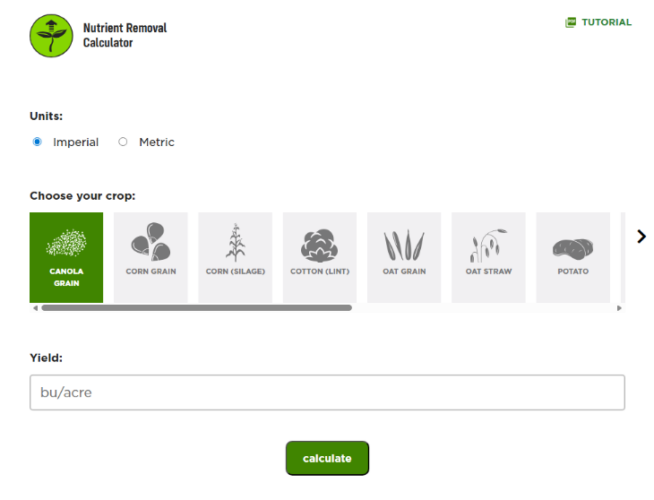
- Location selection: Choose your geography (Canada or the U.S./Other).
- Unit selection: Choose your unit preference of imperial or metric.
- Crop selection: Select your crop.
- Yield selection: Enter harvested yield (bushels per acre).
- Calculate: Get a snapshot of estimated nitrogen, phosphorus, potassium, and sulfur uptake and removal for your specific crop.
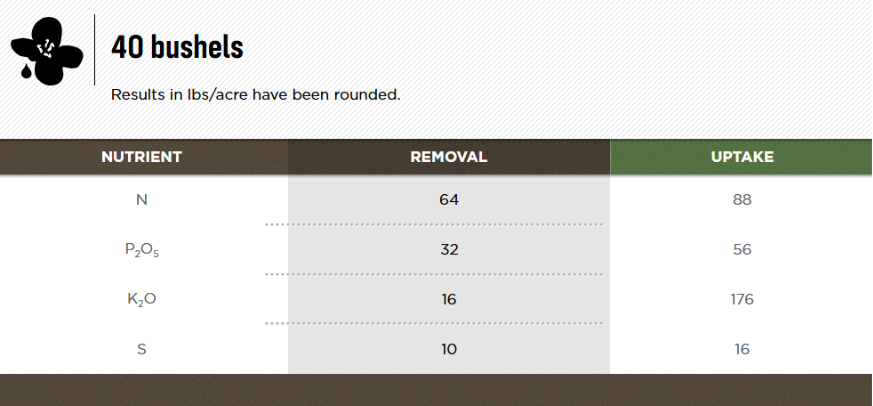
In the example output below, we can see the total uptake and removal rates for each nutrient for a 40-bushel per acre canola (grain) crop.
How nutrient removal impacts soil test levels
To make the most informed decisions for your operations, using these removal rates alongside soil test data is strongly recommended. Every field and fertilizer program is different, and soil test data helps you better understand what removal means for your specific plan.
Every pound of nutrients removed from the field can lower soil test levels and affect the next crop’s productivity. For example, for every five to eight pounds of potassium removed from the soil without supplemental fertilization, soil test levels decrease by one part per million (ppm). For every 20 pounds of phosphorus removed without fertilization, soil test levels decrease by one ppm. Eventually, these decreases will start showing up as deficiencies on your soil test report and have negative impacts on your crop yield.
Nutrient removal rates help us better plan for nutrient replacement, maintain soil test levels, and build fertility programs that support consistent crop performance. Consider your rotation and the next crop in the cycle to better align your program to your specific crop needs.
Using nutrient removal rates to inform fertilizer plans
After calculating nutrient removal and uptake using the Nutrient Removal Calculator, you can begin building your nutrient management plan.
For example, if you determine that your wheat grain removed 48 pounds of phosphorus and 27 pounds of potassium per acre and took up 61 pounds of phosphorus and 124 pounds of potassium per acre, you can begin to understand how these removal rates affect soil test levels.
If only grain was removed, soil test phosphorus levels would decrease by 2.5 ppm, and soil test potassium would decrease by four ppm.
Combining this removal and uptake data with soil test results can help you better understand what nutrients were used, what needs to be replaced, and what’s required to maintain or build soil test levels for the next crop.
Start estimating crop removal in your fields
Knowing what nutrients have been removed is the first step in creating a strong fertilizer program. Start estimating removal in your fields using the Nutrient Removal Calculator, available on the eKonomics website or app.
After running your calculations, results can be emailed to yourself or your advisor to keep them accessible as you plan your program. If you have any questions about your results or removal rates, connect with an agronomist through the Ask an Agronomist tool to review your results and explore next steps.
Explore other farm calculators and ROI tools on the eKonomics app

The Nutrient Removal Calculator can be used anytime, anywhere through the eKonomics app. Download the app on Apple or Android to try it out for yourself and uncover a suite of other farm calculators, ROI tools, and agronomic resources designed to support decisions from planting to harvest.