



The Right Place: Fertilizer Application Options In The Western US
As much as the weather and markets change, the 4R approach to nutrient management remains the steady gold standard for sustainable use of agricultural fertilizers. These science-based best management practices guide the use of the right fertilizer source, at the right rate, the right time, and with the right placement.
Let’s zero in on placement. There are many factors to consider from crop, type of fertilizer, soil properties, weather conditions, and drainage system when choosing a fertilizer application or placement method.
Why placement matters
Fertilizer placement and timing can affect crop yield and quality, as well as how efficiently the crop is able to use the nutrients. The ultimate goal when thinking about placement is how to maximize the contact between the fertilizer nutrients and the crop (seed or plant roots depending on placement and timing). This is particularly important at the early stages of crop development to encourage strong root growth. Proper fertilizer placement and timing in consideration of crop, soil, and weather variables can also reduce potential for nutrient losses.
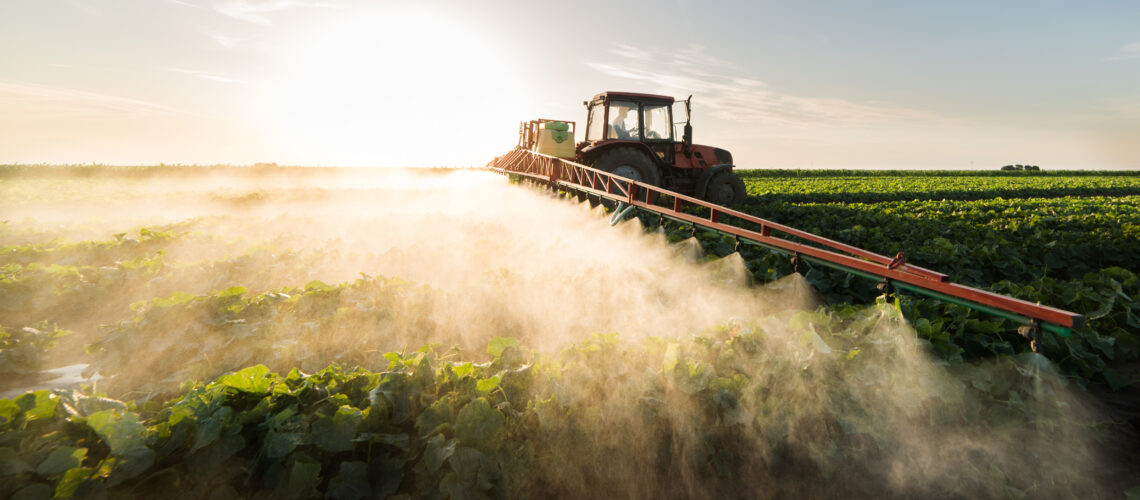
If you are farming in the Western U.S. – Arizona, California, Colorado, Idaho, Nevada, New Mexico, Oregon, Utah, Washington, or Wyoming – fertilizer is most commonly applied by broadcasting, row placement, or fertigation. Broadcasting delivers a uniform application across the entire soil surface. Row placement involves a continuous band of fertilizer beside seeds or plants. Fertigation applies water-soluble fertilizer through an irrigation system.
It’s important to remember that the expected response in crop yield and quality for any application method depends on the specific nutrient and its properties, how well the nutrients are able to move through soil, soil moisture, crop rooting patterns, tillage and planting systems, and the availability of water. Aim for fertilizer application that coincides as closely as possible with the period of maximum crop uptake.
A closer look at the options
Broadcasting
- Can be applied on the surface or incorporated.
- Rapid application method to cover large areas in the least time.
- Phosphorus efficiency is approximately ¼ to ⅓ compared to banding. Broadcasting generally requires higher application rates of immobile nutrients than banding because of nutrient dilution in greater soil volume.
- Broadcasting provides broader nutrient distribution in a greater soil volume and may improve nutrient contact with a greater portion of the plant roots.
- Preferred method for higher application rates when needing to build low soil-test levels.
- Surface broadcasting is fast and economical but can result in less uniform application and higher nutrient losses.
- Incorporating fertilizer increases root contact, plant growth, and minimizes surface nutrient loss. Many cropping systems of this region include specialty crops that require tillage for seedbed preparation. Seedbed preparation may facilitate incorporation and placement of applied fertilizer.
- Broadcast equipment is generally less specialized and less expensive than for banding.
Banding
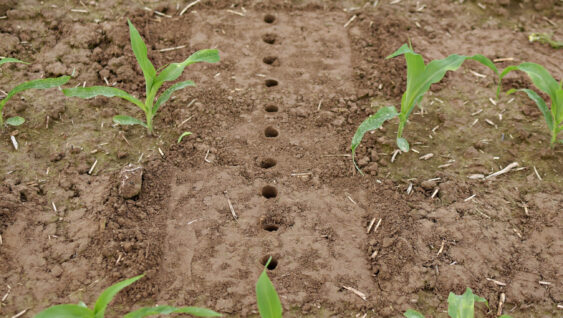
- Any application where fertilizer is applied in strips on or below the soil surface.
- Application can be done at seeding, with or near the seed row (starter), or after seeding.
- Efficient method for most fertilizers as the band is usually placed below or near the seed row for greater root interception and to help jump start early growth.
- Provides a zone of high nutrient concentration to improve root interception, stimulate growth, and reduce nutrient fixation. Especially desirable for specialty or vegetable crops of the region with small or shallow root systems.
- For some nutrients, such as immobile micronutrients and phosphorus, banding may produce better crop response and nutrient efficiency at lower rates than for broadcasting because of higher nutrient concentration in the immediate crop root zone.
- Banding phosphorus is important with low soil-phosphorus levels and in cool soil conditions, because of slow root growth and slow phosphorus diffusion in cool soils.
- More expensive equipment than broadcasting that comes with the risk of salt burn or seedling damage but may allow for lower fertilizer rates, as mentioned above.
Fertigation
- Delivers high nutrient-use efficiency for crops, especially nitrogen, when applied at time of maximum crop uptake and facilitates application at precise times to match crop demand.
- Suitable only for soluble nutrient sources, some of which may bear higher cost. Especially common method of nitrogen application.
- Can reduce or eliminate mechanical applications that consume fuel, may cause compaction, or may not be properly synchronized with crop demand.
- Reduces time required for irrigation and fertilizer application by combining two activities, but windy conditions can cause uneven application.
- Irrigation equipment or system must be properly designed and managed to deliver uniform and timely water application to avoid overapplication of water. Nutrient application is only as uniform or as timely as water application.
For more information or specific recommendations for your area, contact your local agronomist or crop advisor, or refer to these additional resources.
- The 4 Rs of nutrient management, Makena Savidge and Daniel Geisseler, University of California, Davis
- Geisseler Lab Nutrient Management, University of California, Davis
- Fertilizer Placement, Robert L. Mahler, University of Idaho, College of Agriculture
- Fertilizer Placement and Timing, Nutrient Management Module No. 11, Montana State University
- Getting the Most Out of Commercial Fertilizer Applications, Alberta Agriculture
- NutrientStewardship.org
- Advantages and Limitations of Fertilizer Application Methods, Cornell University, Northeast Region Certified Crop Advisor Study Resources