Dr. Karl Wyant currently serves as the Director of Agronomy at Nutrien. In this position, Dr. Wyant contributes proven agronomic leadership in growing the Nutrien commodity and premium fertilizer product lines and promotes advanced sustainability initiatives. Before working at Nutrien, Dr. Wyant served as the Vice President of Ag Science for Heliae Agriculture (2019-2022) and as an agronomist for Helena Agri-Enterprises in California and Arizona (2014-2019). Dr. Wyant earned his advanced degrees at Arizona State University (PhD – 2014) and Colorado State University (MS – 2008). Dr. Wyant is a Certified Crop Advisor and Certified Professional Agronomist (CPAg) and has his CA and AZ Pest Control Advisor licenses. He is chair of the WRCCA Executive Committee for 2022 and 2023. He has received an industry mark of distinction as one of Fruit and Vegetable Growers’ Forty Under Forty.
Soil testing is a crucial step for nutrient management planning that allows for the profitable growth of healthy crops and the maintenance of soil fertility. Although test methods vary by region and laboratory, a soil test will provide information on the quantity of the nutrients in the soil and their reasonable availability for plant growth. According to TFI 2020, a standard soil test typically reports on a variety of physical and chemical metrics, including: soil pH, buffer pH, organic matter, cation exchange capacity, phosphorus, potassium, calcium, magnesium, and base saturation. Some tests also include measurements of soil texture (sand, silt, and clay), nitrate-nitrogen, ammonium-nitrogen, micronutrients, and sodium to help round out the management picture. These data points are used to generate a holistic management plan for the upcoming crop year. The goal is to optimize the spend on the fertilizer inputs and make sure that crop needs are addressed.
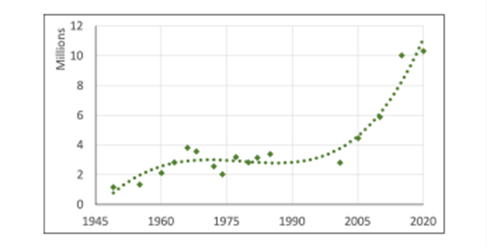
Despite the utility of a soil test, the ag industry has only been using them for less than a century. Soil testing began in North America in the 1950s and 1960s and experienced rapid growth, driven by a combination of factors including consistent yearly yield gains, improved crop genetics, investment in industry agronomists, the development of cheap and scalable extraction methods, and extension research (Peck 1990). The popularity of soil testing has increased in recent years due to the introduction of grid and zone soil sampling as part of precision agriculture management and improved turnaround times in the lab (Figure 1). TFI (2020) estimates that there were roughly 10 million soil samples taken in the USA in 2020.
Figure 1. Estimated soil sample volume in the USA 1949-2020. TFI 2020.
Soil Test Critical Values
Once a soil sample is taken, one question that remains is “Now what”? This is where the idea of critical values comes in. A critical value refers to the result on a soil test, typically phosphate and potassium, from many years of experimentation on connecting soil test values, fertilizer response, and crop yield. This type of research is often done by university extension services.
A basic interpretation reads as follows:
A critical level is tied to a specific nutrient metric in the soil on the X axis (e.g., phosphate or potassium) and the corresponding yield is shown on the Y axis. Many years of testing will reveal that there is a certain level of a soil nutrient that provides optimum yield (100%). Below this point, crop yield may decrease quickly and, thus, a fertilizer response is high. Above this point, the crop does not respond, and the fertilizer cost is not worth the yield return (Figure 2). Understanding the critical values (e.g., how low/high is the bank account?) and expected crop nutrient removal rates are useful for determining the nutrient management plans for a field.
Figure 2. Using phosphate as an example, we can interpret a critical value and begin planning our fertilizer program. Below the critical level (left) for a nutrient (phosphate), a fertilizer response is likely; above it (right), no response is expected. This key bit of information can help guide sound fertilizer investment decisions. Source: Cornell University, 2010.
Critical Values and Fertilizer Strategy
Now that we know our critical value, using phosphate and potassium as example nutrients, we can formulate a short- and medium-term nutrient management strategy (Figure 3).
Is your critical value on the low side? You need to deploy a “build up” strategy where you are applying more of the nutrient in each season than is removed from the soil via harvest or other losses. In this case, your goal is to build the bank account over several years.
On the other hand, if your critical value is high, you can deploy a drawdown strategy where you are purposely not applying a certain nutrient to help take advantage of a rich soil bank account. This can save you money on fertilizer inputs as you are not likely to see a profitable response to nutrients when you are on the right side of the curve below.
If you are right around the middle of the curve, near the critical value, you can match your fertilizer inputs to your expected crop removal rates and other loss mechanisms (e.g., runoff, leaching, etc.) so that the critical value is maintained over time. This strategy will ensure that your fertilizer investment dollars are optimized in a holistic nutrient management plan.
Figure 3 – Your critical value can help determine your fertilizer strategy and help to organize and optimize nutrient inputs CSU.
Trends in Phosphate and Potassium Critical Values
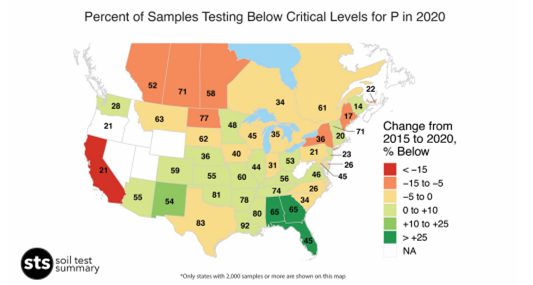
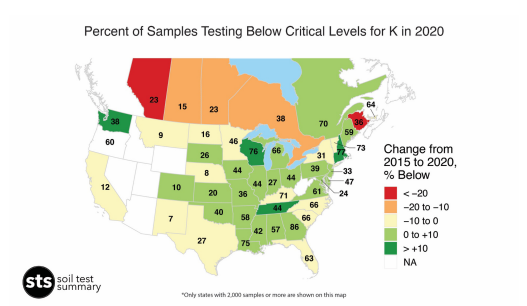
In agronomy and nutrient management circles, we have witnessed a steady increase in the number of soil samples that are below the critical value for phosphate and potassium (Figure 4). The upwards creep has been slow and has occurred over several decades. What this trend tells us is that we are continuing to remove more nutrients with the harvested portion of the crop (phorphorus and potassium) than we are putting back in the soil with our fertilizer programs. The result is that soils are becoming less fertile over time and that more attention should be paid to the build up strategy. Having a full soil bank account becomes especially important when fertilizer prices are high as a grower has many more options available to get through a period of increased input process than otherwise.
Figure 4 (top) and 4 (bottom) – Percent of soil samples testing below critical levels for phosphorus (Top) and potassium (bottom) since 2015. Focus on the number in each Province or State for ease of interpretation. Percent Below :: STS (tfi.org)
Critical Values, Nutrient Management Strategies, and Fertilizer Price Volatility
Without question, we have gone through tremendous price volatility for fertilizer inputs in recent years (Figure 5). All nutrient classes have been impacted, including nitrogen, phosphorus, and potassium (potash). Despite the volatility in fertilizer prices, we have learned some good lessons in nutrient management and have been reminded about the value of soil test data as a fertilizer investment tool.
Lessons Learned
When fertilizers are more affordable, it may be worth running the buildup strategy where nutrient inputs are greater than nutrient removal to help build the soil bank account.
When fertilizers are less affordable, it may be worth running the drawdown strategy where nutrient inputs are less than nutrient removal to help manage costs. However, the soil bank account must be above the critical value before deploying this strategy, so a yield penalty is not observed for insufficient nutrient application.
Soil testing can reveal which nutrients might be eligible for maintenance applications, based on expected crop removal rates and pre-existing soil conditions.
When fertilizers are less affordable and the soil critical values are low (depleted bank account), growers will need to make hardchoices on where to put their input dollars. Soil testing can help drive improved decision making as specific nutrients can be targeted depending on their impact on yield and crop quality and a management strategy selected to reasonably manage higher input costs.
Figure 5 – The Green Markets Weekly North America Fertilizer Price Index is constructed using the fertilizer benchmark prices of US Gulf Coast Urea, US Corn Belt Potash, and NOLA Barge DAP. Price Index – Green Markets (fertilizerpricing.com)
Conclusion
Soil testing and the interpretation of critical values are key tools for growers to help make fertilizer input decisions. This is especially important in times of high fertilizer price volatility, and the information can help guide nutrient management decisions that are both optimized and profitable to farm operations. For more information, please check out the links below: