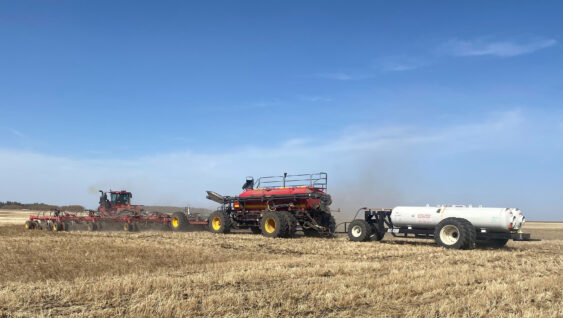




Managing Nitrogen In Corn: Tips For Success

As a critical macronutrient for plant growth, nitrogen plays an essential role in corn production. Effectively managing nitrogen in your field allows your corn crops to reach their full yield potential while improving profitability and on-farm sustainability. A recent article from the University of Minnesota’s Extension Nitrogen Management Specialist, Fabian Fernandez, summarized key learnings from over 10 years of research in corn nitrogen management to help you effectively manage this vital nutrient. The article uncovers Fernandez’s greatest tips for managing nitrogen in your corn crops including ideal application timing and popular nitrogen sources. Let’s dig into his findings.
The Value of Spring Applications
Regardless of nitrogen source, placement, and rate, spring application timing tends to outperform fall applications in almost every scenario. Studies have found that spring applications can produce between 9 and 34 bushels per acre more than the same application performed in the fall. While spring nitrogen applications may not produce a significant advantage over fall in every field, most studies show a substantial advantage with spring nitrogen applications.
The Fall Anhydrous Ammonia Advantage
Despite the fact that spring is a much more advantageous time to apply nitrogen to your field, not every grower will have the opportunity to apply their nitrogen in the spring. If you’re considering a fall application, Fernandez says that anhydrous ammonia is your best (and only) choice.
While urea and anhydrous ammonia are both popular sources of nitrogen, urea is much more susceptible to loss. Anhydrous ammonia has a 60 percent chance of producing a better yield than urea when applying nitrogen in the fall. Fernandez found that growers experienced an average increase of 49 additional bushels per acre when fall applying nitrogen with anhydrous ammonia. He also found that when applying enhanced-efficiency fertilizer products like ESN in the fall, band applications perform better than broadcast applications.
The Value of Split Applications
While there is generally no significant difference between the efficacy of single pre-plant and split applications of nitrogen, split applications can produce better results under certain soil conditions.
In sandy soils, two, or even better, three or four nitrogen applications deliver consistently better results than single pre-plant applications. Nitrogen applied before planting is highly susceptible to loss in sandy soils. In wet, fine-textured soils, split applications of nitrogen can deliver better yields and greater nitrogen efficiency, but it is not guaranteed. While split applications are more likely to support nitrogen availability in wet, fine-textured soils, it doesn’t mean that unexpected weather conditions won’t affect split applications.
Expert Tip: Use the eKonomics rainfall tracker to uncover weather patterns in your area to determine the best approach to applying nitrogen in your field.
Drained Versus Undrained: What Soil is Best?
In wet soils or weather conditions, nitrogen can be susceptible to loss through leaching (nutrients are washed away from the root zone) or denitrification (excess water causes losses to the atmosphere).
Soil drainage can make a difference in these conditions. Fernandez found that wet soils without drainage lose more nitrogen through denitrification than drained soils lose through leaching. Studies have shown that soils without sub-surface drainage require more nitrogen to reach yield goals with a lower nitrogen-use efficiency. Adequate soil drainage is key to reducing denitrification losses and protecting your nitrogen investment.
Looking Ahead
Nitrogen is one of your most costly crop inputs and managing it in your field is essential to profitability, productivity, and sustainability. It is also vital to optimizing crop yields, soil health, and nutrient availability. Following best practices in nitrogen management will allow you to make the most of your nitrogen investment and uncover a greater ROI while producing high-yielding, quality corn crops.
Want to dig deeper? Explore the following eKonomics articles to learn more about nitrogen management and best practices for managing this essential nutrient in corn:
Take Advantage Of Phosphorus And Nitrogen Interactions To Boost Corn Yields