Lyle Cowell is based in northeast Saskatchewan, where he has spent his career in agronomy with a focus on better soil management. Lyle has always had the goal of connecting the three points of good research, agronomy extension and farm gate advice and application of soil fertility principles.
Soil pH is one of the most influential, and often overlooked, variables in crop production. Beyond its role in nutrient availability, it affects herbicide behavior, microbial activity and the development of soil-borne diseases.
Understanding how pH can influence the activity and structure of herbicides or the productivity of fields will help you make more informed decisions for your crops.
Soil pH and herbicides
The degradation and stability of herbicides are often affected by soil pH. As pH changes, herbicide structure and potential toxicity to plants may also change. However, the effect is not easy to predict as degradation depends on several interacting factors that are all influenced by pH. Soil microbial activity (moisture and temperature), soil cation exchange capacity (organic matter and clay content) and previous herbicide use (microbial adaptation to consumption of an herbicide) can all influence herbicide degradation. Because soil pH affects each of these processes, a change in herbicide stability may ultimately trace back to pH-driven changes in the soil.
It’s important to measure the soil pH at the depth where the herbicide was exposed. This is most often within the top five centimeters from the surface, a layer of soil that usually has a lower pH than at more depth.
Soil pH and herbicide structure
Soil pH can also alter the chemical form of certain herbicides, affecting how they interact in the soil. In lower pH soils, herbicides may react to form a cation (an ion with a positive charge). Then, the herbicide could be adsorbed to the negatively charged surface of clay and organic matter, making it less biologically active. As pH increases, the product may form a neutral or anion form. In general, the neutral forms are most readily absorbed by plants. The example below is imazethapyr, which may exist as a cation, neutral or anion form (Figure 1).¹ At a very low soil solution pH, the cation will form and be attracted to the edges of clay and organic matter. At a higher pH (but more in line with acidic soils), the neutral form dominates and is then most readily absorbed by plant roots. Residual weed control may increase, but so would the risk to other crops in the rotation. These shifts illustrate why understanding soil pH is so important and how it can significantly influence the structure and behavior of applied herbicides.
Figure 1: Illustration of the neutral, cation and anion form of imazethapyr.
Read product labels carefully
Nearly all herbicides are affected by soil pH.
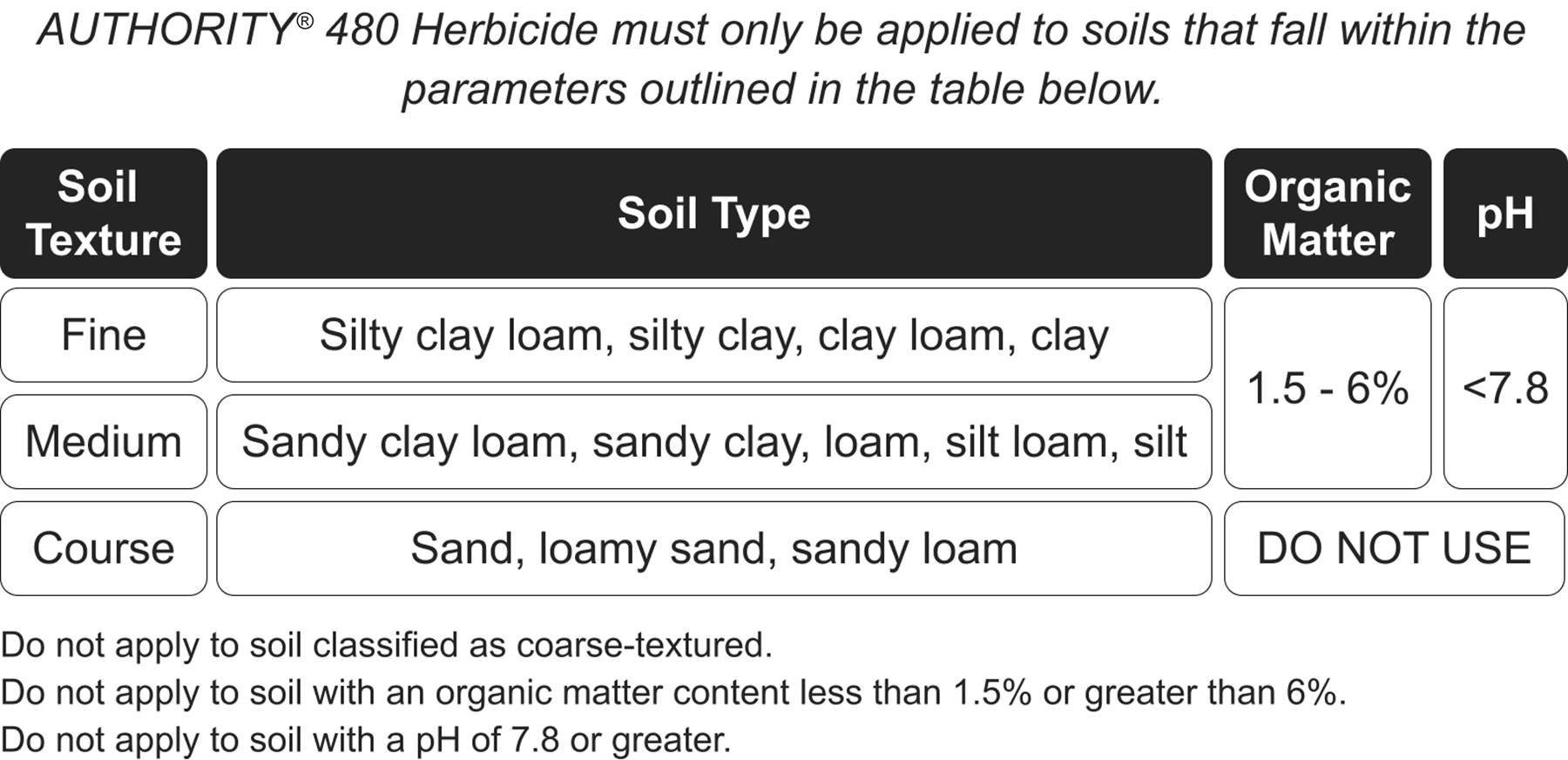
In general, sulfonylurea (SU) herbicides and sulfonyl amino herbicides (Everest) persist more at a high pH, and imidazolines (‘Imi’) herbicides persist more at a low pH. One cannot emphasize enough that the biological activity of each herbicide can be very hard to predict and is well beyond the scope of this article. Keep an eye on herbicide label statements that mention soil pH, such as the example below for Authority® 480 herbicide.
Figure 2:Authority 480 herbicide label with guidelines for applying inspecific soils.
Soil pH and pathology
Soil pH also influences soil biology, with bacteria and bacterial processes such as rhizobia nitrogen fixation and bacterial nitrification occurring more rapidly in high pH soils, and fungi persisting in low pH soils.
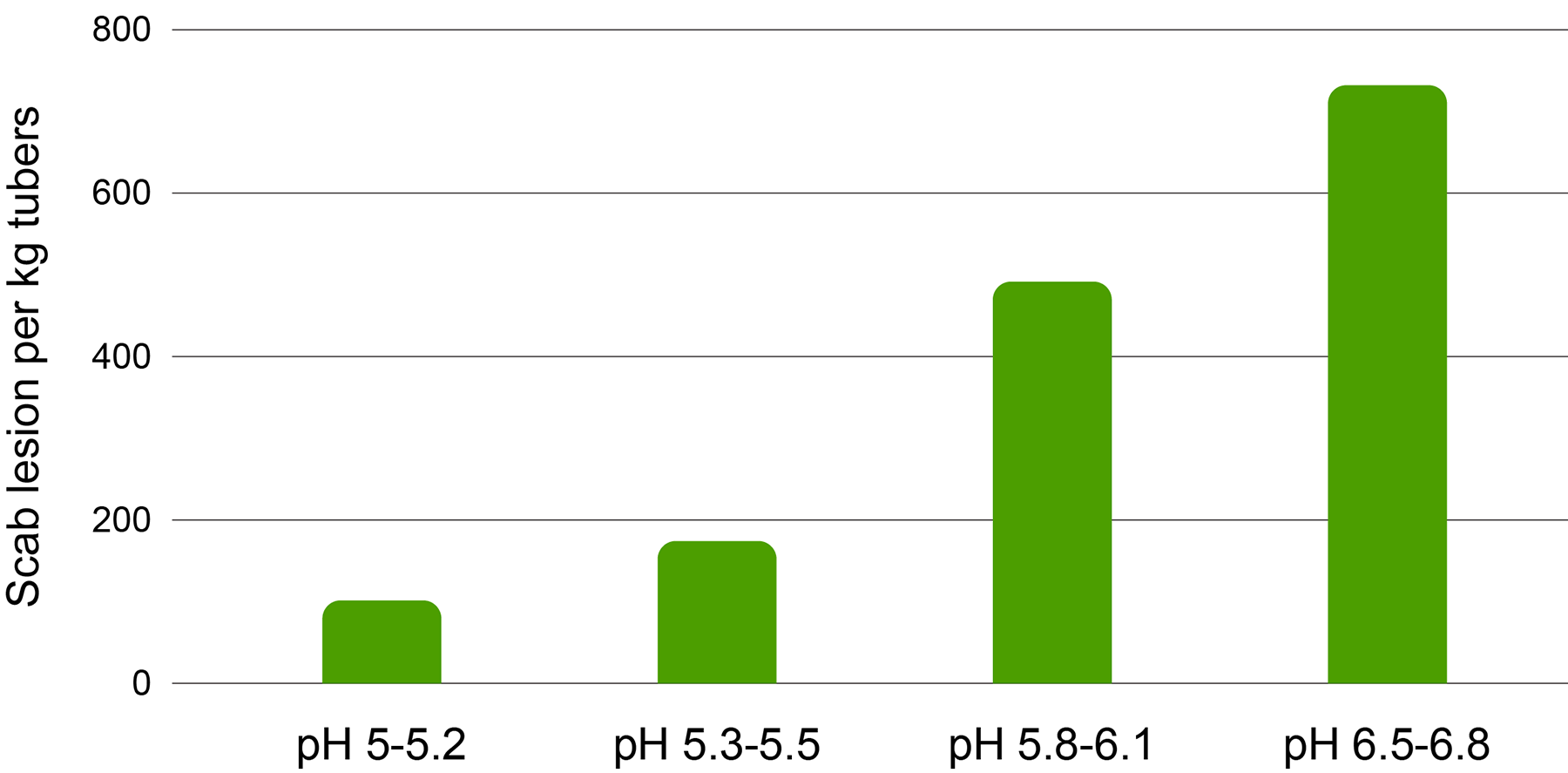
An example of a pathogenic bacterium that is more severe at higher soil pH is potato scab (Streptomyces scabies). Research in New Brunswick Doyle and Maclean, 1966 provides a clear example of how potato scab can increase as soil pH increases (Figure 3). Some farmers attempt to manage scab risk by acidifying the topsoil, but in most cases, it is more effective to choose a variety less sensitive to scab infection.
Figure 3: Data from Doyle and MacLean’s 1966 research in New Brunswick, demonstrating how potato scab lesions increase as soil pH increases.
Research with clubroot in canola has shown that soil pH seems to impact the success of this disease. Additions of lime can reduce spore success, but it is not completely clear if this is due only to soil pH or to the added calcium and magnesium applied with lime sources. The foundation of this interaction was first reported in greenhouse work with broccoli.
Application of this data to field conditions has not been conclusive as it relates to the application of lime to the soil, and there has not yet been validation if natural soil pH or ‘free’ lime in soil may suppress clubroot.
pH plays a vital role in field agronomy
Soil pH affects multiple parts of the soil system. Understanding it can help explain differences in herbicide performance across various fields, how various products perform in differing soil conditions, and how disease pressure can change when your pH does.
By paying closer attention to soil pH, you’ll have a better understanding of what’s happening beneath the surface and make more informed decisions for your crops.
Learn more about the importance of soil pH in the following eKonomics resources: