



Prevent Fertilizer Caking And Bridging: Why Moisture Control Matters
Summary of what you'll find
Fertilizers don’t just cake and bridge overnight.
Caking and bridging builds over time, through moisture, handling, and subtle changes in storage conditions, until fertilizer that should flow freely starts to harden, clump, and clog equipment.
These conditions can damage your equipment, compromise product quality, complicate applications, and pose real safety risks, from engulfment to dust inhalation.
The good news? These issues are preventable, and the more we stay ahead of them, the safer we’ll be.
How caking and bridging work
Fertilizers behave similarly to salts, meaning they can absorb water from the atmosphere. When this happens, fertilizer granules begin to dissolve and recrystallize, forming solid masses or ‘cakes’ over time.
As caking progresses, it can form walls of fertilizer within bins or equipment that can restrict flow, put uneven pressure on storage systems, and in some cases, collapse, posing risks to safety, application, and product quality.
Bridging occurs when these hardened cakes begin to form between various particles, creating blockages or issues during application or storage.
Both caking and bridging are driven by the same core factors.
The top six causes of fertilizer caking and bridging
1. Humidity
Moisture is the critical driving factor behind caking and bridging, and humidity is where the problem tends to begin.
Every fertilizer product has a different tolerance for moisture, defined by its critical relative humidity (CRH). This is the point at which fertilizers begin to absorb moisture from the air. Once that threshold is passed, fertilizer particles begin to dissolve and reform, leading to caking.
Keeping your relative humidity well below 50 percent is essential to prevent moisture absorption and maintain quality for most fertilizer products in storage.
2. Blending
Blending is another common cause of bridging and caking.
When you blend products together, you can lower their tolerance for moisture absorption and increase the likelihood of caking. This is because most fertilizer blends have a lower CRH than their individual products.
For example, urea has a CRH of 72, and ammonium sulfate (AMS) has a CRH of 79. When blended together, their CRH drops to 56, making it much more prone to moisture absorption and the risk of caking.
Limiting unnecessary blending can help reduce your risk.
3. Condensation
Condensation is another common cause of both caking and bridging.
It occurs when warm, moist air cools rapidly and releases water onto solid surfaces, often during seasonal temperature swings.
For instance, spring can bring a sudden rush of warm air into cool storage bins, causing water droplets to ‘rain’ down on stored fertilizer, quickly leading to issues with caking and bridging.
Condensation can also impact fertilizers during application. Warm air can move through air drill systems onto cooler fertilizer, leading to caking in delivery lines that can complicate applications.
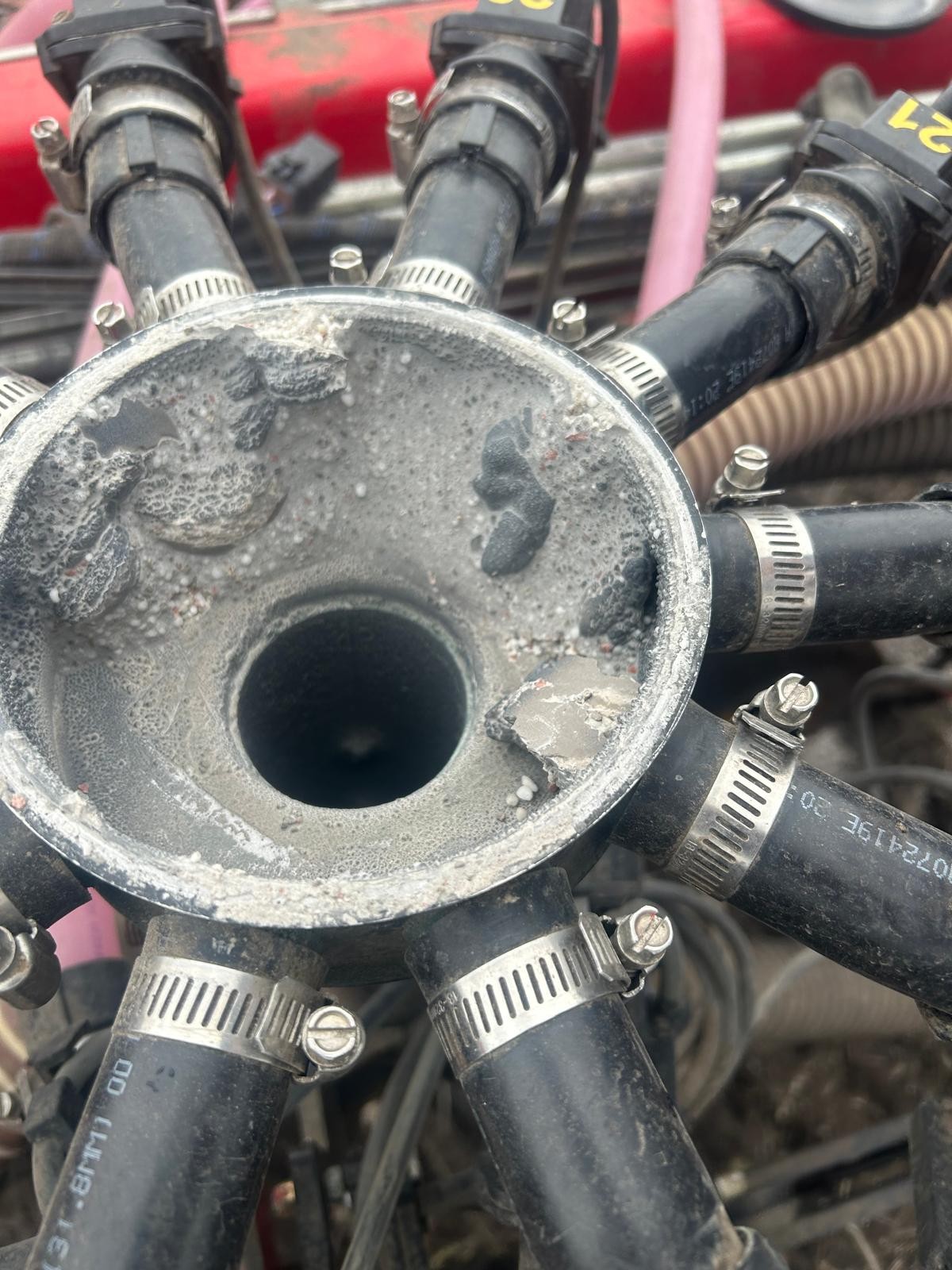
Monitoring temperature and minimizing big swings in temperature can help prevent caking caused by condensation.
4. Static electricity
The risk of fertilizer caking or bridging increases when static electricity, dust, and condensation are present.
As fertilizer moves through certain materials, like plastic hoses, static electricity can form on the surface. Any fertilizer dust in the bin or hose can then attach to these surfaces, where they can collect moisture and quickly begin to clump together.
Over time, this buildup can restrict flow and contribute to caking.
Keeping dust levels low and checking equipment daily can help prevent caking caused by static electricity, dust, and condensation.
5. Excessive handling
Excessive or unnecessary handling is another common cause of bridging or caking.
Every transfer you make can create small particles of fertilizer dust that fall into equipment or storage bins. This dust can then be attracted to surfaces and absorb moisture, causing caking.
Reducing excessive or unnecessary handling will decrease the risk of dust formation and caking.
6. Bin residue
Leftover fertilizer residue can also drive caking.
Any residue left behind in bins or on storage floors can unintentionally mix with other fertilizer products to create a blend. These inadvertent blends can alter how your fertilizer reacts to moisture, often increasing its risk for caking.
Thoroughly cleaning bins, floors, and fertilizer equipment can help reduce accidental blending and prevent caking.
Why does it matter?
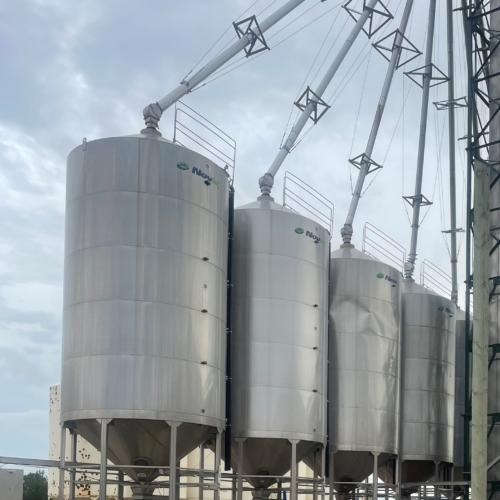
Not only can caking and bridging impact your applications and storage, but they can also cause serious safety risks.
When fertilizer hardens and forms bridges, it can collapse inside storage bins and create a serious hazard for anyone working near or inside the bin. It can also place stress on bin walls, create excess dust that can pose respiratory risks, and in some cases, it can even contribute to dust ignition.
What starts as a storage issue quickly turns into a real safety risk. That’s why it’s essential to prevent it.
The top five ways to prevent fertilizer caking and bridging
1. Stay aware of the risks
Understanding the main causes of caking and bridging is the first step in preventing them during storage or application. Managing moisture, limiting blending, reducing handling, controlling dust, and maintaining clean storage and equipment all play a role in reducing your risk.
2. Reduce handling
As mentioned previously, the more we handle products, the more dust we create. This dust can then absorb moisture and increase the risk of caking. Reducing the number of times you handle, transport, or move products can help decrease dust formation and reduce the risk of caking.
3. Maintain clean bins
Thoroughly cleaning and drying your storage bins and application equipment is one of the simplest ways to avoid fertilizer caking and bridging. It prevents the risk of accidental moisture absorption and inadvertent blending while lowering the likelihood of caking.
4. Monitor storage
Monitoring your storage conditions is essential for preventing all six causes of caking and bridging. By staying on top of temperature, product quality, dust formation, and the cleanliness of your storage and equipment, you can reduce your risk.
5. Communicate with others
Open communication is also an essential step in preventing caking and bridging and the safety risks associated with them. Notify your team if you notice a cliff or signs of caking in storage and work together to develop a plan to address the situation in a safe and controlled manner.
Prioritizing safety across your operation
Preventing caking and bridging comes down to managing conditions before issues arise. Proactive practices that reduce handling, blending, and moisture can help you protect your product, your equipment, and most importantly, your people.
Learn more about fertilizer safety and on-farm safety with the following eKonomics resources:
Managing Water in Dry Fertilizer Blends
Ten Tips For Safety On The Farm
The Dirt S4E23 – Fertilizer Storage: Protecting Quality and Flowability