






Read Full Transcript
[00:00:07] The Dirt PodKast:
Welcome to The Dirt, an eKonomics podcast bringing you the down and dirty agronomic science behind growing better crops and bigger returns. Backed by nutrien-ekonomics.com, we break down the latest research, news, and insights to help farmers make better business decisions. Let’s dig in.
[00:00:32] Alan Blaylock:
Welcome back to The Dirt for this episode today. I’m your host, Dr. Alan Blaylock, agronomist with Nutrien. Our guest today is Dr. Miles Dyck, professor of soil scientist at University of Alberta. We’re going to be talking today about soil pH and we’re talking with a guest who has a lot of experience with that in Western Canada. Miles, as we start out here, why don’t you tell us a little bit about yourself and what you do there at University of Alberta and a little brief background of your experience and why we have you on as a guest talking about soil pH.
[00:01:04] Miles Dyck:
Sure. Thanks Alan. It’s a real pleasure to be here. I’ve been working at the University of Alberta since 2008 as a professor. I teach courses in soil physics and soil classification. My interest in soil started from a young age when I was growing up on our farm near Swift Current, Saskatchewan and I became interested in soils and landscapes at that time and farming as well. When I went to university, I took a number of soil science classes and one thing led to another and I ended up doing a master’s and then a PhD and I guess here I am today. I have a broad research interests in soils and when it comes to soil pH and soil acidity, very much interested in how management, agricultural management, crop rotations, fertilizer management affects soil pH and soil acidity.
[00:01:52] Alan Blaylock:
Let’s start by asking you what is soil pH, for those who may not know? What does it mean and why is it important to our growers? What do they need to know about soil pH to better manage their farms? I know there’s a couple of questions involved there, but just boil it down for us. What is soil pH and why does it matter?
[00:02:11] Miles Dyck:
Without getting into too much chemistry, soil pH has a measure of acidity. It has a scale from one to 14 and seven is neutral and any pH below seven we would consider acidic. And if the pH is above seven, we consider that basic or alkaline. Kind of like the Richter scale, the pH scale is logarithmic. If you have a one unit change in pH, that’s a tenfold change in acidity. The reason we measure pH in soil and the reason it’s important measurement for soil is that crops prefer a narrow range of pHs to grow well. Most cereal and oil seed crops prefer pH between 5.5 and 6.5 or seven. Pulse crops are a little more sensitive to acidity. When the pH falls below six or 5.5, the yield starts to decline. And for legume forages like alfalfa, alfalfa is famous for being sensitive to acidity. There’s other crops like oats that are a little more tolerant to acidity and they’re happy when soil pH is around five.
[00:03:15] Alan Blaylock:
Thanks, Miles. Continuing on with that discussion, I’d like to ask why are we talking about pH issues in Western Canada? Much of Western North America, as many people are aware, we generally fight against problems of high pH and some of those effects, and we’ll get into that a little bit later, but are there particular issues showing up in Western Canada with pH that we need to be aware of? And then we’ll talk a little bit about what we do about that.
[00:03:41] Miles Dyck:
Soil is variable. It varies regionally. With respect to pH, that’s true as well. So you’re right. Most of the time in Western Canada, we don’t have a lot of soil pH issues, but there are pockets, say in western Northwestern Saskatchewan and Central and Northern Alberta where we do have fairly large acres of what we would consider acidic agricultural soils. Some really rough estimates for Alberta around 13 million acres of soils with pH less than six. And that’s really a function of soil parent material. On the prairie provinces, Manitoba, Saskatchewan, and Alberta, as we move from Manitoba westward across Saskatchewan and Alberta, the amount of free lime in the soil parent material decreases. So there in Alberta, we still have quite a bit of free lime that occurs naturally in the parent material, but when we get it in essential in Northern Alberta and Northwestern Saskatchewan, that’s where the parent material is naturally lower in free lime. Those soils have naturally lower pH, six or lower. That baseline there can be changed by management, fertilizer and rotation practices, et cetera.
[00:04:53] Miles Dyck:
That’s the regional story. There’s within field variability as well at a smaller scale. That very much also depends on the parent material. It depends on the history of how that soil was managed in the past. And since the land was converted to agriculture and the legacy of conventional tillage and soil redistribution, that’s exposed parent materials on the knolls and moved a lot of topsoil from the knolls down slope, depending on the pH of the parent material. So if you had a lot of carbonates in the parent material, you would have carbonates exposed at the knolls now. You have locally areas of high pH on the knolls and you’d have more acidic pH in the lower slopes. There’s also areas in Alberta where the subsoil is acidic. Those knolls where the para material’s been exposed, those are actually acidic now.
[00:05:43] Miles Dyck:
There’s lots of spatial variability. And then I guess the one other factor I’ll mention is since the late ’80s and early ’90s, we’ve been practicing either zero till or minimum tillage. And along with that, we started banding our fertilizers in the top three inches of the soil. Year after year, those fertilizers are being banded in that top three inches and that’s where the young seedling grow and the majority of the crop roots are concentrated so that’s where nutrient uptake is also concentrated. Of course, it occurs at deeper depths as well, but it’s much more in that top three inches. Over time, that has potentially in some areas acidified those top three inches of soil and it doesn’t always show up in a six-inch soil sample. That’s another thing that we’re looking into as well in our research here.
[00:06:30] Alan Blaylock:
Interesting. So in the Western US, Miles, we have some areas that have developed acidity in rather severe cases. For example, in Montana, you may have read about some of the changes that have occurred there over the years and now we have areas developing acidity that is particularly problematic where it’s maybe even difficult to grow a crop in some areas. And you mentioned fertilizer and much of these problems in the Western US have been attributed specifically to certain forms of nitrogen. You mentioned fertilizer placement and how that can play a role in acidification at the soil surface. Can you talk a little bit about nitrogen soil chemistry and transformation processes that may be contributing to some of the development of that acidity? Because I know that’s been described as a factor in some cases. So can you talk a little bit about that?
[00:07:18] Miles Dyck:
Yeah. Certainly. Whether it’s fertilizer nitrogen, fertilizers like urea or anhydrous ammonia or even soil organic nitrogen, all of those forms of nitrogen, fertilizer nitrogen, soil organic nitrogen, they undergo oxidation reactions during the growing season and those oxidation reactions result in the nitrogen being converted to plant available forms ammonium or nitrate. The final product is nitrate and that’s where our crops take up nitrate mostly. That series of reactions to produce nitrate, those reactions produce acidity naturally, whether it’s fertilizer nitrogen, or soil nitrogen. Over time, there’s just been this consistent annual inputs of we’ll call them acidity. You can think of a soil acidity balance if you like, like we think about soil nutrient balances. Over time, the natural way of things is just for the soil to become acidified or the pH to slowly decline because of these processes.
[00:08:17] Miles Dyck:
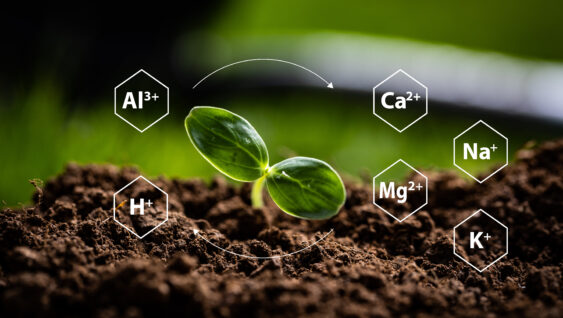
That’s one factor the acidity produced by the fertilizer, but it’s a little more complex than that. That acidity is buffered by the soil. It’s either buffered by free lime that occurs naturally in the soil or that has been applied, the lime that’s been applied by farmers, or it’s buffered by the so called basic cations. If there’s a lot of free lime in the soil, that acidity that’s been added by fertilizers or other natural processes, that acidity is neutralized over time until that free lime is exhausted and then the soil acidity reactions are buffered with the basic cations. When we get into that stage, it’s very much the soil pH drops because the soil is being depleted in cations over time because we’re removing cations in the harvest of our crops every year.
[00:09:04] Miles Dyck:
Traditionally, we haven’t used calcium or magnesium fertilizers because our soils have a lot of calcium and magnesium. But when we think about all of these processes being concentrated in that top three inches, so we have annual inputs of acidity through fertilizers and then losses of basic cations through crop uptake and harvest. And over time that’s resulted in pH decline in the soil.
[00:09:30] Alan Blaylock:
Let’s talk just a little bit about some of the effects of the acidity. You talked about different crops being more sensitive or less sensitive to acidity. Obviously crops vary widely and some crops are very tolerant and others are not. But aside from a specific crop adaptation, are there other specific problems that we need to be aware of that result from soil acidity? We’ve talked a bit about some of the nutrient interactions and that’s often mentioned. Can you talk a little bit about some of the effects of the acidity and why we’re concerned about this soil variable?
[00:10:02] Miles Dyck:
In extreme cases, very low pH aluminum becomes more soluble in the soil and the aluminum is a phytotoxic element when it’s available to plants. That’s at the extreme end, but as the soil pH falls below 5.5, a lot of those nitrogen transformation processes that I talked about, those become inhibited. Those processes produce acidity. If the soil is already acidic, that acts as an obstacle for those processes to occur. When the soil becomes too acidic, we have run into reduced nitrogen cycling, reduced nitrogen mineralization, reduced transformations of those nitrogen fertilizers, and that can potentially result in lower crop uptake of applied nitrogen. Another important nutrient in this case is phosphorus and that’s the one we all learn about in undergrad. Phosphorus is very much phosphorus phosphate ion, which is plant available. The sorption of that ion to soil particles or the reaction of the phosphate ions with calcium, iron or aluminum in the soil is pH dependent. Once the soil pH falls below six or around 5.5, that’s a range where phosphate is less soluble in the soil and not as available to plants.
[00:11:23] Alan Blaylock:
We’ve talked about some of the effects. We’ve talked about what pH is and how that might be important. Are you seeing these areas of problematic soil pH being too acid expanding, becoming worse with time? We mentioned a little bit about long-term cropping and some of those effects. In your judgment, are you seeing this problem becoming worse across Western Canada?
[00:11:45] Miles Dyck:
Anecdotally, it’s something that’s hard to really nail down on a wide large scale area in agricultural fields. Anecdotally, we’re hearing from farmers that they feel their pH is decreasing over time. It’s something that certainly is likely occurring, but we don’t have a good handle on the rates or how widespread it is. In some of my research at the Breton Plots, the bread and plots is a long-term research site run by the University of Alberta. We have a long-term rotation study there where we have lime treatments. We have records from that experiment that show that soil pH has been changing over the last 100 years. That experiment’s been running for over 95 years. We can show in a five-year cereal forage rotation that what would be considered fertilizer applications that would be on the average side. PH declines probably about a 10th of a unit per year. We’ve had to correct the pH. Once the pH falls below six, our protocol is to add lime to bring the pH back up to 6.5. That has to be done every 10 years or so for that soil.
[00:12:57] Alan Blaylock:
I’m glad you mentioned the Breton plots. These long-term studies. We have a few of these across North America and these can be very informative for things like these long-term changes of pH looking at the various crop rotations and their effects over the long-term tillage changes and some of that which have certainly occurred. Are there particular crop rotations that tend to result in greater acidification, more change in soil pH over time that you’ve observed in these long-term plots?
[00:13:29] Miles Dyck:
We just have that on long-term rotation with detailed records, but from that we can infer that we have this natural acidification rate, but that can be accelerated or decelerated as a function of fertilizer management and crop rotation. The on long-term crop rotation that we recently published a paper on is a five-year cereal forage rotation. We analyzed the records from 1980 to 2020. So as wheat, oats, barley, and then two years of alfalfa bromee hay and that alfalfa brome hay is started in the barley phase that’s underseeded with the barley. What we saw in our analysis there was that it was very much the forages that affected the soil cation balance. I talked about that process of acidification. The acidity is added with the fertilizers increase the amount of acidity that’s introduced into the soil, but it’s the cation export from the soil and the harvest those two in combination decrease the soil pH over time.
[00:14:30] Miles Dyck:
And with forage crops and especially legume forages, they take up a lot of cations. And as you know, with forages, the entire above ground biomass is removed with harvest in hay. Those crops contribute a lot to depletion of soil cations over time. And we found that rotation under conventional fertilizers, urea, triple superphosphate, elemental sulfur and potash had much greater rates of acidification than the other treatment, which is manure. The manure treatment, there’s actually a lot of cations in manure and so the regular application of manure offset those cation losses in the harvest of the forage crops. We saw a really big contrast. The soil pH stayed relatively constant in the manure treatment, whereas we had to correct soil pH with lime every 10 years or so under conventional fertilizer.
[00:15:21] Alan Blaylock:
I’m glad you mentioned crop removal of those cations with the forages. That’s certainly a concern for all the nutrients. When we’re harvesting forages we remove everything. And so nutrient removal and in this specific case, those basic cations, the removal of those is much greater than removal of a grain crop. I’m glad you brought that up. You’ve mentioned liming a couple of times. Let’s talk now about correction of soil pH. What can the grower do and when do we want to start taking that remedial action? And certainly eKonomics are a big challenge these days for many growers. We want to talk about that in an economic context, but what does the farmer do if he observes in his soil test that his acidity is becoming problematic or maybe he’s noticed some production declines that maybe he’s not quite sure why that is occurring. How does the farmer recognize this? And then what does he do about it?
[00:16:16] Miles Dyck:
That’s a great question. Certainly regular soil sampling to monitor pH is important along with if the farmer does soil tests for nutrients regularly. Certainly pH is often included in the package and it’s something to pay attention to. But once pH gets around 5.5 or lower, then that’s in the area where one might want to start being concerned about it and start thinking about some actions to try to at least ensure the pH doesn’t fall any lower than that. I mentioned liming a couple of times. Liming materials, often crushed limestone is the most common liming material. That’s why we call it lime, but there’s other materials that can help increase pH. What’s common among all those materials including crushed limestone is that it supplies calcium or basic cations. Dolomitic limestone has lots of magnesium as well. But the other half, it has an ion ion that neutralizes the acidities. So with limestone is calcium carbonate, it’s a source of calcium. And then the carbonate reacts with the acidity, the hydrogen ions that cause the acidity in the soil and neutralizes those. In that way, you’re building up that soil reservoir of basic cations again, and you’re also neutralizing the acidity that’s in the soil and that will increase the soil pH over time.
[00:17:35] Alan Blaylock:
In Western Canada, Miles, do you have sources of those materials available? We’ve talked about how these problems are not as common across the prairies. Maybe those sources are not as developed. I don’t know the situation up there. Can you address that? Are liming materials that growers can use readily available if they need them?
[00:17:54] Miles Dyck:
We have such a large area. So transportation costs do weigh heavy at times. We do have a quarry in Southern Alberta as to Calgary limestone is used in cement production, but those companies also do produce an ag lime product. I think Graymont is one of the companies. There is another quarry in Northeastern BC close to the Peace Region in Alberta here that is a source of limestone. So those are what we would call standard liming products. There’s what I would call non-standard liming products available, especially in the Peace Region where there’s lots of forested land. A lot of the mills have wood ash available and wood ash is a liming material. The reason I call it nonstandard is it varies batch by batch in terms of its acid neutralizing capacity, but it is a very good liming material. There’s other liming materials that would be considered non-standard. Cement kiln dust is one. These companies that manufacture cement, they have a waste product called cement kiln dust. Again, it varies batch by batch in terms of its acid neutralizing power, but that is an effective liming material.
[00:19:01] Miles Dyck:
In Southern Alberta, there’s where they process sugar beets for sugar. There’s a waste product that’s called spent lime. They use lime in that process and it reprecipitates and it’s called spent lime, but it’s basically calcium carbonate. It’s a very good source of lime. There’s other lime sludges in some industrial facilities. There’s sources. I would say they’re becoming more available in terms of word of mouth getting around and then having farmers being able to access it. One of these non-standard sources that these companies, they’re not in the agriculture business, so you need a broker or someone in the middle to facilitate hooking the farmers up with those products.
[00:19:41] Alan Blaylock:
Can you tell us briefly as a farmer’s considering these sources and you may have multiple choices there from which you can choose to use as a soil amendment. Just briefly, what are the key things the farmer might need to know about those materials in order to make the best decision on what material might be the best fit for him or her?
[00:20:00] Miles Dyck:
With the crushed limestone products, more or less you know what you’re getting, but one important factor there is how finely it’s been crushed. The finer it’s been crushed, the quicker it reacts in the soil and neutralizes the acidity. On the other hand, the finer it’s crushed, the harder it is to handle sometimes. It’s a very fine flour-like dust. Applying it to the soil, those handling problems can occur. With the non-standard products, then it requires characterization. Definitely a sample of each batch needs to be sent to a lab to get a calcium carbonate equivalent test so the farmer can determine the correct rate of the product to be applied. A calcium carbonate equivalent test lets you know what the acid neutralizing power of that liming material is and allows you to get a lime recommendation from the lab in tons of calcium carbonate per hectare or per acre and you have to convert that to say tons of wood ash per acre. You need that calcium carbonate equivalent to make that conversion.
[00:21:04] Miles Dyck:
With those materials, there’s handling considerations. Wood ash can be very fine and be blown away in the wind, or it can be sitting in a stockpile and have been wet for a while and it’s all clumped up. The beet lime has some moisture in it when it comes out of that process. You have to account for the amount of moisture in it when you apply it to get the right rate. There’s quite a few factors that need to be considered and very much depends on the liming material that the farmers choose to apply.
[00:21:31] Alan Blaylock:
It sounds like it’s very much like applying a nutrient source. We start with our soil test, see if we have a problem. If we need lime the soil test, we’ll often produce a number from that soil test to make a recommendation for that lime. And then the farmer has to evaluate these various materials, look at the analysis, do some calculations to match that up with the recommendation. It’s not just as simple as going and buying a truckload of something and throwing it out in the field. We want to do the math because we don’t want to spend more than is necessary and there can be some negative effects of over liming. Just a reminder, those who need to make some amendments, there’s a little bit involved in that process and paying attention to what’s going on with your soil test.
[00:22:14] Alan Blaylock:
Miles, I did want to come to a topic that sometimes comes up in Western North America and that is this question of high pH soils. We have a lot of those. Sometimes it’s caused by certain salts. We may have sodic soils where the pH is high and you talked about free lime in soils. We have soils that have alkaline pHs because they have a lot of limestone. I’ve been asked, how can I acidify that soil and bring that high pH down? Let’s talk just a little bit about that before we wrap this up, because I think that’s also important to understand if the pH is too high. Can we manage around that? What do we do with that? Is it practical or economical to amend those high pH soils in the same way that we do with acid soils, which certainly need to be corrected, but do we need to watch out for the same with some of these high pH soils?
[00:23:03] Miles Dyck:
We can use a liming material to raise pH. We can use something like elemental sulfur, which when it’s oxidized in the soil, elemental sulfur is oxidized by the microorganisms to sulfate. That reaction produces quite a bit of acidity. That would be an amendment that could be used to decrease pH. There’s other sources, maybe not so common and more expensive that likely wouldn’t be used on a large scale, but I know in some research they use aluminum salts like aluminum sulfate or other aluminum salts. And aluminum is very reactive in the soil and also creates acidity. In terms of like on a farm scale, elemental sulfur would be the product that would likely be used. Again, with that product, it’s the fineness that is important.
[00:23:53] Alan Blaylock:
So a lot of the same principles apply that we would apply to the question of limine materials. Some of those same principles, fineness, reactivity, the chemistry of the material we’re using to change the pH. It seems like those principles would be the same but in a different direction. What might be the issues that a farmer would be concerned about if the pH is too high? Are there particular problems that … We talked about those in relation to acid soils, what particular problems might high pH present?
[00:24:21] Miles Dyck:
The phosphate and the phosphorus availability being affected at a lower pH. Well, that phosphorus cycles gets optimum availabilities around pH-6 or 6.5. And then once pH increases above 6.5, again, we get into this range where the phosphorus reacts with calcium ions to produce these sparingly soluble complexes or precipitates. So the phosphorus becomes less available when soil pH increases above seven. Also for nitrogen, for example, volatility like ammonium, ammonia volatilization is an issue in soils where we have higher pHs above seven or. So if we think about urea, when urea is applied to the soil first reacts with the soil water to form ammonium or ammonia. And if the pH is too high, the gaseous ammonium isn’t converted to a dissolved ammonium ion right away. You have this opportunity there where you have a lot of gaseous ammonium in the soil and it can be lost to the atmosphere. That’s a process by which some of the nitrogen you apply could be lost to the atmosphere and it’s not a very good return on your investment.
[00:25:33] Alan Blaylock:
And of course we can have issues with some of the micronutrients like phosphorus can become less available at high pH. Those aren’t typically quite as big a problem perhaps as phosphorus, but just something for growers to be aware of. I wanted to ask you, Miles, when you talked about applying elemental sulfur to bring that pH down with sulfur prices climbing higher and higher, is that economical to try to adjust the pH of say a calcarious soil where there’s free lime present and often highly buffered situations? Is that an economical solution to that high pH?
[00:26:05] Miles Dyck:
That’s a really great question, Alan. Either way for using elemental sulfur or lime to bring up the pH depending on the circumstances, it’s an expensive proposition. And especially because that I mentioned the pH is that logarithmic scale and to change the pH by a small amount, that involves a large amount of acidity that needs to be neutralized or basicity that needs to be acidified, you end up needing very high rates, higher than fertilizer rates. So lime, for example, you know you’re likely going to need depending on the soil properties … I guess that’s another factor is the liming rate very much depends on the amount of clay and organic matter in the soil. These two metric tons per hectare for a lime application. And in some areas in our research, some areas up in the Peace Region of Alberta where they have high clay soils, we’ve calculated lime rates required up to 15 metric tons per hectare or even 20. That’s a lot of material. The transportation costs, the costs for the material itself and the application, those costs are not going to be recovered in a year or two. It’s very much one has to consider it as a long-term investment that will be recovered maybe in 10 or 20 years. And to look at it from the perspective of there’s a cost to not doing anything as well, look at it from that perspective.
[00:27:30] Alan Blaylock:
One last question then we’ll wrap up here. If the grower can’t for either economic or practical reasons, can’t make the correction that he needs to make. Either the amendment isn’t available or he can’t afford it, or for some reason it’s not possible to really correct the problem that needs to be corrected, what are the options? What does the grower then have to do if it’s not possible to really solve the problem that he needs to solve?
[00:27:55] Miles Dyck:
There are still options like acid-tolerant crops in rotation. If a one-time large application of lime isn’t feasible, then there’s potentially some plans that could be developed with the help of a professional agronomist where you could do smaller, more frequent applications over time to slowly increase the pH over time. As I mentioned before the pH gets to that 5.5 or lower level, applying amendments that would replenish those soil cations like manure, composted manure or even compost, you have to be a little more creative, but I know there have been some breeding efforts. In the Peace Region there is a more acid-tolerant variety of alfalfa available now. It’s also interesting, especially in the Peace Region, some of those soils are quite acidic pH around five or lower and they’re still fairly productive. And so I think we’re still trying to understand why that might be, but I think it is because they have really quite high amounts of organic matter compared to a lot of the literature we rely on that tells us that if the pH is below 5.5, there’s going to be yield loss right away. Those are from the Midwestern states where soil organic matters aren’t quite as high as up in the black soil zone or dark gray soil zone.
[00:29:12] Miles Dyck:
Organic matter is key as well. If you can build organic matter in your soil, you may not have to increase the pH to that six or 6.5 level. You might be able to be productive at a lower pH.
[00:29:26] Alan Blaylock:
Well, Miles, it’s a great deal of information today that’s obviously a very complicated subject or can be complicated and may not always be a simple problem to solve for the grower. As always, a grower should probably consult with his crop advisor, professional agrologist, agronomist to work through a system-wide approach to something like this because it can be complicated. Are there any take-home messages, final thoughts you’d like to add, maybe something you’d like to address that we didn’t get to today, thoughts you’d like to leave with our listeners?
[00:29:57] Miles Dyck:
One thing I was going to mention there when I was talking about liming products was often gypsum is thought of as a liming product, but it’s not. It’s a source of calcium, but it doesn’t have that acid neutralizing anion with it. Certainly gypsum has its place, but it’s not a liming product.
[00:30:14] Alan Blaylock:
Great reminder. And it does supply calcium, which may be beneficial for a variety of reasons.
[00:30:19] Miles Dyck:
That higher pH, it’s a source of sulfur as well. It would be a less acidic source of sulfur than something like AMS, ammonium sulfa.
[00:30:27] Alan Blaylock:
Okay. Lots of great information today Miles. Glad you could join us. For our listeners, always a reminder that you can find more information on this topic and many other topics at our website, Nutrien-ekonomics. That’s eKonomics with a K, nutrient-ekonomics.com. I know we have a number of articles there on soil pH and its management as well as various topics on nutrient and soil management and a host of related agronomic topics. With that, we will leave you until the next episode. This is Alan Blaylock with Nutrien signing off from The Dirt and we’ll look forward to catching you in the next episode. Thank you.
[00:31:08] Speaker 1:
Farming isn’t farming without questions and now there’s a place to go for answers. At eKonomics, an entire team of agronomists are ready and waiting to help for free. No question is too big or too small. Visit nutrient-ekonomics with a K .coom and submit your question with the ask an agronomist feature.
[00:31:31] Speaker 1:
How can I adjust soil pH?
[00:31:34] Speaker 4:
In some regions of farming, we need to adjust the soil pH. We’re usually talking about adjusting the soil pH so that it is less acidic. We want the increase the soil pH. In some regions, soil pH can be very low. You might see soil pH levels of well under six, perhaps even under five in some cases. And it becomes a big deal then. You can have a direct impact of acidity on crops due to toxicity of hydrogen and aluminum and direct impact on the crop, but it can also have other impacts on the crop. Acidic soil is more likely to be deficient in a number of nutrients. Example that we often lean on is phosphorus. Acidic soils are often very deficient in phosphorus. There are many reasons that we might want to increase the soil pH. This depends on what the soil pH is to begin with. It depends on the crop that you’re growing because some crops are very tolerant of low pH and some are not. We need to think about really the whole farming environment on if you really want to or need to increase your soil pH.
[00:32:42] Speaker 4:
Now, how do we do that? It’s lime. It’s high rates of lime. Utilizing soil test lab that is very familiar with liming, understanding the proper soil test, some titratable measurement of soil pH to understand what rate you really need for applied lime and making sure that you have both an effective lime source, the right rate of lime, and apply it properly. And this usually has to come with some significant incorporation of the lime. It’s a significant cost, but if soil pH is very low, if you have acid soil, it can have a big impact on crop yields. It can have a big impact on many other agronomy factors within the field, anywhere from nutrient availability to pathology within the soil to many other factors. You do have to keep an eye on it. It’s a significant expense, but if you need to do it, you need to do it right and rely on the right resources to find the right rate of lime to apply.
[00:33:43] Speaker 4:
On the other end of it, once in a while, very rarely, you might have a farmer who wants to decrease soil pH. That’s more difficult to some sense because you need to use usually products like powdered elemental sulfur or other products that can actually reduce pH and you really have to ask yourself if you really want to take that step. There are very few crops that you grow that really need a lower pH and you may actually cause more harm than good or it may be ineffective in terms of reducing pH. When it comes to assessing what level of acidity, what level of pH that you have in your soil, approach it carefully, understand what your crop needs and understand what the right steps are to adjusting that level of pH.
[00:34:31] Speaker 1:
If you liked what you heard today, share this podcast with someone who would enjoy it, your neighbor, a friend, or your crop advisor. Your support helps us keep these conversations going. Don’t forget to like, subscribe and leave a rating wherever you listen.