Jodi Derkach, P. Geo, Senior Manager, Land and Resource, Nutrien
Jodi Derkach, P. Geo, Senior Manager, Land and Resource, Nutrien
Jodi is a geoscience professional with over 18 years of experience, of which the last 15 have been with Nutrien Ltd. Currently, she serves as the Senior Manager of Land and Resource and contributes to the long-term operational success of Nutrien by leading a team that evaluates potash mineral potential and secures surface and mineral rights. She sponsors the use of various technologies, including LiDAR and GIS, to achieve business objectives.
Jodi holds a Bachelor of Science in Geology from the University of Saskatchewan. She also completed the Geographic Information Systems for Resource Management certificate program at SaskPolytech.
Canada is host to a world-class potash deposit and tops the global list for potash production by volume. Potash is known to be present in several places across Canada, namely the Prairie provinces and most eastern maritime provinces, but the vast majority of production comes from the province of Saskatchewan. Interestingly, the productive potash-rich beds for which Canada is known for are almost unique to southern Saskatchewan, marginally crossing over into bordering provinces and the United States.
What is potash?
But what is potash? It is a generic term that has several applications. It was first used to describe the fertile ashes that resulted from burning wood and plants (there is evidence that aboriginal peoples of North America used ashes long ago to help plants grow).
Now, it is used to describe both the raw in-situ ore buried deep below the Earth’s surface as well as the refined end-product used in fertilizer. All have one thing in common – they refer to potassium-bearing minerals. At Nutrien, the refined potash produced is near-pure potassium chloride (KCl) or a mineral called sylvite, and it provides two essential nutrients, potassium and chloride, to support plant growth and reproduction.
Potash ore and potash products
In the fertilizer industry, potassium chloride (KCl) and a variety of other potassium-bearing products are typically expressed as a potassium oxide (K2O) equivalent value regardless of their precise chemical composition. This enables a standardized comparison of potassium content between products. By extension, Nutrien’s raw ore grade is also reported as a K2O equivalent with averages ranging from 21.6 to 25.1 percent K2O equivalent across the network.
Commonly, potassium products are mixed with other key plant nutrients such as nitrogen and phosphorus. For example, a North American fertilizer might have a nitrogen-phosphorus-potassium (N-P-K) formula of 3-10-10 which means it contains three percent total nitrogen (N), 10 percent available phosphate (P2O5), and 10 percent soluble potash (K2O).
Forming potash deposits
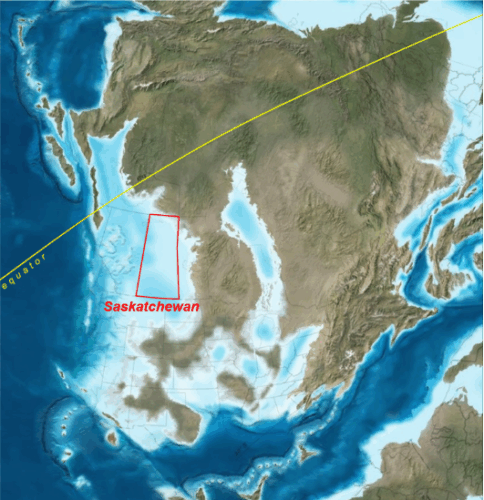
The vast, potassium-rich salt deposits of Saskatchewan exist because of a unique set of environmental and geographic conditions that existed more than 360 million years ago. The map below (Figure 1) is an illustration of what North America might have looked like during the Devonian Period when potash was forming. The illustration shows how present-day Saskatchewan was near the equator and was covered by a shallow inland sea. It would have been hot and dry in this subtropical environment – a key environmental factor for the formation of potash.
Figure 1: Illustration of North America during the Devonian Period (Source: Ron Blakey, Colorado Plateau Geosystems, Arizona USA)
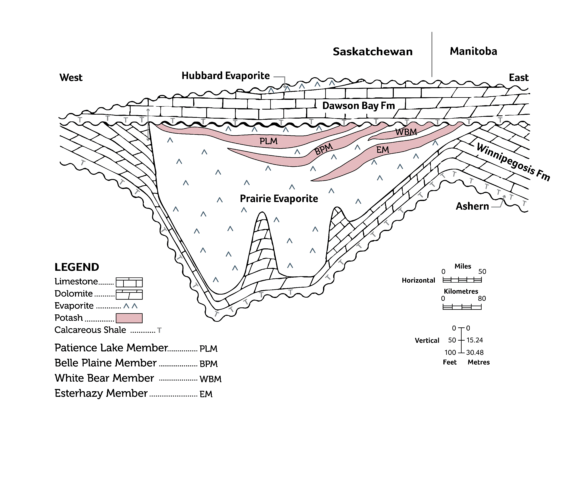
As is common in shallow coastal environments, reefs formed. The illustration below (Figure 2) shows these reef bars and how they grew to obstruct the flow of ocean water to the inland sea. For millions of years, extensive saltwater evaporation with repeated influx and recharging of the inland sea occurred in what we now know as Saskatchewan’s potash basin. It resulted in the deposition of potash beds near the top of a much larger 200-metre-thick ancient salt deposit with many successive layers.
It is understood that for every meter of salt accumulation, an approximate 60-meter column of seawater must be evaporated. To get the accumulation of salt minerals that are present in Saskatchewan today, about 12,000 meters of seawater would have evaporated over millions of years.
Figure 2: Illustration of seawater evaporation resulting in the formation of potash(Source:Geological Atlas of the Western Canadian Sedimentary Basin)
Uncovering pink gold
Seawater consists of water and dissolved minerals. When the evaporation of water is greater than the influx of water, the dissolved mineral constituents precipitate out in crystalline form. Geological processes are cyclic, and these minerals cycle from crystalline to a dissolved state in various environmental conditions. The precipitation of minerals in seawater happens in a predictable sequence starting with the least soluble minerals precipitating (when saltwater is at least 50 percent evaporated) and ending with the most soluble minerals precipitating (when saltwater is more than 90 percent evaporated).
The first of the evaporite minerals to precipitate out of seawater are carbonates (i.e., calcite/limestone and dolomite). Then, sulfates (i.e., gypsum, anhydrite) and finally, chlorides which are predominantly halite (i.e., sodium chloride (NaCl) or “table salt”), each forming successive depositional layers. Among the most soluble of the chlorides – and much less abundant – is potassium-rich sylvite (i.e., KCl) which forms when saltwater is more than 95 percent evaporated. Sylvite (or simply, “potash”) is the desired mineral in the ore that we mine today. It is an opaque white mineral that is readily dyed a pinkish color from iron exposure within the ore bed. Due to its abundant value, it is sometimes called ‘pink gold.’ Sylvinite is the term used to describe the raw ore which is a is a mix of sylvite, halite, and sometimes minor amounts of insoluble materials (casually referred to as “clays” or “clay seams”). A “clay seam” contains only a small proportion of actual clay minerals. The majority of its composition consists of detrital materials; weathered rocks from the surrounding landscape which are primarily limestone/dolomite, anhydrite, and quartz (along with other minor constituents).
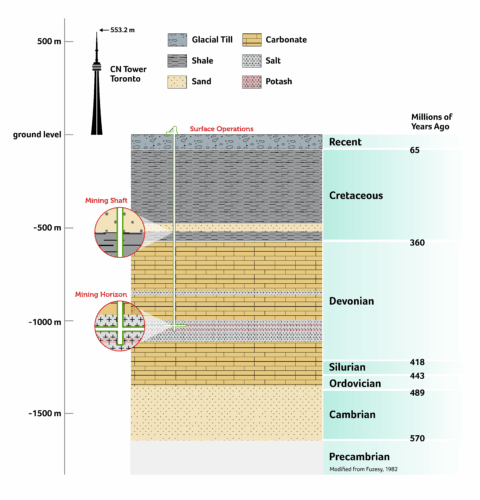
These potash layers within the great salt deposit were later buried by more than 1,000 meters of sediment in Saskatchewan. Importantly, they were covered with mudstone and a few hundred meters of largely impermeable carbonates that serve as a caprock, protecting the soluble salts from the freshwater that would come later in history. The image below (Figure 3) shows all of the layers of rock above the salt and below our feet. These are the stratigraphic layers that Nutrien must travel through via shafts in order to mine the horizontal potash layers below the surface. Less than a couple meters of soil sit atop the glacial till (a remnant of the last ice age), highlighting that agricultural activities occur on a very thin and relatively young slice of the stratigraphic column.
Figure 3: The layers of rock above soluble salts in the Earth that we must travel through in order to mine potash
Layers of potash
Each of the three main economic potash layers at the top of the salt deposit were given a name: the Esterhazy Member, the Belle Plaine Member, and the Patience Lake Potash Member. Each member is a few meters thick, flat-lying, and laterally continuous. Of course, irregular development and disturbance within the potash layers occurred, but generally, they are remarkably consistent for hundreds of meters.
Continuity is perhaps best demonstrated in the even thinner, few-centimeter-thick “clay” seams within the potash beds that extend, more-or-less consistently, from Nutrien’s Vanscoy potash operations to Nutrien’s Lanigan potash operations (over 165 kilometers), and beyond. Cumulatively, the potash members and other evaporated minerals (mostly halite) make up the Prairie Evaporite Formation – the formal geological name for the ancient-evaporated sea basin. It is this continuity – along with a favorable depth and relatively straight-forward mineralogy – that sets the Prairie Evaporite Formation of Saskatchewan apart from other potash deposits. The cross-section below is an illustration of what the basin looks like today (Figure 4).
Figure 4: An overview of the Prairie Evaporite Formation (Source: A, Fuzesy, 1982)
Mining potash
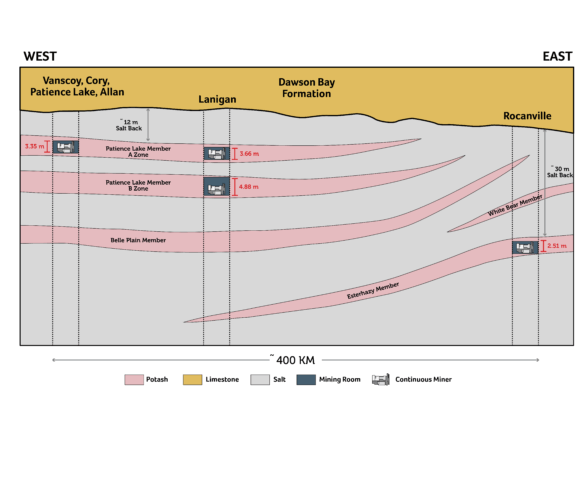
Below is a cross-section that depicts how the potash members are mined at Nutrien potash operations (Figure 5). Large continuous mining machines (i.e., borers) cut ore from the horizontal layers, feeding it onto a network of underground conveyor belts where it is hoisted to the surface through a shaft for processing in the mill.
Figure 5: Visual overview of how potash members are mined at Nutrien potash operations
Processing and producing potash
In the mill, the raw potash ore – which is a mix of sylvite, halite, and sometimes minor amounts of insoluble materials – is refined into finished potash products. Specifically, the ratio of halite to sylvite – or waste rock to desired mineral – is about 3:1 and it is the reason for the halite (i.e., “salt”) tailings piles adjacent to the Nutrien mills.
One of the two processes for producing potash in the Nutrien mills (crystallization) mimics natural geological processes, putting the raw potash ore evaporated out of seawater back into solution in order for isolated sylvite (i.e., KCl) to be extracted. Nutrien’s mills – through both crystallization and flotation – produce near-pure potassium chloride (KCl) which is predominantly used as a fertilizer on crops around the world.
Figure 6: An overview of potash mines currently running across Saskatchewan, Canada
It all began with the right geology
With a growing population comes a growing demand for quality food.
Meeting this demand requires the right amount of nutrients which is why potash is now classified as a critical mineral in both Canada and the United States.
The potash mined, processed, and produced in Saskatchewan plays an essential role in food security around the globe, and it all began with the right geology.
Dive deeper into the origins and significance of potash with the following eKonomics resources: