



Potash Mining and Processing
Potassium is one of the three macronutrients critical to plant growth. Required in large quantities, plants use potassium to regulate water pressure, activate enzymes, balance electrical chargers, transport sugar and starches, and more.
Potash describes the various mined and manufactured salts that can supply potassium to growing crops (usually designated as K₂O). It’s mined from various salt deposits around the world where more than 90 per cent is used for plant nutrition and crop production. It’s considered to be one of the most cost-effective and accessible sources of potassium in the world.
Every year, more than 70 million tons of potash are produced worldwide with the majority of production in Canada. The most common forms of potash derived from this production process are potassium chloride (also referred to as muriate of potash) and potassium sulfate (also referred to as sulfate of potash). The infographic below visually demonstrates how potash is mined and processed for agricultural use.
Knowing what goes into the potassium fertilizer you use and the agricultural inputs you invest in is essential to making more informed decisions about nutrient management and crop production.
The process begins when raw materials and minerals are collected and extracted for production. These materials are processed and chemically engineered to be used for agricultural production or to create specific nutrient products. Once manufactured, fertilizers are stored and prepared for distribution. Retailers then purchase the products to distribute to customers while often producing custom blends for the farmers in their region. The final fertilizer products are then shipped and delivered to producers to be applied on the farm.
Understanding this process will give you greater insight into the factors that influence fertilizer production, availability, and cost. This will help you plan ahead, make more informed input decisions, and manage your fertilizer programs and budgets more efficiently.
Producing the fertilizer needed to support agricultural production and feed our growing world is no simple task. The supply chain relies on the dedication of producers, suppliers, and distributors who work together to create a meaningful product that can support agricultural production.
Click through the MORE buttons below to learn more about the process of potash production.
Facts about Potash
- Potash is a general term used to describe a variety of potassium (K) containing fertilizers used in agriculture.
- The term potash comes from an early production technique where potassium was leached from wood ash and concentrated by evaporating the leachate in large iron pots.
- One of the initial processes for producing potash from wood ash was the first patent filed in the United States. It was signed by George Washington.
- Global potash production is around 70 million tons per year.
- Eighty percent of the tons produced globally come from Canada, Russia, Belarus, and China.
- Canada has the largest known reserves.
- Over 90 percent of global potash production is used for plant nutrition.
- Canada is currently the world’s largest producer and exporter of potash.
- Potassium chloride (KCl) accounts for most of the potassium used in world agriculture (about 90 percent).
- It is also commonly referred to as muriate of potash or MOP (muriate is the old name for any chloride-containing salt).
- It is the most abundant, accessible and cost effective per unit of potassium.
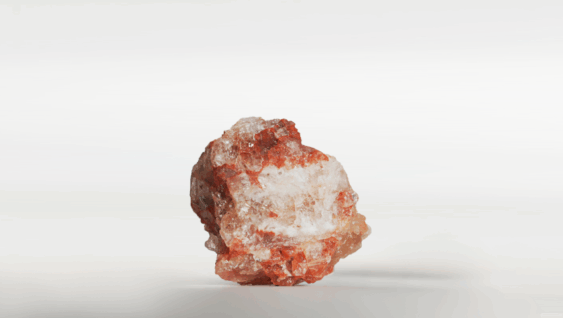
- The color of potassium chloride can vary from red to white, depending on the source of the ore and how it is processed. The reddish/pink tint comes from trace amounts of iron oxide contained in the ore.
- There is no difference in agronomic performance of red and white forms of potassium chloride. They do have different uses though. Red/pink potash and white can all be used for bulk spreading in agricultural soil, but white is the form primarily utilized for creating potassium solutions.
- Other potassium products include potassium sulfate, potassium nitrate, and potassium-magnesium-sulfate salts and more.
Mining/Milling
- Potassium bearing minerals are mined from underground ore deposits or extracted from salt lakes and brines. (e.g. Great Salt Lake, Utah and the Dead Sea).
- These deposits were formed as ancient oceans evaporated, leaving behind concentrated salt layers that were subsequently buried by sediment.
- Most potash mines today are deep shaft mines.
Tour of a Nutrien Potash Mine
- Underground mines have roads, vehicles and offices, and electrical stations and repair shops.
- Workers are moved from the service shaft to active mining areas (often miles away).
- Boring machines cut wide tunnels to extract ore from the rock deposit. A mine can have numerous boring machines working at different locations to provide a continuous supply of ore to feed the processing mill.
- Conveyors carry raw ore to storage areas underground until it is raised up to the surface for milling.
- Buckets called skips take the ore up to the surface in a continuing cycle that takes 90 seconds to complete.