



Supplemental K Applications Can Increase Cotton Yields and Quality

Low soil potassium levels, combined with the plant uptake of potassium by the cotton plant during growth, leads to nutrient deficiencies that ultimately reduce yields and fiber quality in cotton production.
Dr. Glen Harris, one of the nation’s top soil fertility experts and the Extension Agronomist for Environmental Soil and Fertilizer at the University of Georgia, advises how cotton producers can prevent potassium deficiency issues through proper fertilization.
“Potassium is our number one nutrient problem in cotton in Georgia and the Southeast,” said Harris.
The eKonomics nutrient balance analysis shows that an alarming 85 percent of the soils submitted in 2015 for analysis in Georgia are below the critical level for soil test potassium. Several other states in the southeast United States also have a high percentage of their soils under the critical level for potassium, which can have negative implications on cotton yields and fiber quality.
On average, cotton requires 40 pounds of K2O to produce one bale (480 pounds of lint), which removes 14 pounds K2O at harvest.
Why Timing of Potassium Application Matters for Cotton Growers
A shift in cotton varieties has also changed potassium nutrient management in cotton production. In the past, a single cotton variety was planted on 80 percent of the cotton acres in Georgia. However, Harris explained seed companies have released new, higher-yielding varieties. The new varieties are short season, which have a shorter period of flowering than “full season,” and earlier flowering varieties, which start to flower at the presence of the fifth node as oppose to the eighth or ninth.
Because of this, new varieties use potassium before producers would typically make a side-dress application. Harris recommends that producers apply potassium earlier to ensure adequate potassium during the flowering stage, as potassium increases drastically during early boll set. Seventy percent of potassium uptake in cotton occurs around first bloom.
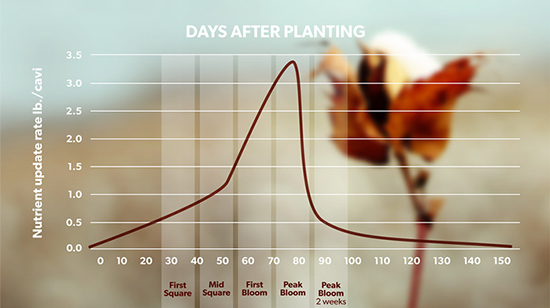
To maintain quality and yields, Harris recommends that cotton producers consider applying supplemental potassium applications around first bloom in addition to their full pre-plant rate.
In the late 1990s, Harris linked potassium deficiency with an increase in some cotton leafspot diseases. Once deficiency sets in and leafspot appears, a fungicide application will not alleviate the condition. Ensuring adequate potassium levels is one way to prevent these harmful leafspot diseases.
Potassium Applications: Split Versus Supplemental Application Rates
Over the years, there has been debate if producers should apply all potassium fertilizer pre-plant or split their potassium fertilizer applications – splitting the full rate in half between pre-plant and the growing season. Splitting the full rate would be similar to how many cotton producers manage their nitrogen application.
Harris has researched these techniques for many years and believes that with the introduction of short season, early flowering varieties, potassium uptake would peak before the in season split application is made.
“I was initially leaning toward split application being a better approach,” he said. “However, I found that applying a full rate of potassium fertilizer pre-plant and supplemental applications, if needed, produced the highest yields.”
Part of the reason for the difference is that potassium is not as mobile in the soil as nitrogen. Based on Harris’s research, producers should consider a supplemental potassium application if they have any of the following field conditions:
- Deep sanded soils (clay soils not found until at least 18 inches deep in the soil profile)
- Low testing potassium soils
- High-yielding conditions
- Areas where potassium deficiency and leafspot have been observed in the past
- Planting of short season cotton varieties
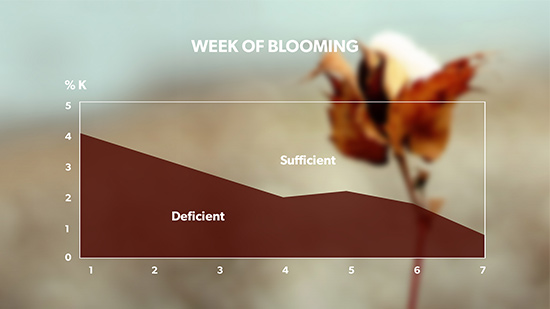
Harris recommends producers apply a full rate of potassium at pre-plant and be prepared to make two supplemental applications in season. Tissue testing of the cotton petiole can be used as a great tool for determining if additional potassium is required. When potassium is needed, cotton producers should consider applying 5 to 10 pounds of K2O per acre in two supplemental applications during the bloom growth stage. The applications should be made two weeks apart and be finished by the eighth week of bloom. As seen in Figure 2, greater potassium concentrations in the petiole during the early bloom stages decrease as the plant progresses into maturity.
Cotton producers can use tools such the eKonomics nutrient ROI calculator 2.0 and eKonomics nutrient removal calculator to estimate the amount of potassium to maximize the investment in their crop.
Harris continues to research how the latest production practices affect his cotton soil fertility recommendations. While more research is being conducted, producers should continue to soil test, apply a full rate at pre-plant and prepare for supplemental foliar potassium applications to maximize their yields and return on investment.