Dr. Karl Wyant currently serves as the Director of Agronomy at Nutrien. In this position, Dr. Wyant contributes proven agronomic leadership in growing the Nutrien commodity and premium fertilizer product lines and promotes advanced sustainability initiatives. Before working at Nutrien, Dr. Wyant served as the Vice President of Ag Science for Heliae Agriculture (2019-2022) and as an agronomist for Helena Agri-Enterprises in California and Arizona (2014-2019). Dr. Wyant earned his advanced degrees at Arizona State University (PhD – 2014) and Colorado State University (MS – 2008). Dr. Wyant is a Certified Crop Advisor and Certified Professional Agronomist (CPAg) and has his CA and AZ Pest Control Advisor licenses. He is chair of the WRCCA Executive Committee for 2022 and 2023. He has received an industry mark of distinction as one of Fruit and Vegetable Growers’ Forty Under Forty.
As soybean yield goals rise, sulfur (S) has emerged as a critical yet often overlooked nutrient. Growers are finding that incorporating sulfur into their management plans is key to maximizing ROI. Here is why sulfur is getting so much attention—and what’s driving it may surprise you.
The shift away from “free” sulfur
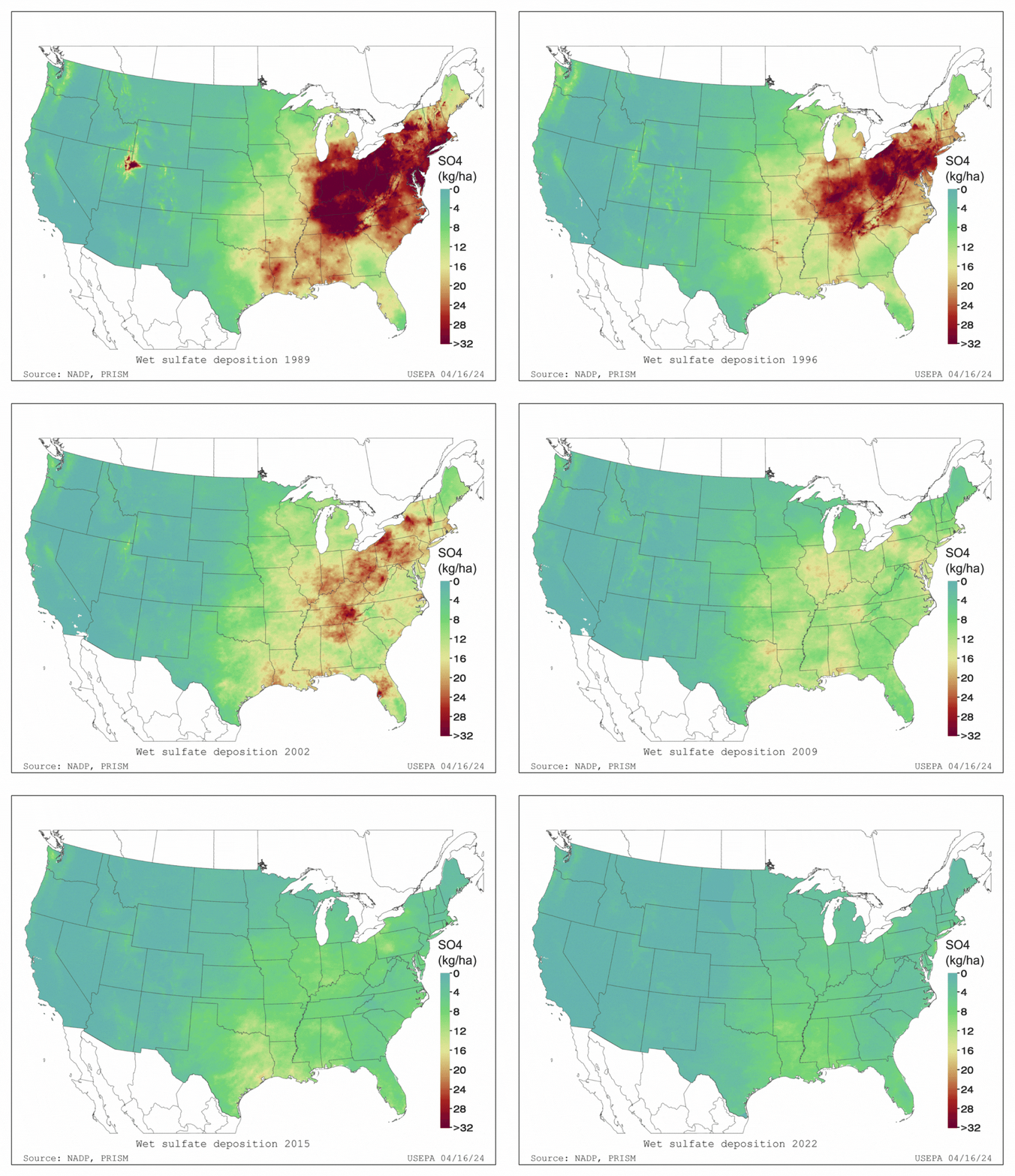
Soybean acres used to receive up to 30 pounds per acre of free sulfur (via sulfate) because of industrial activity and emissions (Figure 1: 1989 panel vs. 2022 panel). As environmental regulations have reduced atmospheric sulfur emissions, growers can no longer rely on free sulfur deposition and must now incorporate sulfur fertilizers into their nutrient management plans. For example, recent research in Indiana shows that adding sulfur to a soybean program adds between 7 and 22 bushels per acre in yield, especially on early planted soybeans where sulfur availability in the soil can be a challenge due to cool, wet soil.
Timeseries showing wet deposition of sulfate from 1989 through 2022:
Figure 1: Timeseries showing wet deposition of sulfate from 1989 through 2022. The red areas show where sulfur deposition from air pollution was highest. Source: EPA
How sulfur supports soybean yield and development
Why do we see such a strong yield response from soybeans when sulfur is added to the fertilizer program? The answer lies in the unique biology of the soybean crop.
Soybeans, along with all other crops, require sulfur to create proteins and build enzymes — it even creates the flavors we associate with garlic and onions. Sulfur also plays an important role in the structure of the enzymes that the crop uses to synthesize chlorophyll, or the cellular component that has the special ability to turn sun energy into a form the crop can use to grow and build yield. Consequently, there is a connection between sulfur nutrition and the crop’s energy and profit generating machinery.
Moreover, soybeans, and all other legume crops, have an additional need for sulfur that is not present in corn, cotton, and wheat. Sulfur is needed for root-nodule formation by Bradyrhizobium japonicum bacteria, which is responsible for fixing nitrogen (N) from the atmosphere and making it more plant available.
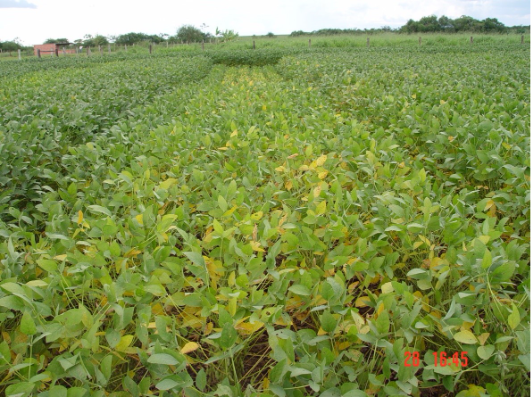
Sulfur is also a crucial component in nitrogenase, which is the enzyme that does the actual work of turning atmospheric nitrogen into a plant available form. If sulfur is limiting (Figure 2) in the field, soybeans may not be able to develop the nitrogen-fixing relationship needed to get the free nitrogen required to fuel growth and yield.
Figure 2: Soybeans with sulfur deficiency (middle with yellowing symptoms). Image Source: IPNI and V. Casarin.
Adding sulfur into soybean systems
Sulfur fertilizers (e.g., ammonium sulfate, thiosulfates, etc.) and amendments (elemental sulfur and gypsum) can be blended into existing fertilizer programs to provide sulfur to a soybean crop. Fields that test low in available soil sulfur, have low organic matter, have high sand content, stay cool and wet at planting, or some combination thereof are good candidates for another look at sulfur in a soybean production program.
Explore other sulfur management resources and tips for managing sulfur across soybean systems with the following eKonomics resources: