


The Right Place: Fertilizer Options In The Southeastern United States

As farmers in the Southeastern US plan for the upcoming growing season and approach the beginning of spring, fertilizer efficiency is top of mind. Farmers can enhance fertilizer efficiency using the 4Rs of nutrient stewardship; ensuring the use of the right fertilizer source, at the right rate, the right time, and with the right placement.
Let’s zero in on the right placement. There are many factors to consider from crop, type of fertilizer, and soil conditions when choosing an application or placement method in the Southeastern United States.
Why placement matters
Fertilizer placement and timing can affect crop yield and quality and how efficiently the crop is able to use the nutrients. The goal when thinking about placement is how to maximize the contact between the fertilizer nutrients and the crop (seed or plant roots depending on placement and timing). Optimizing nutrient access promotes the strong uptake of fertilizer and helps reduce the risk of loss to the environment. This is particularly important at the early stages of crop development to encourage strong root growth. Proper fertilizer placement and timing in consideration of crop, soil, and weather variables can also reduce the potential for nutrient losses.
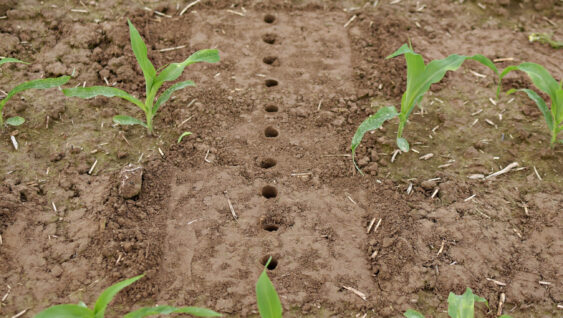
In the Southeastern United States—including Arkansas, Louisiana, Tennessee, Mississippi, Alabama, Georgia, Florida, North Carolina, and South Carolina—broadcasting and banding are the most common fertilizer application methods used. Broadcasting delivers a uniform application of nutrients across the entire soil surface, whereas banding covers any application method that applies fertilizer in concentrated strips.
It is important to remember that the expected response in crop yield and quality for any application method depends on the specific nutrient and its properties, how well the nutrients can move through soil, soil moisture, crop rooting patterns, tillage and planting systems, and the availability of water. Aim for fertilizer application that coincides as closely as possible with the period of maximum crop uptake and reasonably avoids conditions where risk of environmental losses is high (e.g., fertilizing right before expected rain).
A closer look at the options
Broadcasting
- Can be applied on the surface or incorporated.
- Can be used for liquid or dry fertilizers.
- Incorporating fertilizer increases root contact and plant growth and minimizes surface nutrient loss.
- Broadcast applications of immobile nutrients, such as phosphorus and potassium, can lead to the stratification of nutrients near the soil’s surface.
- Rapid application method to cover large areas in the least time.
- Provides broader nutrient distribution in a greater soil volume and may improve nutrient contact with a greater portion of the plant roots.
- Broadcast equipment is generally less specialized and less expensive than for banding.
- Incorporation of slow-release fertilizers can extend and enhance nutrient release.
- Incorporation of nitrogen and phosphorus is encouraged before crops are planted or banded.
- More effective later in the growing season once the roots of a row-crop have begun to develop. Highly effective for forage crops that cover the entire surface of the soil.
- Preferred method for higher application rates when needing to build low soil-test levels. Surface broadcasting is fast and economical but can result in less uniform application and higher nutrient losses.
Banding
- Any application where fertilizer is applied in strips on or below the soil surface.
- Application can be done at seeding, with or near the seed row (starter), or after seeding.
- Efficient method for most fertilizers as the band is usually placed below or near the seed row for greater root interception and to help jump start early growth.
- Provides a zone of high nutrient concentration to improve root interception, stimulate growth, and reduce nutrient fixation.
- For some nutrients, such as immobile micronutrients and phosphorus, banding may produce better crop response and nutrient efficiency at lower rates than for broadcasting because of higher nutrient concentration in the immediate crop root zone.
- A more expensive option than broadcasting, banding can come with the risk of salt burn or seedling damage but may allow for lower rates to be used for some nutrients.
- Preferred over broadcasting in no-till, dryland cropping systems.
- More effective than broadcasting when applying potash to soils testing low in potassium in this region.
- A more effective method than broadcasting when applying phosphate to soils testing low in phosphorus in this area.
- Fall applications of banded nitrogen are never recommended for spring-planted crops in the Southeastern United States.
For more information or specific recommendations for your area, contact your local agronomist or crop advisor, or refer to these additional resources.
Sources
Timing is everything with fertilizer, Louisiana State University AgCenter
Best Management Practices for Agricultural Nutrients, North Carolina State Extension Publications