Dr. Alan Blaylock brings extensive North American and international experience in nutrient management to the agronomy team. University studies and service as a university extension soils specialist prepared him for a long career in the fertilizer industry. Having managed both domestic and global research and education programs, Dr. Blaylock has a wealth of experience in applying science-based nutrient management principles and products to solving practical questions. Dr. Blaylock earned Bachelor of Science and Master of Science degrees in agronomy and horticulture from Brigham Young University and a Ph.D. in soil science from Iowa State University. He has been in agriculture his entire life — from his childhood on an irrigated farm in eastern Oregon to teaching soil science at Iowa State University to his current role as an agronomist at Nutrien. These diverse experiences helped Dr. Blaylock develop the skills to excel in translating complex scientific principles into practical solutions. Although early in his university studies he explored computer science as a profession, deep family roots in agriculture brought him back to the people and values of his heritage. His career satisfaction comes from helping others improve the performance of nutrients and cropping systems. Dr. Alan Blaylock is a recipient of the 2022 Great Plains Soil Fertility Conference Leadership Award. The Fluid Fertilizer Foundation also recognized Dr. Alan Blaylock with the Werner Nelson Award for his outstanding contributions in the development of soil fertility practices and plant nutrition management to increase crop yields for the benefit of North American farmers and consumers
This is part three of a three-part series taking a deep dive into soil pH.
Soil pH may shift gradually over time and can affect the way fertilizers and other nutrients need to be managed. Soil pH is defined as the concentration of hydrogen ions (H+) in the soil solution. Soil pH can affect nutrient availability and the crops being grown. Maintaining optimum soil pH levels helps retain soil quality and maximize crop and pasture production.
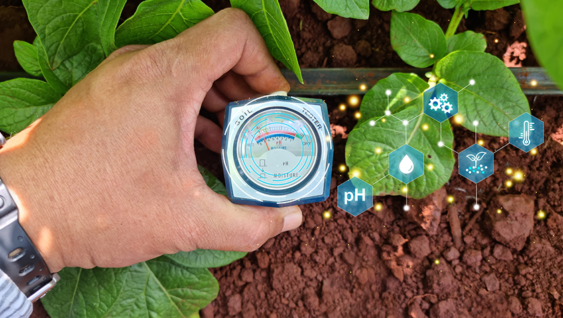
Parts one and two in this series covered soil pH basics, how it is measured, the chemistry of soil pH, and how all of this impacts a grower’s ability to have a healthy, productive crop. Part three will look at soil pH management and remediation. The first step is proper soil testing to identify pH levels and then planning an appropriate remediation strategy if pH is too low (acidic) or too high (alkaline).
Input management supports healthy soil pH
Ammonium-based nitrogen fertilizers can acidify the soil as the hydrogen ions are released into the soil solution through nitrification (conversion of ammonium to nitrate). Improving nitrogen management can slow acidification of the soil. Montana State University explained it this way:
“Nitrate-based nitrogen fertilizers, such as calcium nitrate, may increase soil pH at both the surface and deeper levels but only if the nitrate [is] taken up by the plant and is not lost to leaching. In contrast, ammonium-based fertilizers, such as urea and ammonium phosphates can slowly lower pH of basic soils, [but] in some areas …have led to excessive acidification of the seeding zone and decreased yields….
Managing Nitrogen to Prevent Soil Acidification
Nitrogen fertilizer acidification, and concomitant hydrogen, aluminum and manganese toxicity, is more severe with nitrogen application rates in excess of crop requirements, especially in the seeding zone… To minimize soil acidification due to nitrogen fertilizer, use practices that prevent excess nitrogen application, encourage uptake of all applied nitrogen, and reduce nitrate leaching.” 1
Sound management includes common agronomic best practices such as choosing the economic-optimum rate, slow-release nitrogen, split applications, planting deep rooted crops to scavenge for nitrate, planting cover crops to take up residual soil nitrate, and using legume rotations. Nitrogen is available in different fertilizer forms such as urea, ammonium sulphate, and ammonium nitrate. Some of these fertilizers leave the soil more acidic than others, so they need different amounts of lime to counteract the acidity.
Managing acidic soil pH
Lime is used to raise soil pH by neutralizing acids in the soil solution. Lime and other basic materials (acid-neutralizing minerals), such as dolomitic lime, calcium oxide, or similar compounds may be used if they are of sufficient purity and particle fineness.2
The pH of the soil itself does not indicate how much lime to apply. According to Michigan State University, “Use a soil test to determine the amount of lime needed. A soil pH measurement alone is not sufficient to determine lime requirement. Most soil testing laboratories use a special buffer pH method to determine the amount of lime needed.”3
Factors That Determine Lime Effectiveness
The effectiveness of lime is evaluated in a few ways: its neutralizing value (NV); the particle size (smaller particles react more quickly); and purity (the amount of inert or non-neutralizing material is present).
Because not all liming materials react the same on a pound-for-pound basis, a standard to evaluate the ability of liming materials to neutralize soil acidity is necessary. “Pure calcium carbonate has a value of 100, and all other materials are chemically compared to this standard. Most liming materials contain impurities, so lime recommendations are made on the basis of a neutralizing value of 90 percent. If a liming material has an NV other than 90 percent, an adjustment will need to be made in the amount of lime to apply.”3
The chart above shows the Calcium Carbonate Equivalents (CCE) of various liming materials.
What Influences Liming Frequency?
Soil and nutrient management can determine liming frequency. Growers need a clear understanding of:
Soil texture
The rate of nitrogen fertilization
The rate at which the crop is using calcium and magnesium
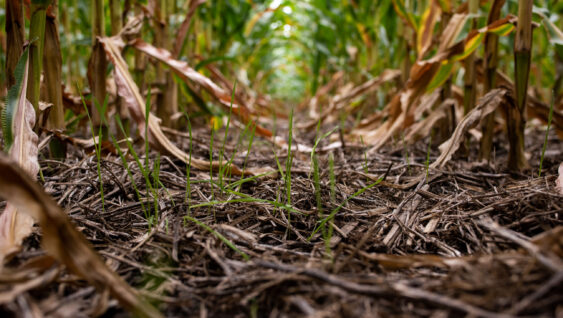
Tillage itself won’t always increase or decrease soil pH, but topsoil in no-till fields can become more acidic due to nitrogen applications. Tillage can be used to mix acidic soils with higher pH soil deeper in the profile, or to mix in a lime treatment. The downside of tillage is a reduction of organic matter which can aid the soil in resisting pH changes.1
Liming is not a quick fix. Lime will react completely with the soil in two to three years after it has been applied; although, benefits from lime may occur within the first few months after application if sufficiently fine liming materials are used. “How long the effects of lime last will depend on the kind of lime used, total soil acidity, amount of organic matter, kind and amount of clay, and cropping and management systems used. A soil test three to four years after lime application will help provide the answer.”3
Adjusting pH of high alkaline soils
Alkaline soil has a pH higher than 7.0 and is the opposite of acidic soil. These soils are common in arid or semi-arid climates. “Soils may be alkaline due to over-liming acidic soils, but alkaline soils are primarily caused by a calcium carbonate-rich parent material weathering (developing) in an arid or dry environment.”4 High pH caused by high soil lime content is not usually profitable to manage by soil acidification. Alkaline irrigation waters may also cause soil alkalinity, which may be treatable with water amendments. The impacts of high pH, or alkaline soil, include the reduced availability of phosphorus and micronutrients.
Soil pH greater than 8.5 is the result of high exchangeable sodium. Sodium readily hydrolyzes water in the soil solution to produce excess hydroxide, which increases soil pH. As the pH rises, calcium carbonate precipitates, removing calcium from the soil solution. High exchangeable sodium causes deterioration of soils’ physical properties in addition to high pH. High soil sodium is a difficult soil problem to remediate and usually involves drainage management, proper water management if irrigating, and calcium or calcium-forming amendments. These problems are often more than just soil pH problems and require careful management described under the topic of managing salt-affected soils.
Short-Term and Long-Term Remediation Options
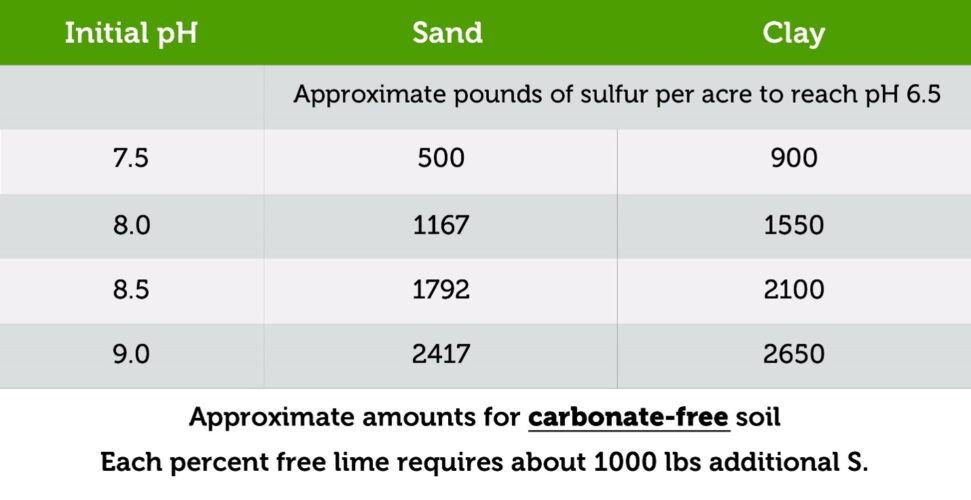
For near-term solutions, elemental sulfur, sulfuric acid, lime-sulfur, or other acid-forming amendments can be added to the soil. Long-term maintenance requires a change in soil management practices, using ammonium fertilizers, growing acid-producing plants, and the neutralization of carbonates or bicarbonates in irrigation water. In remediation of sodic soils (high exchangeable sodium) the reaction of acid-forming amendments solubilizes calcium minerals in the soil, which calcium displaces the exchangeable sodium and improves soil structure.
Understanding the comparative acidifying elements is important for appropriate application and remediation.
The value of soil management
The ROI or return on investment of soil pH varies depending on the severity of the problem and cost of treatment. Liming acid soils is often effective and usually delivers a positive ROI. However, trying to acidify alkaline soils with sulfur applications or other acid-forming amendments can be relatively expensive, takes time, and often delivers a negative ROI. The effects of high pH on availability of certain nutrients can often be more effectively mitigated with alternative nutrient management practices than by trying to acidify an alkaline soil.
Many factors impact soil pH. When it is too high or too low, nutrition balance and plant growth can be severely impacted. Soil acidity can and should be managed for long-term soil health and optimum crop production.