


The Right Place: Fall Fertilizer Application Options In The Corn Belt

As the fall season approaches, growers are starting to evaluate the nutrients in their soil and plan for another year of productivity and growth. It’s also a great time to take a closer look at the 4R approach to nutrient management. This science-based approach outlines best management practices that will guide you in the use of the right fertilizer source, at the right rate, at the right time, and in the right place.
Let’s zero in on placement. No matter where you farm or what the weather looks like in your area, there are many factors to consider with fertilizer placement options, from the type of crop and fertilizer you are using, to the properties of your soil, and the weather conditions.
Why placement matters
Fertilizer placement and timing can affect crop yield and quality, and how efficiently the crop can use the nutrients. The goal when thinking about placement is how to maximize the contact between the fertilizer nutrients and the crop (seed or plant roots depending on placement and timing). This is particularly important at the early stages of crop development to encourage strong root growth. Proper fertilizer placement and timing in consideration of crop, soil, and weather variables can also reduce the potential for nutrient losses.
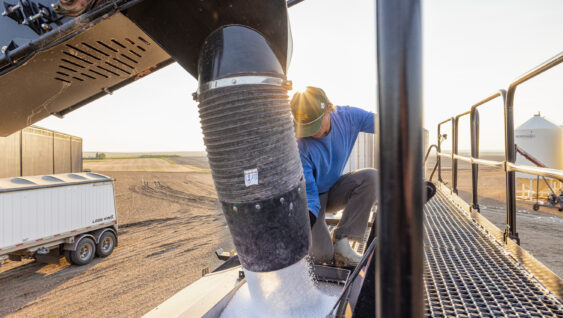
In the corn belt (Illinois, Indiana, Iowa, Minnesota, Nebraska, Ohio, Wisconsin, Missouri, and Kentucky), potassium and phosphorus fertilizers are most often applied in the fall by broadcasting or banding. Broadcasting delivers a uniform application across the entire soil surface, while banding covers any method that applies fertilizer in concentrated strips. Both methods can be used for applying dry or liquid fertilizer.
It is important to remember that the expected response in crop yield and quality for any application method depends on the specific nutrient and its properties, existing soil test levels, how well the nutrients can move through the soil, soil moisture, crop rooting patterns, tillage and planting systems, and water availability.
Broadcasting vs. banding
Broadcasting
- Can be applied on the surface or incorporated.
- Rapid application method to cover large areas in the least amount of time.
- Equipment is generally less specialized and less expensive than banding.
- Pre-plant incorporation is the most effective method for applying potash fertilizers to soybean crops in this area.
- Preferred method for higher application rates when needing to build low soil-test levels.
- Broadcast applications of phosphorus should be applied in the early spring or fall for maximum benefit.
- Incorporating broadcast fertilizer increases root contact and minimizes surface nutrient loss but is prevented in no-till systems.
- Nutrients are more prone to runoff (phosphorus) or volatile losses (nitrogen).
- Popular and low-cost method for phosphorus application in this area.
- Surface broadcasting is fast and economical but can result in less uniform application and higher nutrient losses.
Banding
- Any application where fertilizer is applied in strips on or below the soil surface.
- Application can be done at seeding, with or near the seed row (starter), or after seeding.
- Fields that are well drained will benefit most from fall banding. Fall banding is typically more effective than spring broadcasting.
- Efficient method for most fertilizers as the band is usually placed below or near the seed row for greater root interception and to help jump start early growth.
- Banded fertilizers can improve the movement of phosphorus and potassium to crop roots (through diffusion).
- Can increase plant uptake in soils with higher capacities to fix potassium.
- For some nutrients, such as immobile micronutrients and phosphorus, banding may produce better crop response and nutrient efficiency at lower rates than for broadcasting because of higher nutrient concentration in the immediate crop.
- Banded potassium can accelerate growth and development, but yield is comparable to broadcast application.
- Deep banding of potassium is suggested for ridge-till, no-till, or strip-till systems.
- Provides a zone of high nutrient concentration to improve root interception, stimulate growth, and reduce nutrient fixation.
- A more expensive option than broadcasting. Banding comes with the risk of salt burn or seedling damage if placed too close to the seed row but may allow for lower fertilizer rates, as mentioned above.
For more information or specific recommendations for your area, contact your local agronomist or crop advisor, or refer to the resources below.
Sources:
Proceedings of 2019 Integrated Crop Management Conference (iastate.edu)
Management of phosphorus for crop production | Integrated Crop Management (iastate.edu)
Potassium for crop production | UMN Extension
Opportunities for Subsurface Nutrient Placement in Ohio | Ohioline (osu.edu)
4R | Missouri Fertilizer Control Board (mofcb.com)
Getting Ready for Fall Fertilization | Integrated Crop Management (iastate.edu)