Lyle Cowell is based in northeast Saskatchewan, where he has spent his career in agronomy with a focus on better soil management. Lyle has always had the goal of connecting the three points of good research, agronomy extension and farm gate advice and application of soil fertility principles.
Behind every nutrient management decision made in the field is soil chemistry that influences how nutrients behave once they hit the ground.
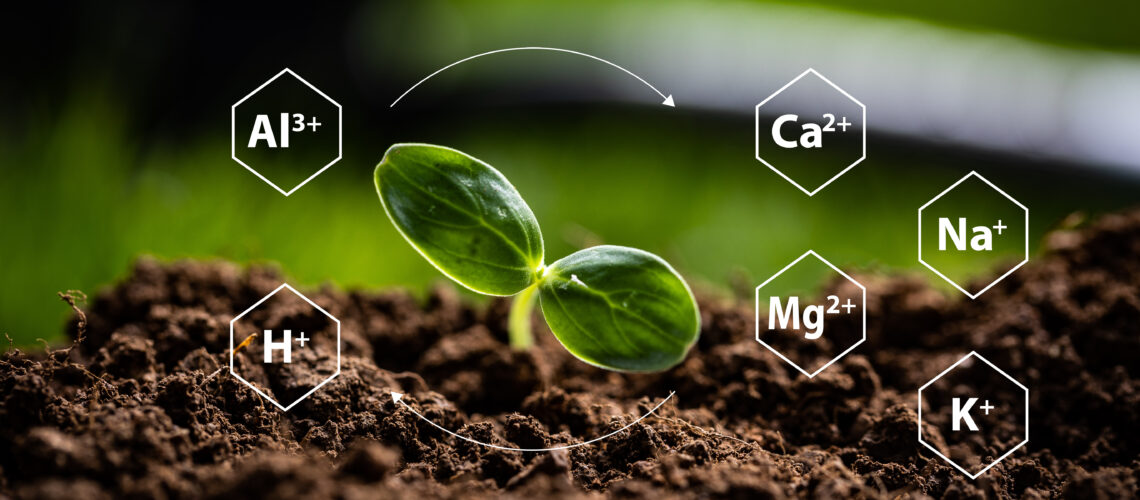
One of the most foundational and often overlooked drivers of that chemistry is ions, including cations, anions, and cation exchange capacity.
Who cares about soil ions anyway?
You may think, “I would never talk to a farmer about nitrate anions or about the cation exchange capacity of their soil, so why would I learn about it?” An analogy for this concept would be a nurse that didn’t feel it was important to understand electrolyte panels or ion exchange in cells because they would not use those terms when talking to a patient about their health. As a patient, I would assume that the nurse knows far more about health than they will ever explain to me in detail, and I rest assured that the advice given to me is based on this depth of understanding. The same goes for agronomists and ions.
Why understanding ions is important
When it comes to recommending the best 4R practices and building customer trust, understanding the foundations of soil fertility can be more important than knowing the price or application rate of a fertilizer. When you say, “You may see a response to potassium on your knolls,” a farmer expects that you based this advice on a foundational understanding of soil science and are not just giving a blanket piece of advice.
Overall, ions have a direct impact on soil fertility, soil pH, the toxicity of some elements, and the residual potential of many pesticides. That’s why it is essential to understand them.
What are ions?
An ion is an atom or molecule that has gained or lost an electron.
If an ion has gained an electron, it will have a negative charge. These are called anions.
If the ion has lost an electron, then it has a net positive charge. These are called cations.
Elements may also lose or gain more than one electron and have more than one net charge. In fact, some elements may lose or gain more than one electron depending on soil redox conditions (the balance of reduction and oxidation processes within the soil).¹ For example, iron may be present as Fe2+ or Fe3+ in soil.
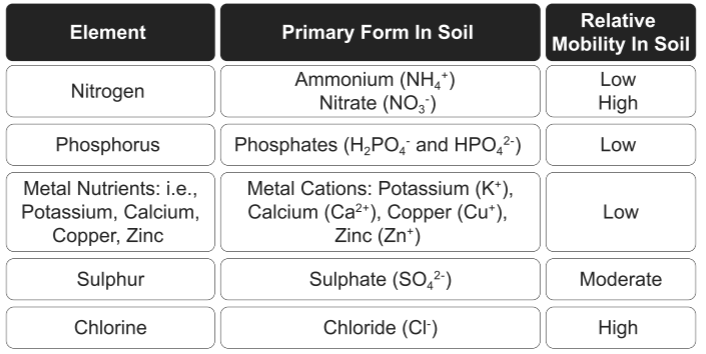
Ions can also be thought of as elements or compounds dissolved in water. Nearly all nutrients must be in an ion form to be absorbed by plant roots. The only exception is boron as it is mostly absorbed as boric acid (H3BO3). Find a summary of the primary form of key nutrients in the soil below (Figure 1).
Figure 1: Summary of primary ionic forms of essential nutrients and their mobility in soil.
Other ions of importance to soil are:
Hydrogen (H+): measured by pH
Aluminum (Al3+): can become toxic to plants in acidic soils
Carbonate (CO32–): reacts with hydrogen to increase pH in acidic soils
Organic ions, including those derived from pesticide reactions in soil
Ions and soil salinity
Soil salinity is all about ions. In western Canada, soil salinity is mainly caused by excess sulfate in the root zone. Previous articles have discussed soil acidity and soil salinity, which are both driven by ions.
Overall, ions represent a chemically active form of elements in soil water that can have chemical or electrical interactions with clay and organic matter. When dissolved in soil water, ions can move through the soil matrix and be absorbed by plant roots.
Ions are reactive, and so are fertilizers
We also must remember that cations and anions will react with each other to form ion pairs. These pairs may then form a compound that drops out of soil solution.
For example, phosphorus is often applied as ammonium phosphate, which dissolves in soil water to form ammonium (NH4+) and phosphate (PO4-3). Because phosphate carries a -3 charge, it is highly reactive and, in turn, can react with other cations in the soil. At a high pH, phosphate most commonly forms calcium phosphates, and at a low pH, it reacts with iron or aluminum to form iron or aluminum phosphates.
This brings us a practical question in fertilizer management: What source is best? There are many phosphorus fertilizers available to farmers, each with a different fertilizer analysis and form of phosphorus. For example, monoammonium phosphate (MAP, 11-52-0) is largely orthophosphate in a dry form. Ammonium polyphosphate (APP, 10-34-0) is a liquid form of fertilizer that includes some long-chained phosphates. There are also liquid orthophosphate products of various analyses.
Orthophosphate versus polyphosphate
So, what is better – orthophosphate or polyphosphate? A dry or liquid phosphate?
Plants take up phosphorus as an orthophosphate, and it takes a bit of time for polyphosphates to breakdown. But does this really matter to a crop?
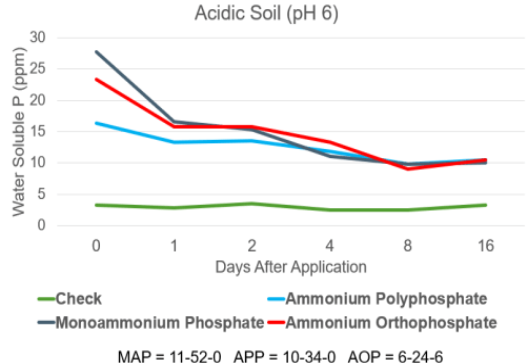
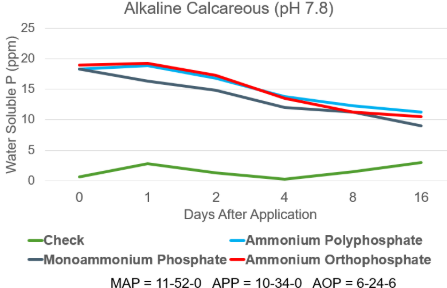
Research in Manitoba soils demonstrated that after a wide range of phosphorus fertilizers were applied to soil, the phosphates from all sources slowly formed calcium or other phosphates with similar solubility in both water and bicarbonate extractions (Figure 2 and 3).² Within the time-period of seedling establishment, all of the products had reacted with soil ions and had no significant difference in solubility.
This brings us to 4R fertilizer management. While choosing an appropriate phosphorus source is important, research shows that soil reactions quickly reduce the differences in solubility among fertilizer products. As a result, focusing on the right rate, placement, and timing of phosphorus applications often has a greater impact on crop response than fertilizer sources alone.
Figure 2: The concentration of water-soluble phosphorus that is available (in parts per million) following applications of three different phosphorus fertilizer sources in acidic soil.
Figure 3: The concentration of water-soluble phosphorus that is available (in parts per million) following applications of three different phosphorus fertilizer sources in alkaline calcareous soil.
Understanding soil chemistry is essential
A strong understanding of soil ions is essential to understanding soil fertility, soil pH, and the behavior of applied nutrients. This foundation leads to more informed and effective recommendations across fields.
Learn more about the foundations of soil chemistry and the various forms of phosphorus fertilizer to make stronger recommendations in the field: