



How Are Seeds And Fertilizers Distributed In Our Soil?

Getting the Most from Seed-Row Fertilizer—Safely
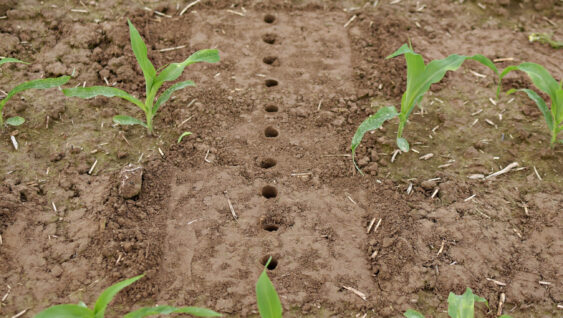
Placing fertilizer near the seed row is a popular practice that is both agronomically and environmentally beneficial as the nutrients are rapidly absorbed by the crop’s roots.¹ For nutrients such as phosphorus and potassium, that don’t easily move in our soil, this fertilizer placement method maximizes nutrient availability and uptake early in the growing season when crops are absorbing nutrients for rapid spring growth. This can lead to quick seedling establishment even in cold soils – often called the ‘pop up effect.’
While seed row placement is both popular and effective, additional considerations must be made to prioritize the safety of your seeds. When looking at applying your fertilizer in the seed row this season, it is important to understand how fertilizer prills and seeds are distributed, how to identify safe rates of fertilizer, and how plants access nutrients in the seed row, to make the most of your fertilizer investment.
Considerations for seed row placement
There are a few considerations to make when it comes to seed row placement. When fertilizer granules and seeds are placed too close together, the fertilizer particles can reduce seed germination and affect your seeds’ ability to grow. This is the result of what we call ‘the salt effect’ where the fertilizer particles are competing with your seeds for access to soil water. The salt effect causes water to move away from the seed and prevents seed germination or seedling root establishment.
Expert Tip: Growers who manage seedbed moisture with direct seeding and the retention of crop residue cover can combat the ‘salt effect’ by allowing seeds to absorb and retain sufficient water to germinate and establish.
Every season, you should consider the amount of space between fertilizer prills and seeds in order to avoid salt injury and promote seed row safety. Increasing the distance between seed and fertilizer prills is a great place to start.
Considerations for seed row safety
Seed row safety is critical to the growth and productivity of your crops, and it is strongly dependent on how close the seed and fertilizer granules are to each other. As mentioned above, when placed too close together, fertilizers can impact or stunt the growth of your seedlings.
The amount of space between fertilizer and seed is determined by your seeding equipment’s opener width, the vertical displacement of seed and fertilizer, and the space between your openers. You should carefully weigh the decisions made around each of these factors and consider how they will affect the growth of your crops before you begin fertilization.
Gravity-drop seeders and slow seeding will lead to less horizontal and vertical mixing, while air delivery and faster seeding will result in more mixing, both horizontally and vertically. There are many factors to consider when it comes to seed row placement and the proximity of fertilizer and seed. It is important to consider them thoroughly when determining safe rates of fertilizer in or near a seed row.

Salt index, explained
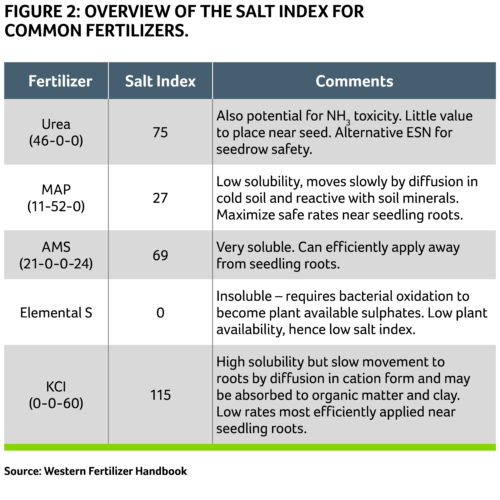
The salt index of a fertilizer will impact seed row safety. Salt index refers to a fertilizer’s ability to absorb soil water and is used to describe its solubility in the soil. While salt index cannot tell growers how much of a product can be safely applied, it can help them to compare the varying salt contents of different fertilizer products.³
When fertilizers have a high salt index, they are considered highly plant available, but they present an increased risk in the seed row as they can compete with your seeds for access to water. Fertilizers such as urea, ammonium sulphate, and potash have a higher salt index and a higher risk in the seed row, whereas MAP (11-52-0) and elemental sulfur have a much lower salt index and a much lower risk in the seed row. While a high salt index is a good trait in fertilizers, as it indicates that it will be highly available to your crops, these fertilizers need to be managed with caution when applied near seeds.
Growers can reference the chart below to learn more about the salt index and salt contents of common fertilizer products.
Improving seed safety and safe rates of fertilizer
Other than selecting a fertilizer product and rate that can be safely applied in your seed row, growers should be aware of what exactly impacts safe rates of fertilizer:
- Soil type: soils that are moist or high in clay content or organic matter will have a higher level of safety.
- Soil temperature: warm soil will allow for faster seed germination and seedling emergence with a reduced risk to seed.
- Soil salinity: the fertilizer salt effect will compound with any salinity in soil.
- Weather: rainfall events that occur shortly after seeding will increase safety.
- Seed quality: damaged seeds, or seedlings, will have a lower tolerance to fertilizer salts.
- Seed stress: any stress in your seeds or seedlings will add risk.
- Crop type: each crop varies in its ability to tolerate fertilizer salts—cereals tend to have the most tolerance.
A closer look at placement
Seed row fertilizer placement can be an efficient means of delivering fertilizer nutrients to a crop. It is considered a highly efficient placement method for most fertilizers as the application creates greater seedling root interception and helps jumpstart early growth.
To better understand the safety of this placement method, it is helpful to visualize the proximity of seed and fertilizer in any given band architecture. Let’s take a closer look at some common examples.
Examples:
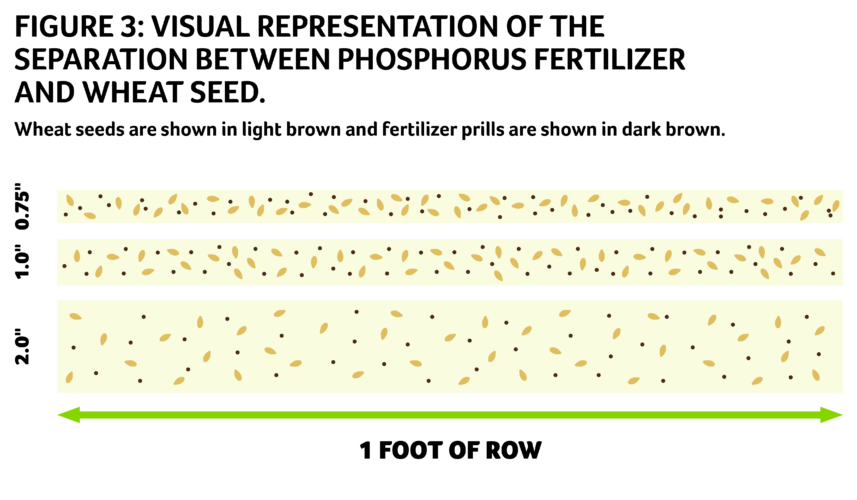
In the diagram below, 30 pounds an acre of P2O5 fertilizer (11-52-0) was placed in the seed row with wheat seed (120 pounds an acre). The field is using 10-inch equivalent row spacing at varying opener widths (0.75 inches, one inch, and two inches). In this diagram, as opener width increases, the risk of having fertilizer prills directly beside seed is reduced.
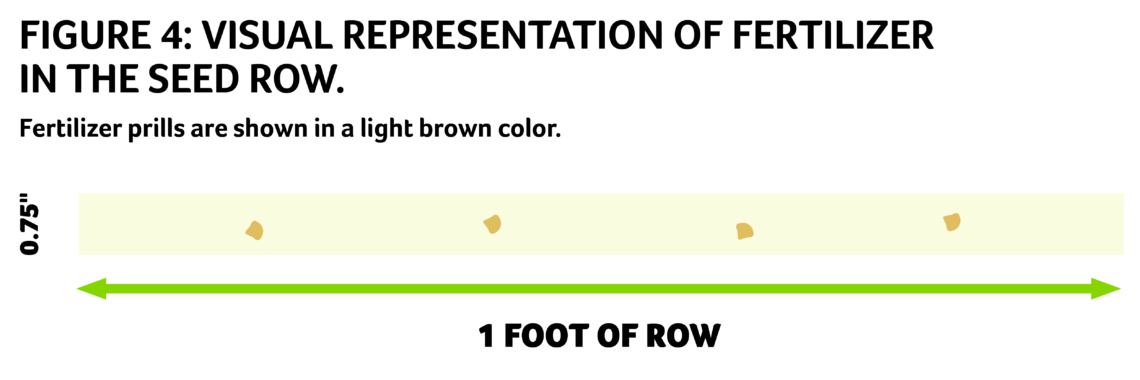
In the diagram below, 15 pounds an acre of K2O (as 0-0-60) was placed in the field using a 0.75-inch opener with 10-inch row spacing. As potash has a high rate of potassium in each granule, fewer granules are required to achieve low rates of applied potash—which can also reduce the risk of seed injury. However, this can create a significant distance between seed and fertilizer and reduce nutrient access for all seeds. For this reason, most potassium recommendations are at a minimum of 15 pounds of K₂O per acre as illustrated in the diagram below.
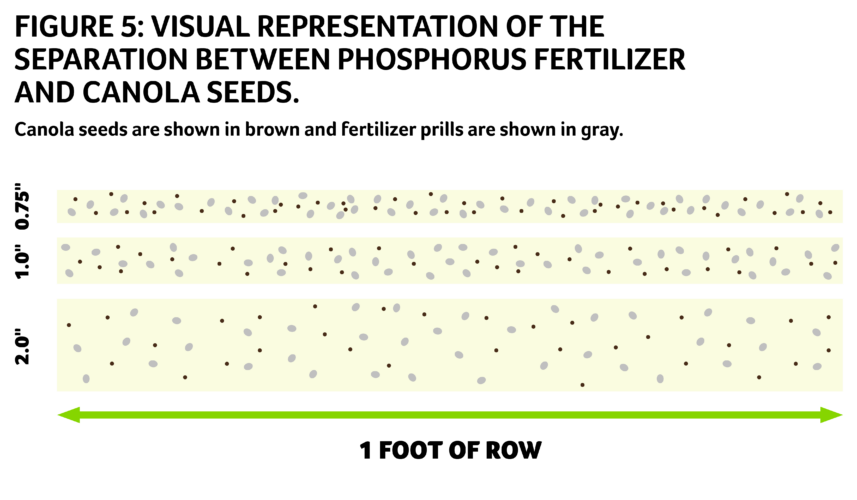
In the diagram below, 25 pounds an acre of P2O5 (as 11-52-0) was blended with 15 pounds an acre of sulfur (as 21-0-0-24) to fertilize canola seeded at five pounds per acre. The example uses 10-inch equivalent row spacing at 0.75 inches, one inch, and two inches of width. Similar to the first diagram, this demonstrates how dense the row of fertilizer and seed can become with a narrower opener.
Below, 25 pounds an acre of P2O5 fertilizer (11-52-0) was placed with 180 pounds an acre of pea seeds. It was placed using 10-inch equivalent row spacing at 0.75 inches, one inch, and two inches of width. In this diagram, the proximity of seed to fertilizer does not present a substantial risk and continues to improve with wider spread of the seed row.

Overall, nutrient management is a delicate science that can support the productivity, profitability, and prosperity of your farm. The more you understand about seed row safety and the impact of fertilizer-seed proximity, the more strategic your nutrient management plan will be.
Interested in learning more about seed-placed fertilizer and seed row safety? Curious about the best fertilizer placement options in your region? Visit these helpful eKonomics resources:
Balancing The Benefits And Risks Of Seed-Placed Nitrogen
The Right Place: Fertilizer Options In The Southeastern United States
The Right Place: Fertilizer Application Options For The Central and Southern Plains
The Right Place: Fall Fertilizer Application Options In The Corn Belt
The Right Place: Fertilizer Application Options In Western Canada
The Right Place: Fertilizer Application Options In The Western US
The Right Place: Fertilizer Application Options For The Northern Plains
Sources:
¹Phosphorus Fertilizer Placement, Fertilizer Canada
²Determining Safe Rates of Seed-Placed Fertilizer, Top Crop Manager
³https://fluidfertilizer.org/wp-content/uploads/2016/05/33P8-11.pdf