Walter Carciochi, Ph.D., University of Nebraska-Lincoln
Walter Carciochi, Ph.D., University of Nebraska-Lincoln
Walter Carciochi is a Research Assistant Professor at the University of Nebraska–Lincoln (UNL). He earned his Ph.D. from the National University of Mar del Plata in 2017. Since then, he has taught undergraduate and graduate courses, mentored students, and conducted research focused on nutrient cycling and management in agroecosystems. His work emphasizes developing management practices for inorganic and organic fertilizers to enhance crop productivity and grain quality while minimizing environmental impacts and promoting sustainable production systems.
Potassium (K) is an essential macronutrient vital to plant growth. It plays a critical role in water regulation, enzyme activation, photosynthesis, and the development of fruits and seeds. Despite its importance, potassium is often overlooked and receives less attention than nitrogen or phosphorus in fertility and nutrient management programs. However, inadequate supplies of potassium can significantly reduce both crop yield and quality, particularly in crops with high potassium requirements or in soils where potassium availability is limited.
The causes of deficiency
Potassium deficiencies arise from various soil conditions and environmental factors. Soils derived from parent materials that are naturally low in potassium, such as sandy or highly weathered soils, may not supply enough of the macronutrient to meet crop demands. In addition, regions with a long history of intensive agricultural production may experience declining soil potassium levels due to continuous crop removal without adequate replenishment. Potassium deficiencies also appear in soils that have grown crops for decades without the addition of potassium fertilizer – resulting in negative potassium balances and the gradual depletion of soil reserves.
In this context, it is essential to better understand the magnitude of potassium limitations across different cropping systems worldwide. This article reviews recent data on potassium limitations and analyzes potassium balances to determine whether systems are maintaining, depleting, or building soil potassium levels. These insights are key to developing nutrient management strategies that maintain soil fertility, improve productivity, and preserve crop quality over the long term.
Potassium limitations in various cropping systems
Field trials that assess yield response to potassium fertilizer are key to identifying potassium limitations. A recent study published by the International Fertilizer Association revealed notable differences in the yield response to potassium fertilization across various global cropping systems.
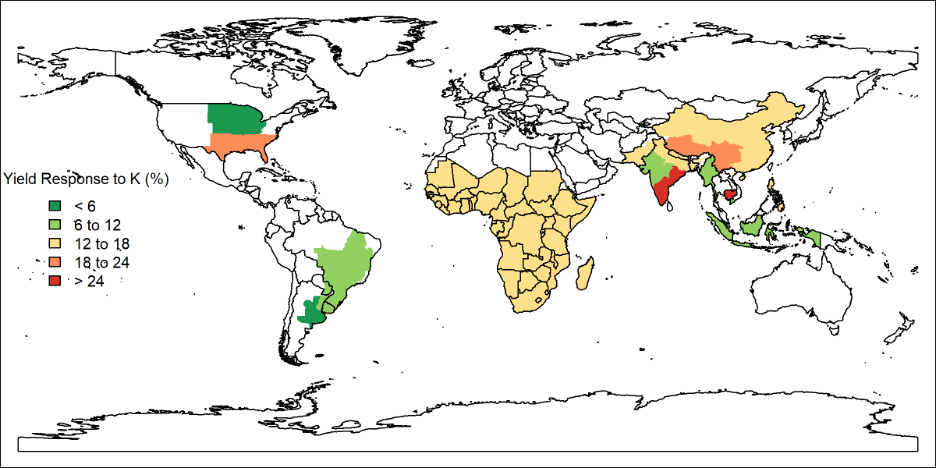
As shown in Figure 1, only a handful of systems showed a relatively low response (less than 6 percent) to potassium. These include maize–soybean rotations in the U.S. Corn Belt and typical soybean–wheat–maize rotations in the western Pampas of Argentina. In contrast, the highest potassium limitations were observed in rice-based systems in Cambodia and Eastern India, where the average yield response to potassium reached 27 percent. Notably, most cropping systems analyzed showed intermediate to high responses (between 12–24 percent) to potassium. This group includes maize and rice systems in Sub-Saharan Africa, rice systems in the Philippines, and diversified systems in the Indo-Gangetic Plain and China.
Figure 1. Yield response to potassium (K) fertilizer applications in the main cropping systems of each region. Adapted from Carciochi et al. (2025).
The potassium balance
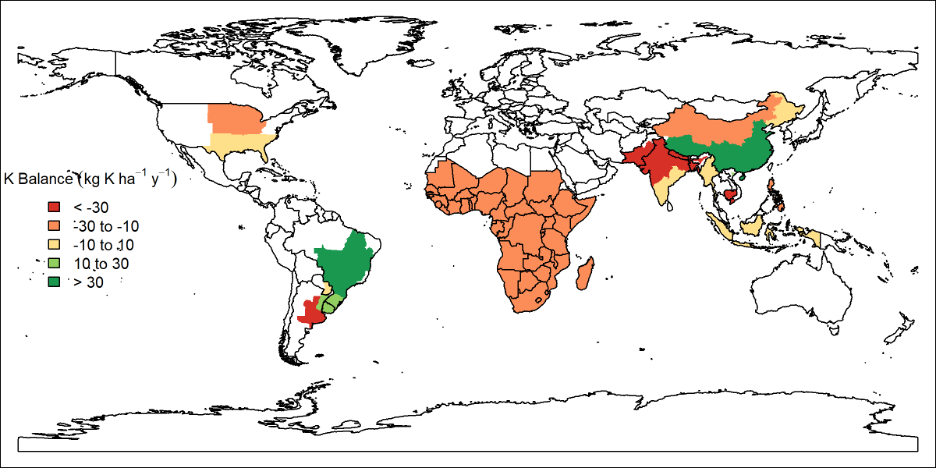
Nutrient balances provide insight into the current potassium status of global cropping systems and help predict future trends under existing management practices. A preliminary analysis found that half of the 22 systems evaluated had negative potassium balances (Figure 2; Carciochi et al., 2025).
Examples of negative balances include:
The Indo-Gangetic Plain experienced a decrease of 60 kilograms of potassium per hectare per year.
The Western Pampas (Argentina) saw a decrease of 50 kilograms of potassium per hectare per year.
Maize and rice systems in Sub-Saharan Africa saw a decrease of 27 kilograms of potassium per hectare per year.
Many Southeast Asian rice systems saw a decrease of 24 kilograms of potassium per hectare per year.
In contrast, positive balances were observed in:
South and Yangtze River regions of China experienced an average increase of 118 kilograms of potassium per hectare per year.
Brazilian Cerrado (BC) experienced an increase of 59 kilograms of potassium per hectare per year.
Eastern Pampas experienced an increase of 25 kilograms of potassium per hectare per year.
Figure 2. Potassium (K) balances in the main cropping systems of each region. Inputs include inorganic and organic fertilizer and potassium in irrigation water. Outputs include potassium removed from the harvested crop as well as residue removal and burning. Adapted from Carciochi et al. (2025).
Equal losses, unequal management
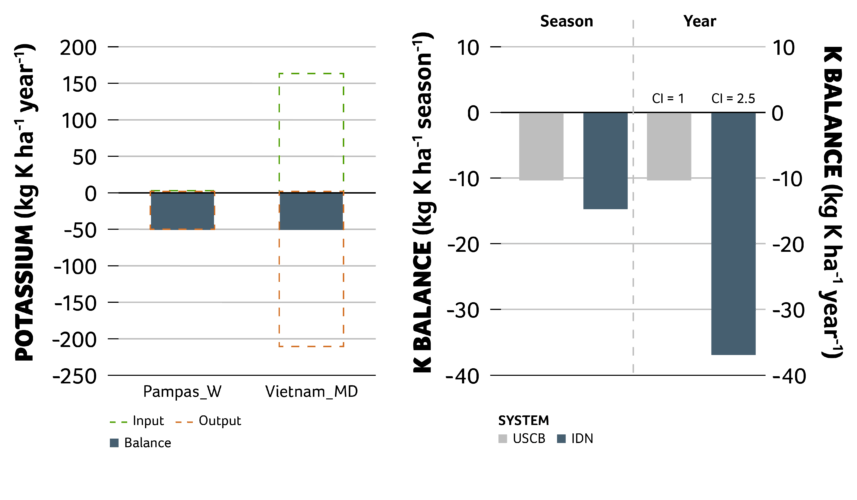
Interestingly, systems with similar overall potassium balances can have different input–output dynamics. For instance, both the western Pampas and the Mekong Delta region in Vietnam showed potassium balances decrease by 48 kilograms of potassium per hectare every year, but for different reasons (Figure 3). In the western Pampas, potassium inputs were nearly zero, so the deficit was driven entirely by crop removal. In contrast, rice in the Mekong Delta received substantial potassium fertilization (162 kilograms of potassium per hectare per year), but this was outweighed by extremely high potassium removal (approximately 209 kilograms of potassium per hectare per year), primarily due to crop residue removal.
Residue management practices, such as removal and burning, significantly influenced potassium outputs in systems like the Mekong Delta, Cambodia, and the Indo-Gangetic Plain, where these activities accounted for 60–70 percent of total potassium outputs.
Crop intensity also played a key role in potassium balance (Figure 3). For example, while the per-season potassium balance decreased by 13 kilograms of potassium per hectare in both the U.S. Corn Belt and Indonesia, the annual potassium balance in Indonesia decreased by 37 kilograms of potassium per hectare due to an average of 2.5 cropping cycles per year, compared to a single crop cycle in the U.S. Corn Belt.
Figure 3. Potassium inputs, outputs, and balances for two cropping systems: western Pampas (Pampas_W) and Mekong Delta in Vietnam (Vietnam_MD) (left), and potassium balance per season and per year for rice in Indonesia (IDN) and maize–soybean in the U.S. Corn Belt (USCB) (right). CI indicates crop intensity (number of crops per year) used to convert seasonal to annual balances.
Future scenarios
In some systems, such as the maize–soybean sequence in the U.S. Corn Belt or the soybean–wheat–maize rotation in the Argentinean western Pampas, potassium limitations are currently minimal or localized. However, two important observations emerge (Figure 4):
Regional variability in soil potassium availability influences potassium management. In 2020, Nebraska had an average exchangeable soil potassium concentration of 285 parts per million, while Wisconsin averaged only 117 parts per million. As a result, Nebraska’s low fertilization rates (seven kilograms of potassium per hectare; ERS-USDA) are leading to potassium mining, whereas Wisconsin’s low soil potassium levels prompt higher fertilizer use (58 kilograms of potassium per hectare; ERS-USDA) and net potassium accumulation.
Soil potassium trends over time help predict future limitations. If current depletion rates continue (–5 and –14 parts per million a year for Nebraska and the western Pampas, respectively), soil potassium in both regions is projected to reach critical deficiency thresholds (150 parts per million in Nebraska and 200 parts per million in the Pampas) in about 30 years.
Figure 4. Temporal trends in median soil exchangeable potassium concentration (ammonium acetate equivalent) for Nebraska and Wisconsin in the U.S. (left) and the western Pampas of Argentina (right). Insights for the U.S. were obtained from The Fertilizer Institute, and insights for Argentina were obtained from Larrea et al. (2024). Pristine (uncropped) soils were included as a reference.
Field level insights
The findings from these analyses on potassium limitation and balances provide important insights for improving nutrient management strategies. The following actions are recommended to address current and future potassium challenges:
Monitor soil potassium levels regularly
Routine soil testing is essential for tracking potassium availability over time. Monitoring helps identify areas where potassium depletion is occurring before it impacts yields, enabling proactive management.
Adopt site-specific fertilization strategies
Recognize that potassium needs vary widely by region, crop intensity, and management history. Tailored fertilizer recommendations should consider local soil test values, crop removal rates, and yield goals.
Balance potassium inputs with crop removal
Avoid long-term negative potassium balances by aligning potassium fertilizer inputs with crop uptake and removal. In systems with significant residue removal or burning, higher potassium applications can be essential to maintaining soil fertility.
Promote residue retention
Retaining crop residues can significantly reduce potassium outputs, especially in rice- and cereal-based systems. Where possible, discourage residue burning or off-field removal to recycle potassium back into the soil.
Integrate potassium into long-term soil fertility planning
Potassium should be treated as a strategic component of long-term soil health. In regions with high initial soil potassium, develop plans to prevent future depletion through balanced fertilization and improved nutrient cycling.
Strengthen extension and policy support
Support from local extension services is key to disseminating updated potassium management guidelines. Policies that encourage balanced nutrient use and support affordable access to potassium fertilizers can help sustain productivity and soil health.
Additional Resources
Want to dig deeper? Learn more about the potassium uptake and removal, potassium deficiencies and the critical role of potassium in various cropping systems with the following resources:
Carciochi, W.D., Dobermann, A.; Aramburu-Merlos, F.; Grassini, P. (2025). A Global Analysis of Potassium Limitation to Crop Yields. IFA Webinar: Global Study – The Impact of Potassium Limitation on Crop Yields. On-line: https://www.youtube.com/watch?v=l453QXZ–Vo&ab_channel=IFAfertilizers